
 crypto.news

Coinbase now runs nearly 10% of all staked $SOL with a newly upgraded, multi client validator architecture it says can update with “near zero downtime.”
Coinbase has disclosed that it is now staking roughly 40.48 million $SOL ($SOL) on Solana, representing 9.52% of the network’s total staked supply, according to a new Q1 2026 Solana validator performance report referenced by industry outlet ChainCatcher.
In the report, Coinbase says its validator nodes are distributed across six countries or regions, positioning the exchange as one of the largest and most geographically dispersed institutional operators on Solana.
The report outlines how Coinbase has implemented what it calls a “near zero downtime” (ZDD) upgrade mechanism that allows validator software to be updated via hot swapping while remaining protected by dual signature controls. According to Coinbase, this process is designed so that the validator update cycle “does not affect network security and stability,” a crucial claim in a network that has previously taken criticism for outages and client level fragility.
Coinbase’s emerging role in Solana validation
Beyond raw stake, Coinbase is leaning into client diversity, stating that its Solana validator stack now supports multiple independent implementations, including Harmonic, Jito, JitoBAM, Firedancer, and Rakurai.
By explicitly avoiding reliance on a single scheduling strategy or client, Coinbase argues it is helping “enhance the diversity and resilience of the Solana validator ecosystem while avoiding the centralization risks of a single scheduling strategy,” according to the performance report cited by ChainCatcher.
The move comes as Solana’s network economics and staking architecture continue to evolve, with developers and the Solana Foundation pushing for broader validator participation and stricter standards on “validators in name only” that depend heavily on foundation delegation, as previously reported by crypto.news.
At the same time, institutional interest in Solana based infrastructure has been growing, with Coinbase Cloud earlier expanding its Solana support to archival nodes for builders, as covered in an earlier crypto.news report.
Institutional Solana staking and multi client trends
Coinbase’s Solana disclosures mirror the transparency the exchange has brought to its Ethereum validator operations, where it has regularly published quarterly performance reports, and recently highlighted a 99.98% average uptime and a self imposed cap of under 30% validator share, according to a separate Ethereum validator update summarized by KuCoin. That same institutional validator tooling is now being exported into the Solana ecosystem, where client diversity and sophisticated uptime guarantees are increasingly seen as non negotiable for large operators.
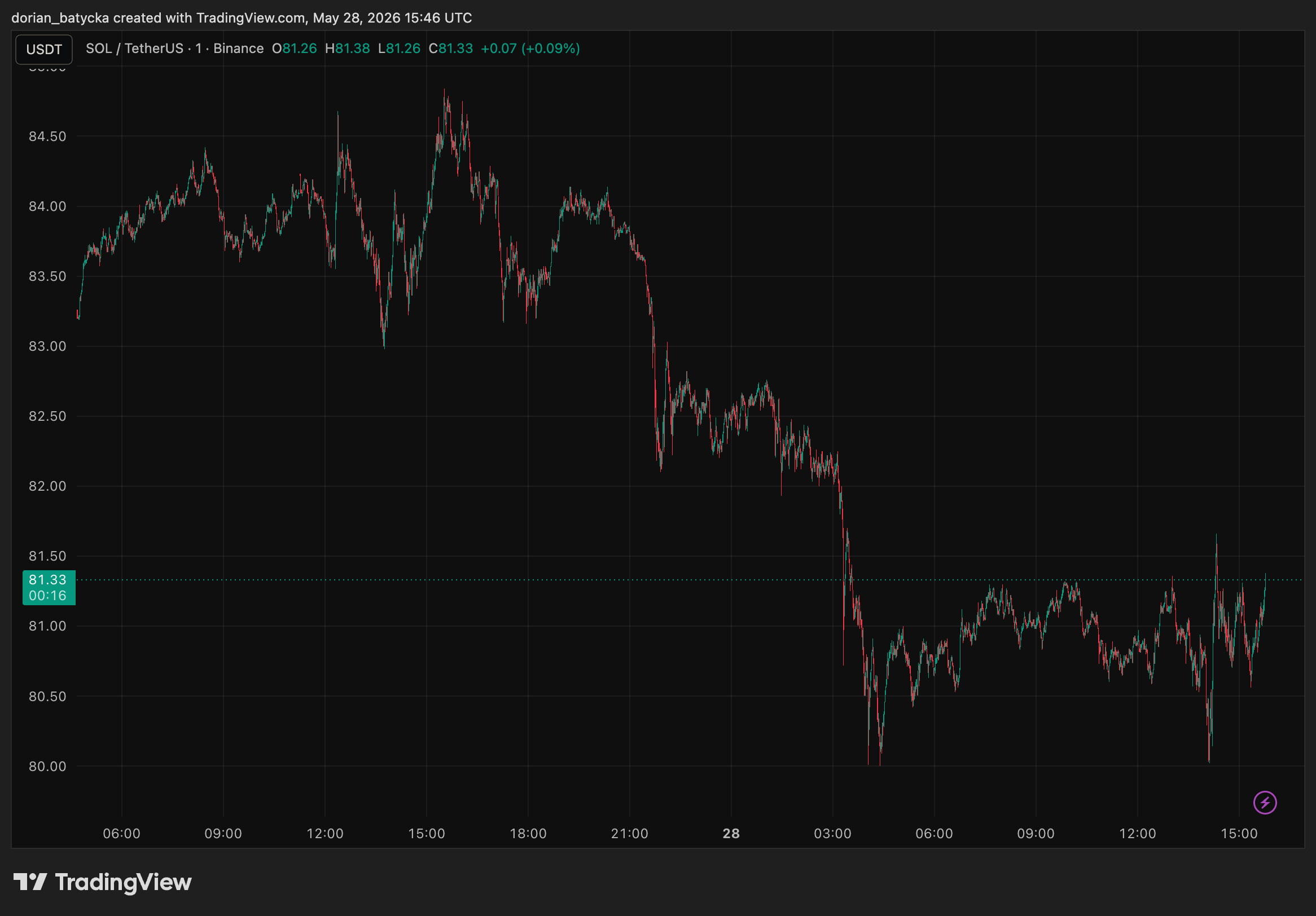
The scale of Coinbase’s stake also lands in a market where $SOL itself is trading in the low $80 range, with Solana changing hands at roughly $82.30 on May 28, 2026, according to YCharts data, implying a Coinbase Solana position north of $3.3 billion at current prices. For context on $SOL’s live market metrics and capitalization, readers can track the Solana price page on crypto.news, which aggregates $ denominated quotes and on chain data.
Coinbase’s decision to support Jito, Firedancer and other alternative clients also parallels a broader industry shift toward multi client architectures, already visible on Ethereum’s Glamsterdam multi client devnet, as detailed in a recent crypto.news analysis of Ethereum’s 2026 roadmap. For Solana specifically, Coinbase’s growing validator footprint follows earlier cross chain infrastructure collaborations such as the Base Solana bridge secured by Coinbase validators and Chainlink’s CCIP, which enabled $SOL and SPL asset transfers into Base apps, as reported by crypto.news.
Whether Coinbase’s 9.52% share of staked $SOL becomes a ceiling or a floor will depend on how the exchange balances institutional demand for yield, its own decentralization commitments, and ongoing debates over validator concentration on high throughput chains. For now, the Q1 2026 report suggests Coinbase is betting that sophisticated operational guarantees and a diversified client stack can justify its growing influence inside Solana’s consensus layer, even as critics continue to scrutinize large custodial stakers across proof of stake networks.