Global liquidity adds $1 trillion this week – What will Bitcoin gain?
ambcrypto.com
28 May 2026 09:37, UTC
Global liquidity movement is hinting that Bitcoin and select cryptocurrencies could see an influx of fresh capital that benefits the broader market.
At press time, Bitcoin’s [BTC] market capitalization stood at $1.51 trillion, down $139 million from the previous day, with the broader crypto market sitting at $2.53 trillion. Risk assets historically gain the upper hand when liquidity flows into the global financial system.
Global liquidity adds $1 trillion this week as bond yields surge
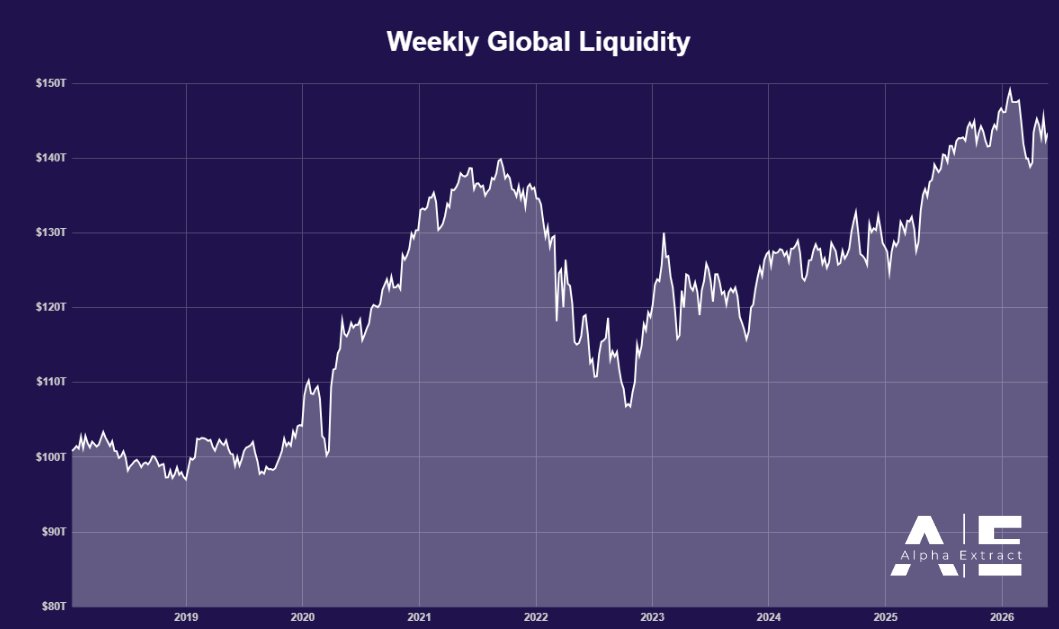
There’s been a rise in global liquidity this week, with data from AlphaExtract showing the total market capitalization climbing from $142.4 trillion to $143.4 trillion, a 0.75% surge representing a $1 trillion addition to the system.
Know when your coins move
Alerts, real-time prices, and market news — all in one app
4.8 based on 40K reviews in the App Store and Google Play
Global liquidity measures the total amount of money and credit flowing through the global financial system. When it rises, risk assets like stocks and crypto tend to benefit as cheap capital chases higher returns.
Crypto, as an established risk asset category, could absorb a portion of this fresh capital, potentially negating the current environment where capital has remained locked and rotated between assets rather than expanding broadly.
Source: AlphaExtract
However, this is not a clean signal. Rising 10-year bond yields in both the U.S. and South Korea, both hitting highs not seen in decades, complicate the picture.
Rising bond yields typically signal growing economic concerns, particularly around inflation, and raise the likelihood of an interest rate hike—a factor that has historically weighed negatively on risk asset performance.
DXY stabilizes at 100 as Bitcoin hits negative correlation
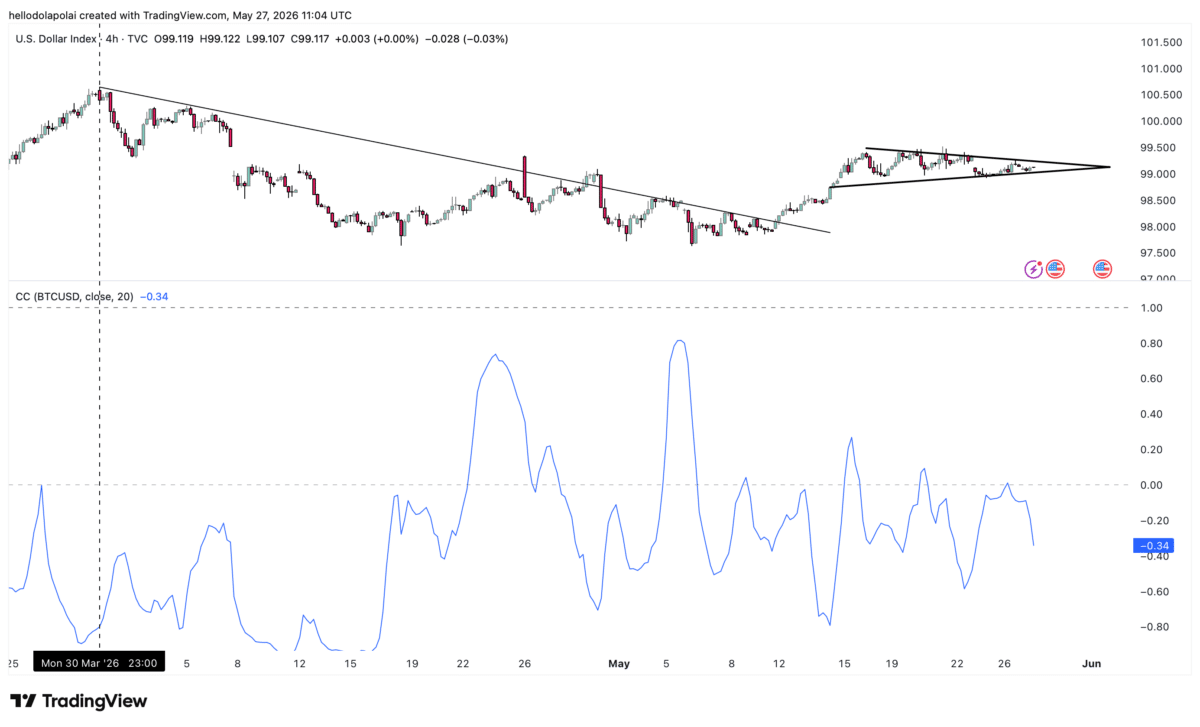
AlphaExtract data links the recent rise in global liquidity to stabilization in the U.S. Dollar Index, which has found support around the 100 level.
The DXY measures the dollar’s strength against a basket of six major currencies, and a rising DXY typically tightens global liquidity and pressures risk assets, as most global debt and trade is dollar-denominated.
AlphaExtract noted that,
Part of that likely comes from continued DXY stabilization around the critical 100 level after months of weakness.
Tracing the correlation with Bitcoin adds further context. The DXY is currently forming a symmetrical triangle around the 99.00 to 99.50 level, with the correlation coefficient between the two assets sitting at -0.35 at press time.
Source: TradingView
Under this inverse relationship, a breakdown from the triangle below 99.00 would support a bullish case for Bitcoin, while a breakout above 99.50 would add downward pressure.
The DXY sits at a decision point, and which side the triangle resolves toward could be one of the more consequential near-term triggers for Bitcoin’s price direction.
The Strait of Hormuz remains a key variable
Geopolitical dynamics continue to play a meaningful role in shaping risk asset performance.
The ongoing West Asia conflict involving the U.S., Iran, and Israel remains a significant factor, alongside the impact of the Strait of Hormuz on global oil prices.
While the current ceasefire has reduced volatility in the market, the Strait of Hormuz continues to carry weight in the broader economic picture.
An open strait allowing free passage of crude oil would push oil prices lower, improving the overall economic sentiment and increasing investor willingness to allocate capital into risk assets like Bitcoin.
Final Summary
Global liquidity has seen a 0.75% surge this week, though rising bond yields in the U.S. and South Korea temper the signal for risk assets.
The DXY is forming a symmetrical triangle at 99.11 with a Bitcoin correlation of -0.34, and a breakdown below 99.00 could be bullish for Bitcoin.

 ambcrypto.com