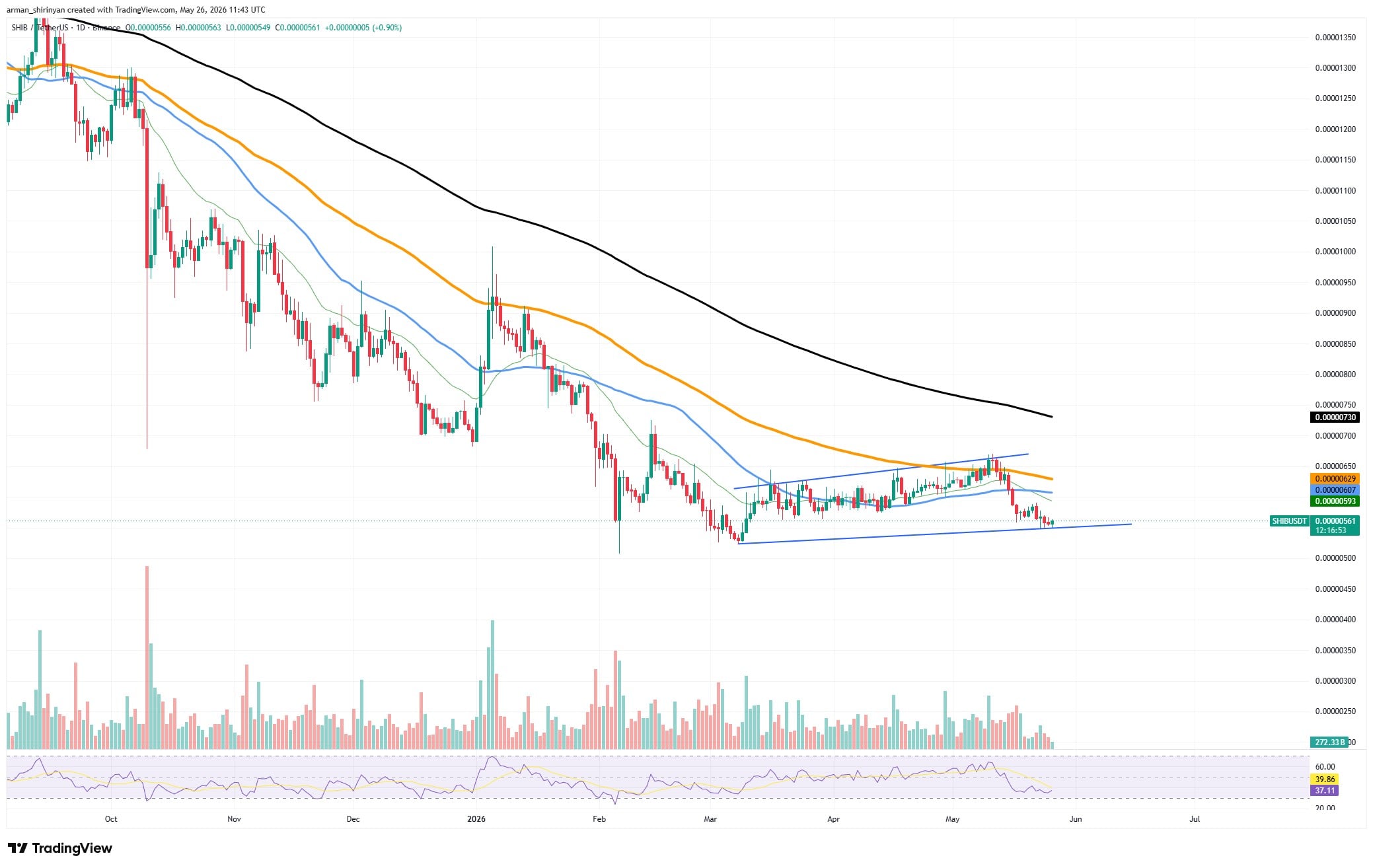
The fact that $SHIB's chart already appears shaky makes that trend significant. The token is still trading below important moving averages and recently lost support from its rising wedge structure. Momentum indicators are still weak, and attempts to recover resistance in the $0.00000620-$0.00000630 region have repeatedly failed. The RSI is currently close to oversold territory, indicating ongoing bearish pressure without clear indications of a return to accumulation.
Growing exchange reserves alone would be alarming. The setup becomes much riskier when coupled with weak price action. Exchange netflows are the first step in the larger breakdown. Inflow metrics have increased significantly despite the fact that overall netflow is still slightly negative. Larger holders may be repositioning coins onto exchanges, as evidenced by recent increases in mean inflows, top-10 inflow transactions, and total exchange inflows.
card
That does not necessarily indicate that dumping will occur right away. Wallets occasionally transfer money for internal exchange operations, derivatives collateral, and liquidity management. However, because it increases the liquid supply available for market selling, persistent reserve growth has historically been associated with higher downside risk.
Sell-side supply moves up
There is symbolic significance associated with the 81 trillion level. In the past, longer consolidation or more severe corrections frequently accompanied periods when $SHIB exchange reserves increased toward comparable levels. Structural overhead pressure is created by more supply sitting on exchanges, particularly when speculative demand declines concurrently.
The psychology of traders is another issue. $SHIB still heavily relies on sentiment. Momentum cycles and aggressive retail participation are more important to meme assets than fundamentals. Because buyers disappear quickly during risk-off phases, even relatively small increases in available sell supply can cause disproportionately large price reactions once momentum fades.
For bulls, there is still hope. The market may still establish a short-term accumulation base if exchange reserves stabilize and $SHIB successfully defends the $0.00000540-$0.00000550 support zone. However, $SHIB runs the risk of entering another prolonged pressure cycle where supply simply exceeds demand if reserves keep rising toward or above 81 trillion while technical structure continues to deteriorate.

 u.today