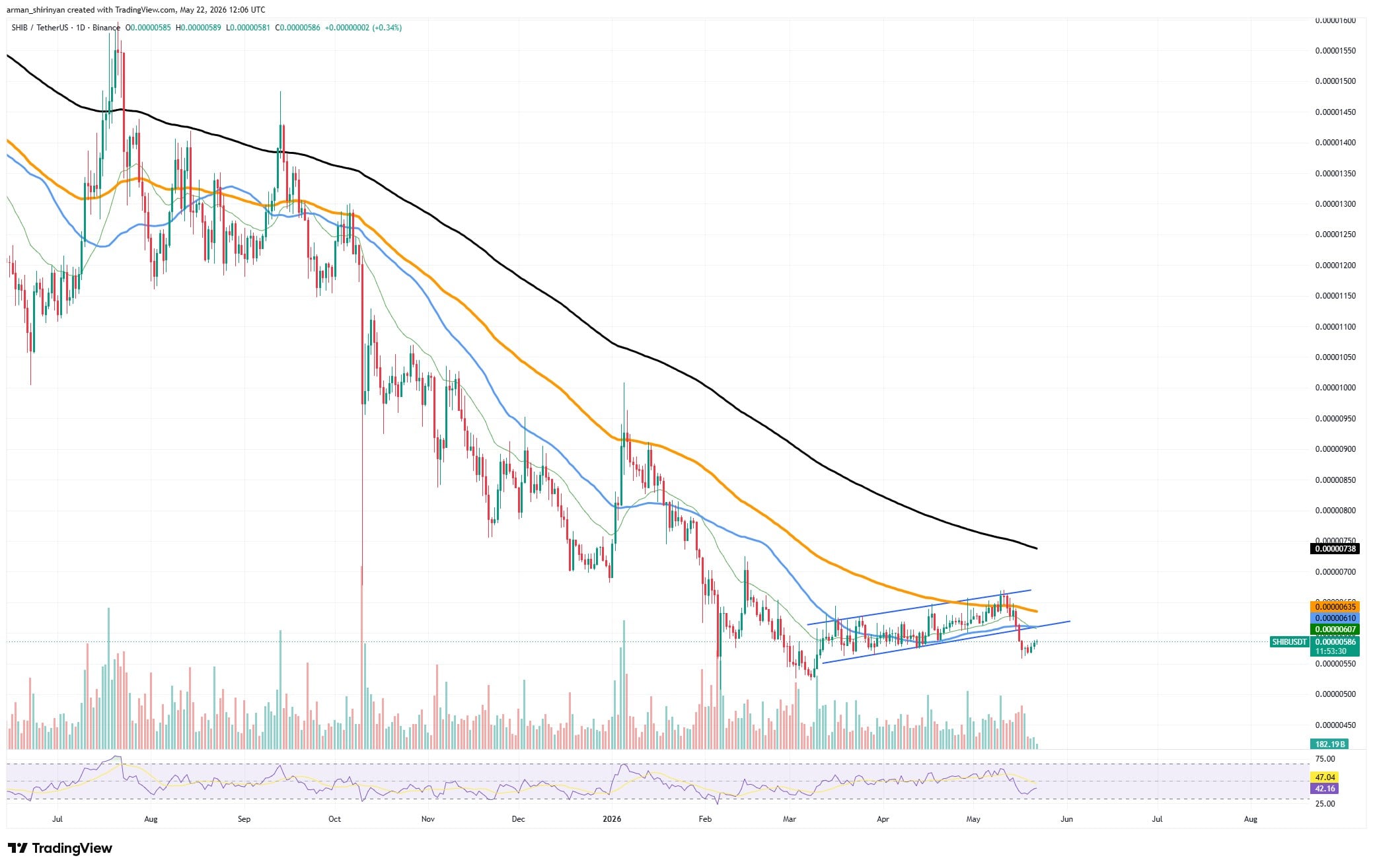
The significant decrease in exchange-related transaction pressure after a protracted bearish period is the metric garnering the most attention. Exchange reserves are still comparatively stable at 80.8 trillion $SHIB, but outflow acceleration has significantly decreased in comparison to earlier phases.
Strong outflow spikes and sharp price swings have historically been associated because traders often move tokens off exchanges during periods of heightened volatility or strategic repositioning. When those flows slow down, it usually signals reduced urgency among market participants rather than a clear bullish reversal.
However, $SHIB is still in a challenging situation technically. The asset, which had been building since March, recently collapsed from an ascending wedge structure. The 200-day moving average is still sloping lower above the current price action, while the price is currently trading below the important short- and medium-term moving averages. As a result, even though on-chain behavior is stabilizing, the overall trend remains negative.
Subtle indications of stabilization are still showing up. Even after the wedge breakdown caused more selling pressure, $SHIB was still able to maintain its position above the local support zone close to the $0.00000550 area. Additionally, volume has begun to cool during the most recent decline phase, indicating that sellers may be losing steam rather than speeding up the dump even more.
Another sign of a divergence
A weak technical structure combined with slowing exchange-flow dynamics results in an unusual setup. This divergence frequently occurs during periods when large holders reduce transfer activity prior to broader sentiment changes.
The market may try another recovery push toward the $0.00000630-$0.00000650 resistance region if exchange outflows continue to decline over the next few days while $SHIB stabilizes above support. Short-term traders would probably have to return to momentum positioning if there was a breakout above that area.
However, $SHIB is still susceptible if the overall weakness in the cryptocurrency market worsens because meme assets usually perform poorly in risk-off situations. As of right now, the declining exchange activity remains one of the more closely watched signals for the asset.

 u.today