
 crypto.news

Pi Network is trying to link token design with real product use as PI continues to trade near the lower end of its recent range.
Pi Network said founder Chengdiao Fan’s Consensus 2026 talk focused on a common problem in crypto: the gap between token design and real product innovation. The project said her session, “Aligning Web3, AI, and Blockchain for Utility,” framed tokens as tools for user growth, engagement, and long-term use.
Fan’s presentation also discussed Pi Launchpad, a proposed model for ecosystem tokens and launch mechanisms. The goal is to help products reach real users who can test, give feedback, and use tokens inside actual product experiences, rather than only trading them.
Pi Founder Chengdiao Fan’s talk at Consensus 2026 was centred on a simple but important challenge:
— Pi Network (@PiCoreTeam) May 22, 2026
The frequent misalignment between token design and real product innovation.
Her presentation, “Aligning Web3, AI, and Blockchain for Utility,” explored how tokens can be treated…
Pi Network’s own blog said Fan argued that AI has made it easier to create applications. That changes the main challenge for builders. In Pi’s view, distribution, verified users, and real usage now matter more than the ability to launch another app.
The Consensus event page used similar language. It said the session would show how Pi combines blockchain infrastructure, verified identity, and a large engaged network to support utility-driven products and AI-era business models.
PI price remains under pressure
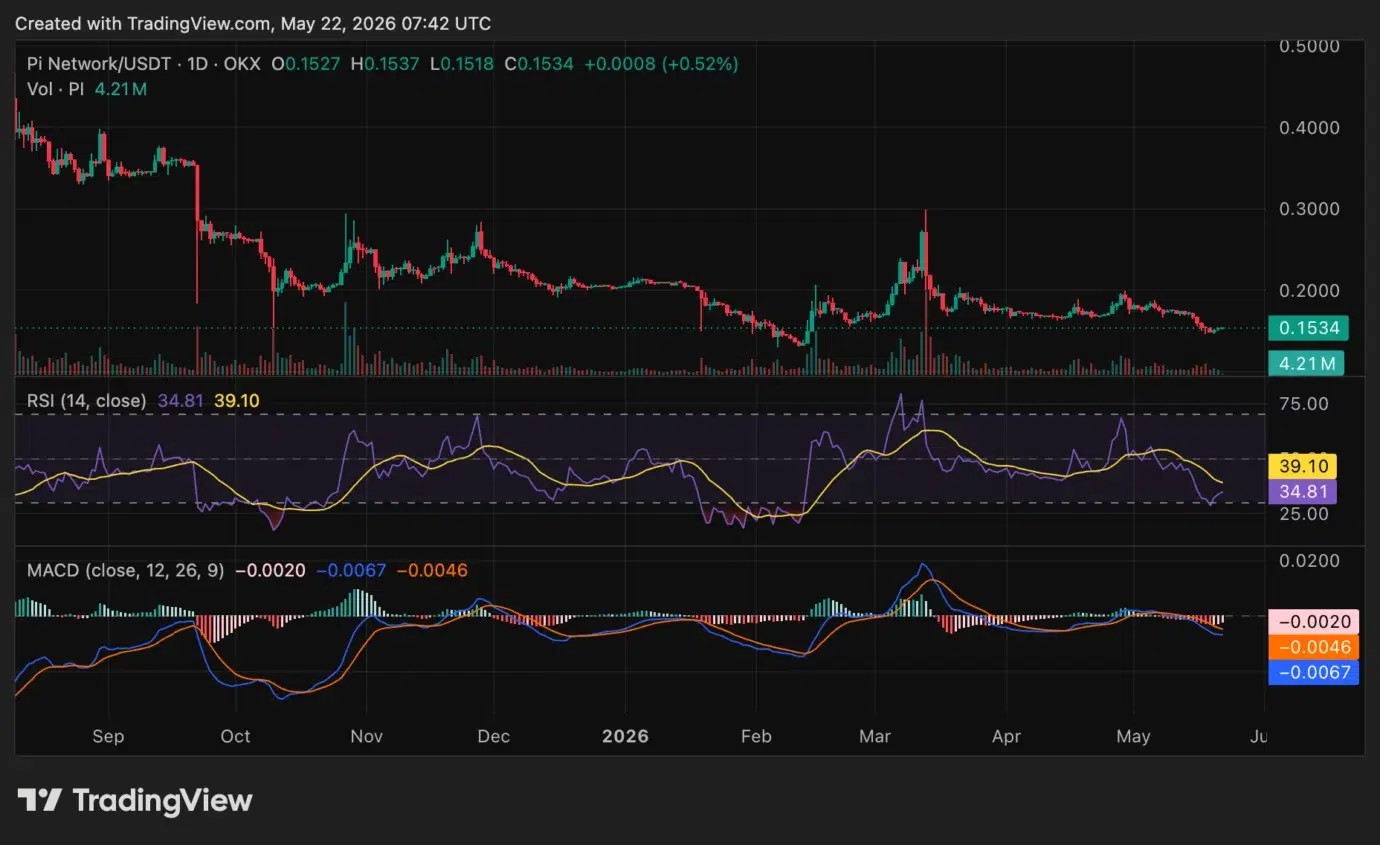
Pi Network’s market data still shows a weak price setup. PI traded near $0.152949 on May 22, with a 24-hour range between $0.150275 and $0.153973. The token was down 10.02% over seven days and 10.14% over 30 days, according to crypto.news price data.
The same data showed Pi Network with a market cap of about $1.62 billion and a fully diluted valuation of about $2.49 billion. PI ranked #54 by market cap, with 24-hour trading volume near $11.5 million.
Pi’s longer-term price picture remains weak. The token is down more than 81% over the past year and remains far below its all-time high of $2.99, reached on Feb. 26, 2025. It is still above its all-time low of $0.131244 from Feb. 11, 2026.
Chart signals also point to limited demand. PI/USDT is trading with muted volume, while the price is struggling to reclaim the $0.17 to $0.20 zone. RSI near 35 shows weak momentum, and the MACD remains negative, keeping sellers in control for now.
Protocol 23 keeps ecosystem hopes alive
Pi Network’s utility message follows a major technical phase for the project. Recent coverage said Protocol 23 activated on May 11, shortly after the project’s Consensus 2026 appearance. The upgrade introduced full smart contract functionality to the Pi blockchain for the first time.
Earlier reports also said Pi’s co-founders used Consensus 2026 to discuss AI, online identity, and Web3 use cases. Fan spoke about utility and token design, while Nicolas Kokkalis joined a panel on proving human identity online without exposing personal data.
That timing matters because Pi is trying to move beyond its long-running mobile mining identity. Protocol 23 gives the network a path toward more programmable applications, while Pi Launchpad would support ecosystem tokens and product launches.
Still, the market has not yet priced in a clear recovery. PI needs a stronger move above $0.17 to $0.18 to weaken the bearish setup. A break below $0.15 could expose another move toward lower support.
Token design becomes Pi’s main test
Fan’s message puts Pi Network inside a wider debate about what tokens should do. Many crypto projects have used tokens mainly for fundraising, speculation, or short-term incentives. Pi is arguing that tokens should help products find users and keep them active.
That pitch fits the project’s existing focus on identity. Pi says its verified user network can help businesses reach real people at a time when AI tools can create fake users, bots, and content at scale. The project says this creates value for apps that need trusted human participation.
The challenge is execution. Utility claims only matter if developers build products that users want and if PI becomes useful inside those products. Price action shows traders remain cautious while they wait for stronger signs of demand.