u.today

After a protracted decline, Shiba Inu is currently in a transitional phase where price structure and on-chain behavior are beginning to align.
Is it getting better for $SHIB?
Months of consistent decline are depicted on the chart below, followed by a tightening range with the formation of higher lows. The price is currently slowly moving upward into the cluster of moving averages while compressing under declining resistance.
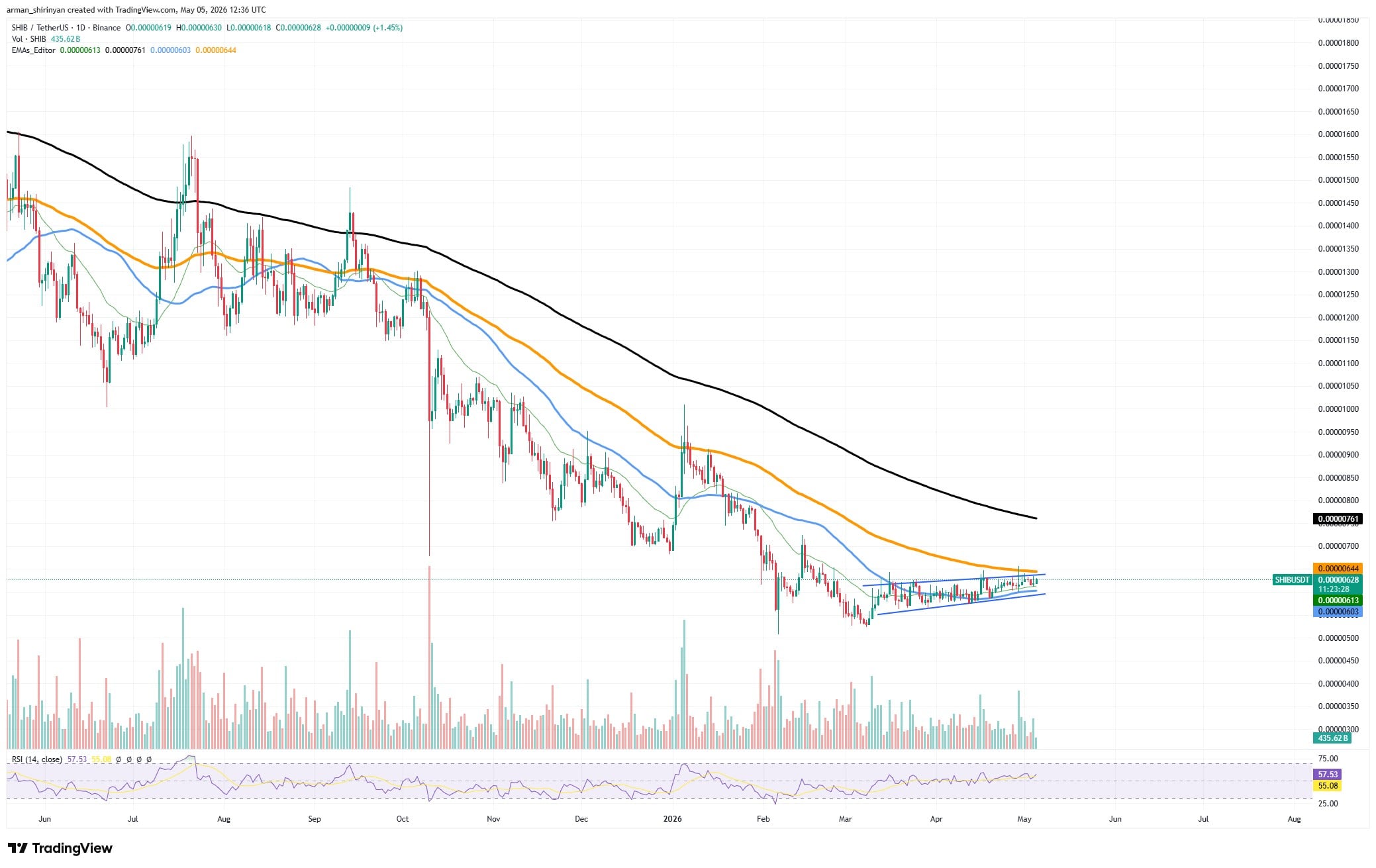
Exchange flow data is one of the most important developments. There has been a massive outflow of 552 billion $SHIB, which is part of a larger trend of tokens leaving exchanges. Hundreds of billions of $SHIB have been removed from trading platforms in similar incidents in recent months, which lowers the supply available for quick selling. When that amount of liquidity leaves exchanges, it typically indicates that holders are moving toward holding or repositioning rather than preparing to sell.
This is significant because $SHIB has been under constant pressure for a long period. The price has had difficulty recovering significant trend levels, and the 100 EMA has been a reliable ceiling. At the moment, that level is beginning to lose some of its power. The price keeps pushing against it, and resistance gets weaker with each test.
Breakout is still possible
An ascending triangle is visible in the current structure, which usually creates pressure for a breakout. At the same time, this change is supported by lower inflows. Because fewer users are sending tokens to exchanges to sell, exchange inflow metrics have been declining. This eliminates one of the primary causes of downward momentum and permits price stabilization.
The market is entering recovery mode if $SHIB breaks above the 100 EMA and holds, opening the door to higher resistance zones. That move would be supported by outflows and decreased sell pressure. Continued compression within the current range is likely to occur if the breakout fails. That would postpone any more significant trend shift and prolong the accumulation phase.
$SHIB is not currently experiencing a significant uptrend, but it is also not in free fall. The 552 billion outflow reveals a shift in holders' behavior. As this compression resolves, traders should be prepared for an increase in volatility, the direction of which will depend on how the price responds to the weakening resistance.