$XRP price has been trapped in a falling trend year-to-date (YTD), and on-chain data analysis signals further weakness in the near term.
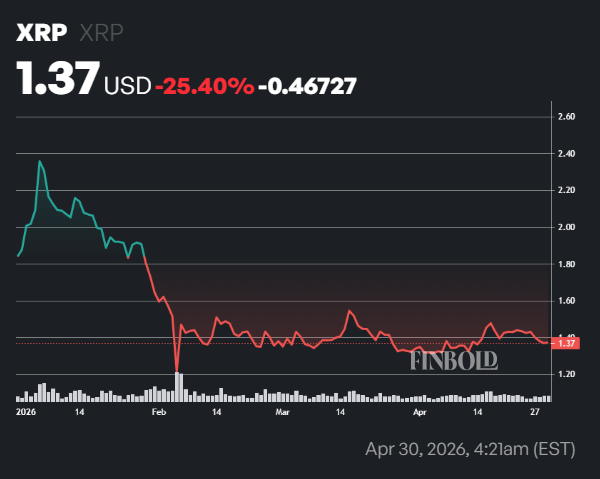
YTD $XRP price has declined over 25% to trade at about $1.37 on April 30. Since early February 2026, the token has oscillated around $1.40, with an upper limit of roughly $1.50.
$XRP/USD YTD chart. Source: Finbold
Know when your coins move
Alerts, real-time prices, and market news — all in one app
Point your phone camera to install
4.8 based on 40K reviews in the App Store and Google Play
As such, the altcoin’s market capitalization has declined to approximately $84.7 billion at press time. Despite the robust fundamentals for $XRP Ledger (XRPL), as Finbold previously pointed out, the token has struggled to rally beyond its multi-week strong supply wall near $1.50. The primary reason why the token failed to maintain bullish momentum in the past was due to low demand from whale investors YTD, led by spot $XRP exchange-traded funds (ETFs), as Finbold reported.
Two main reasons $XRP price could fall further in the near term
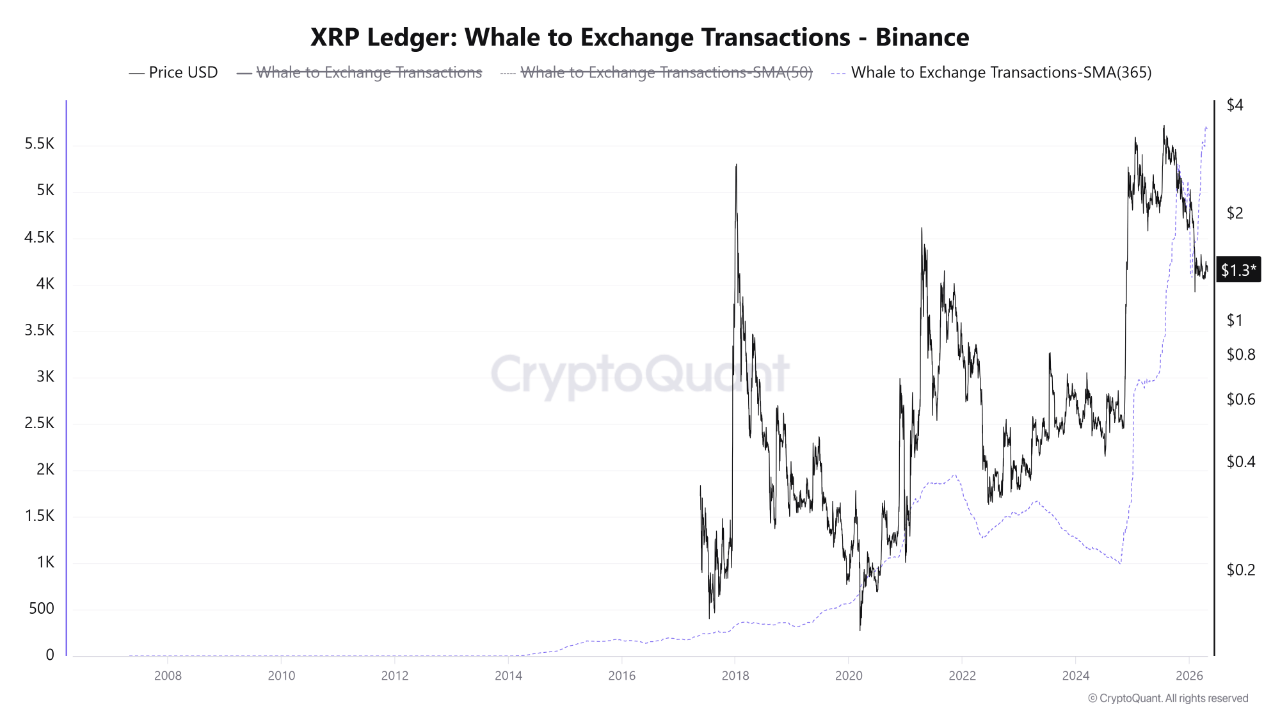
The near-term outlook for $XRP leans heavily toward bearishness due to rising distribution among whales. Since early February 2026, the 365-day Simple Moving Average (SMA) for XRPL whale-to-exchange transactions has spiked to an all-time high ($ATH) above 5,500 as of reporting time, according to data from CryptoQuant.
XRPL whale to Binance transactions. Source: CyptoQuant
With XRPL whale-to-exchange transactions over the past 1 year hitting an $ATH, it is evident that large $XRP holders have been distributing the token for an extended period, thereby weighing on potential bullish sentiment.
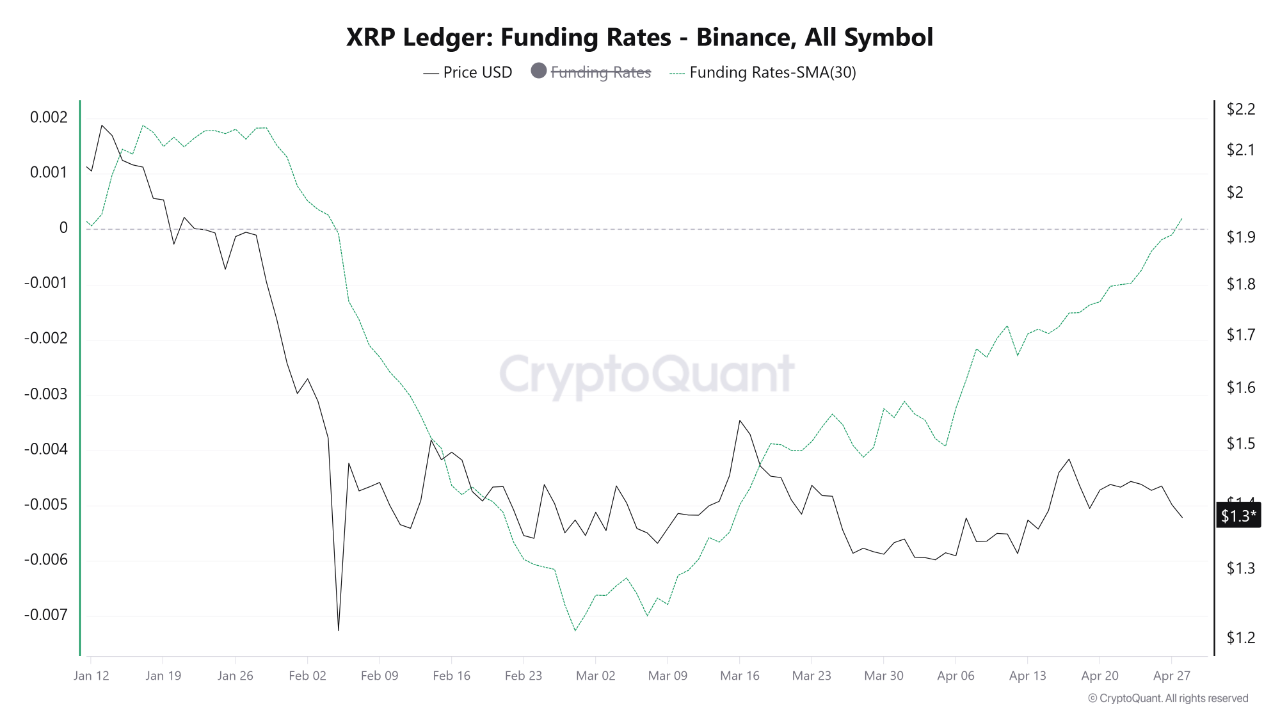
XRPL Funding Rates on Binance. Source: CryptoQuant
Meanwhile, Binance’s XRPL Funding Rates – periodic payments between longs and shorts in perpetual futures to keep the contract price aligned with spot price – recently turned positive, based on metrics from CryptoQuant. As a result, the derivative traders have leaned largely toward bullish, which could trigger a long squeeze – a rapid price drop that forces leveraged long positions to close open trades and accelerates the selloff. The combination of rising whale distribution and renewed long traders is a catalyst for a strong long squeeze.

 finbold.com