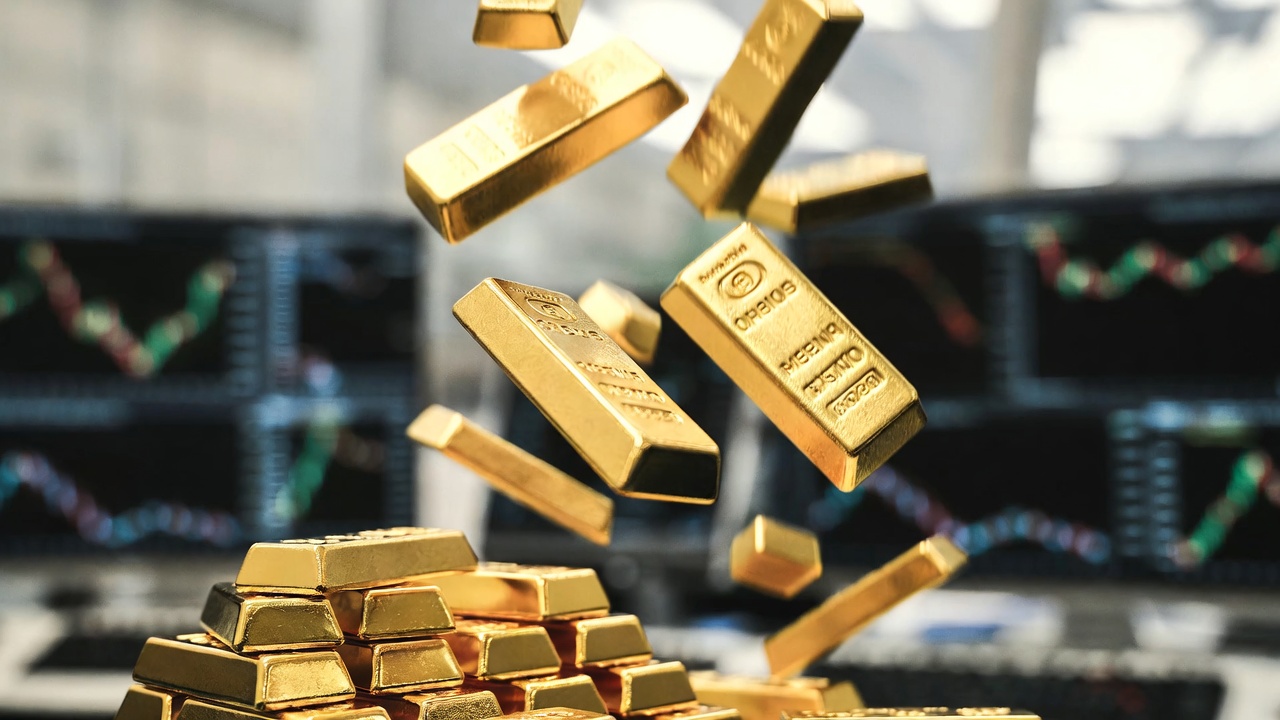
Gold stuck near $4,700: why it's still the safe-haven asset?
invezz.com
27 April 2026 20:02, UTC
Gold prices are boring once again as the yellow metal remains stuck in a range above the $4,700 per ounce mark.
In recent weeks, trading volumes have decreased as prices have moved within a wide band, fluctuating between $4,600 and $4,900 an ounce.
Although geopolitical tensions persist and economic anxiety is high, there is a noticeable lack of immediate urgency driving market positioning, according to a Kitco.com report.
Know when your coins move
Alerts, real-time prices, and market news — all in one app
4.8 based on 40K reviews in the App Store and Google Play
Gold prices on Monday reversed earlier gains and fell slightly as oil prices surged more than 1% due to a stalemate in the US-Iran peace talk negotiations.
At the time of writing, the COMEX gold contract was at $4,727.11 per ounce, down 0.3% from the previous close.
Geopolitical jitters and inflationary pressure
"We're just sort of watching now whether there's progress in the (US-Iran) talks at all in the coming days and that's going to be the biggest driver for gold," Kyle Rodda, a senior financial market analyst at Capital.com was quoted in a Reuters report.
On Sunday, US President Donald Trump stated that Iran is welcome to call if it wishes to negotiate a resolution to the two-month conflict, while simultaneously emphasizing that Iran must "never have a nuclear weapon."
The peace prospects faced a setback when Trump canceled a trip by two US envoys to Pakistan, which has been mediating the war, on Saturday.
Oil prices subsequently increased as the stalled negotiations led to a prolonged disruption of energy exports from the Middle East.
Escalating crude oil costs contribute to inflation by driving up expenses for transportation and production, which, in turn, increases the probability of elevated interest rates.
Although gold is typically viewed as a hedge against inflation, its attractiveness can be diminished by high interest rates, as these make assets that generate a yield more appealing.
Market participants are currently focused on the US Federal Reserve's interest rate decision, which is expected on Wednesday.
Hedge against systemic instability
Despite this, betting on a decline and going against the world's leading, geopolitically neutral safe-haven asset would be an insane move.
Gold prices, though down from January's peaks, are still historically high, reflecting sustained global demand.
Recent market analysis increasingly highlights a significant disconnect between asset valuations and inherent risks, especially within the equity and sovereign debt markets.
In addition, global economic stability faces an underappreciated threat from ongoing geopolitical divisions.
Consequently, gold is now being valued not merely as a hedge against a specific economic event but rather as essential insurance against broader systemic instability.
While gold's correlation with other assets can be temporarily disrupted by short-term volatility, its function as a long-term diversification tool remains intact.
Over a longer timeframe, the absence of a yield in gold is less of a concern than it appears during cycles driven by short-term interest rates.
“Unlike most financial assets, gold carries no counterparty risk a characteristic that becomes more valuable during periods of systemic uncertainty,” according to the Kitco report.
Gold's recent consolidation doesn't signal a weaker appeal, the market is simply absorbing higher prices without heavy selling, suggesting long-term holders are still dominant.
“Gold’s return to quieter, range-bound trading may ultimately be revealing stability rather than stagnation,” the report stated.
Central bank activity and medium-term potential
Currently, gold is trading around $4,700 per ounce, which remains about $1,300 above the 2025 annual average, a factor that is weakening demand for jewellery.
Meanwhile, central bank gold purchases are a noteworthy area of focus.
This is particularly relevant due to the Turkish central bank's need to significantly cut its gold reserves in March.
The particular action was taken to safeguard the national currency against the impact of the Iran war.
All in all, it can be assumed that whilst physical demand for gold has been temporarily dampened, but given the high level of uncertainty and a US Federal Reserve that is likely to be more dovish than in the past, we see potential for gold prices to rise again in the medium term.

 invezz.com