Crypto adoption drops 23% in Q1 2026 – Are mainstream investors losing interest?
ambcrypto.com
25 April 2026 14:43, UTC
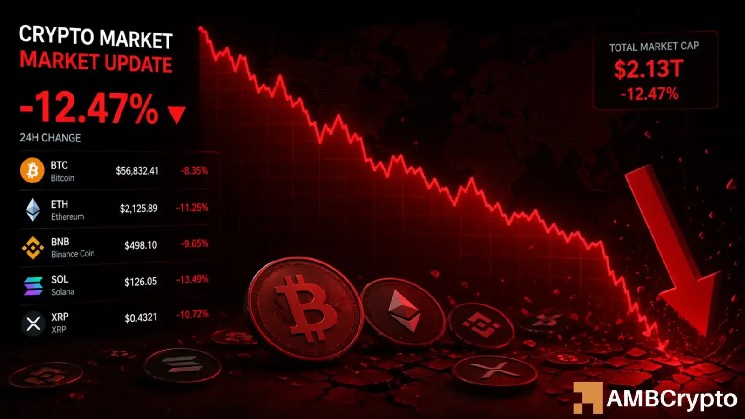
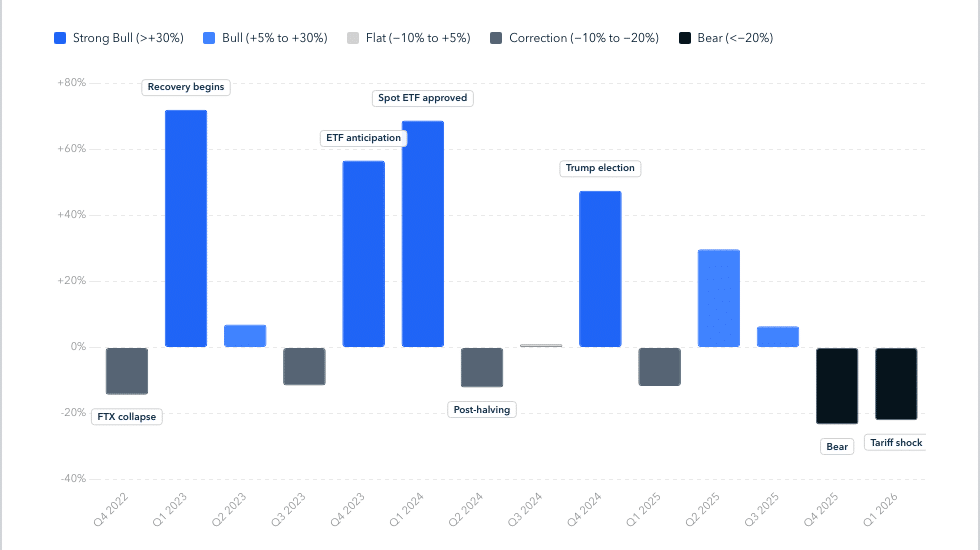
The crypto market entered a prolonged period of weakness following its October 2025 peak, when major assets, including Bitcoin, topped out. What followed was a five-month stretch of sustained capital outflows—the longest on record.
Retail participation hits multi-year low
Retail engagement dropped to its lowest level since the 2022 bear market, according to TRM Labs.
Total transaction volume in Q1 2026 came in at $979 billion, marking a 23% decline from Q4 2025 and an 11% drop year-over-year. The quarter also extended a two-quarter streak of net outflows that began in late 2025.
Know when your coins move
Alerts, real-time prices, and market news — all in one app
4.8 based on 40K reviews in the App Store and Google Play
Source: TRM Labs
TRM Labs attributed the Q1 downturn to a combination of macroeconomic and policy-driven shocks. The U.S. tariff escalation triggered a broader risk-off sentiment across global markets, amplifying the decline already underway from prior bearish conditions.
April data, however, points to a shift in momentum as capital inflows have rebounded to their highest level in seven months, with total crypto market capitalization recovering from $2.05 trillion in early February to around $2.63 trillion.
Regional divergence deepens
Adoption trends varied significantly across jurisdictions, highlighting an increasingly fragmented global market.
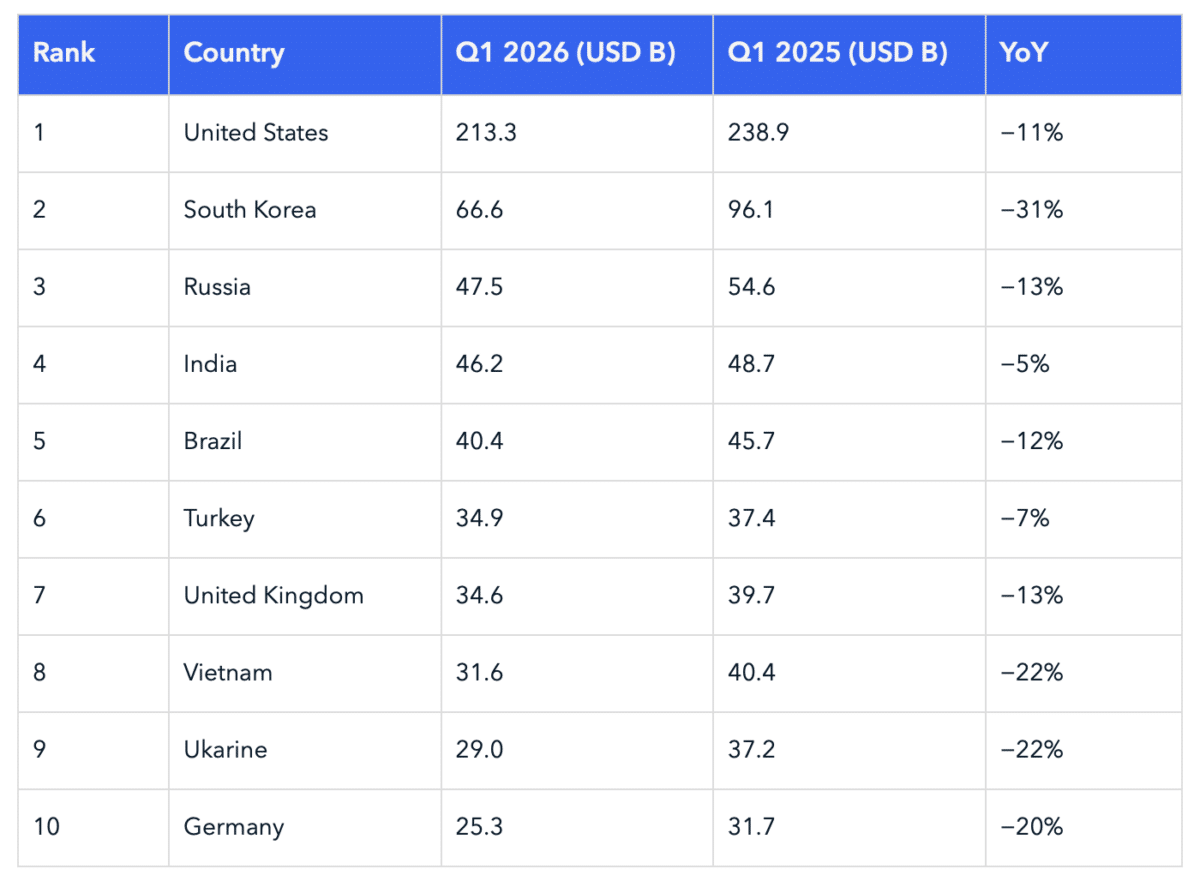
The United States retained its lead in transaction volume at $212 billion, followed by South Korea at $69 billion and Russia at $48 billion.
All three markets recorded year-over-year declines, with South Korea posting the steepest drop at 31%. The U.S. and Russia each saw declines of 11%.
Source: TRM Labs
Elsewhere, local dynamics drove diverging outcomes. Venezuela recorded a rise in activity, with transaction volume reaching $17.9 billion and lifting the country’s ranking to 17th from 21st.
TRM Labs linked this growth to heightened demand for dollar-denominated assets amid economic instability and restricted access to traditional banking.
In contrast, Iran saw a sharp contraction as transaction volume fell 59%, from $2.1 billion in Q1 2024 to $510 million in Q1 2026, reflecting geopolitical tensions and structural disruptions within its crypto ecosystem.
Ari Redbord, Global Head of Policy at TRM Labs, told AMBCrypto that the trend was more structural than cyclical.
What the Q1 2026 data shows is that crypto adoption is increasingly a story of divergence—not a single global market, but a set of regionally distinct economies, each using digital assets for fundamentally different reasons.
He added that regulators and compliance teams will need to adapt to this fragmentation.
Euro stablecoins gain ground but remain marginal
One of the clearest shifts in Q1 emerged within the stablecoin segment, where euro-backed assets recorded rapid growth.
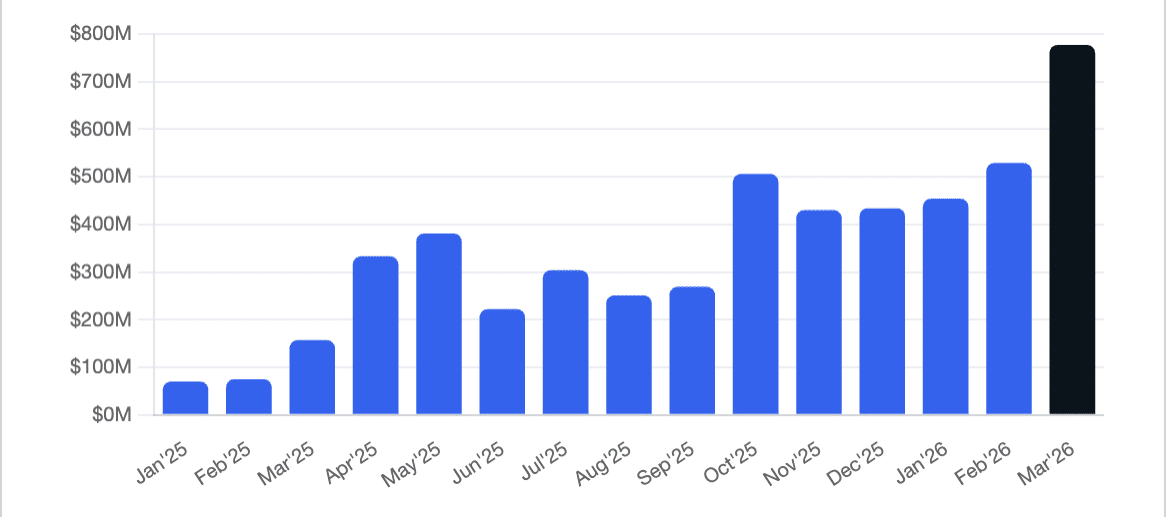
Euro-denominated stablecoins processed $777 million in volume by the end of March, up from $69 million—a twelvefold increase. By contrast, USD stablecoin volume declined from $310 billion to $274 billion over the same period.
Despite the surge, euro stablecoins remain a niche segment, representing just 0.3% of VASP retail transaction volume. Activity remains concentrated in a small group of assets, including EURC, EURS, and EURT.
Source: TRM Labs
Regulatory clarity under the EU’s Markets in Crypto-Assets (MiCA) framework, alongside the expansion of non-USD payment rails and improved institutional on- and off-ramps, has supported this growth.
Redbord noted that the trend could signal a broader structural shift.
We may be watching the early stages of a genuine shift in the geography of stablecoin risk. That has real implications for compliance teams, regulators, and anyone tracking illicit finance flows.
Final Summary
Crypto adoption declined for a second straight quarter, a trend last seen during the 2022 bear market.
Euro-denominated stablecoins surged to $777 million in volume but still accounted for just 0.3% of retail activity.

 ambcrypto.com