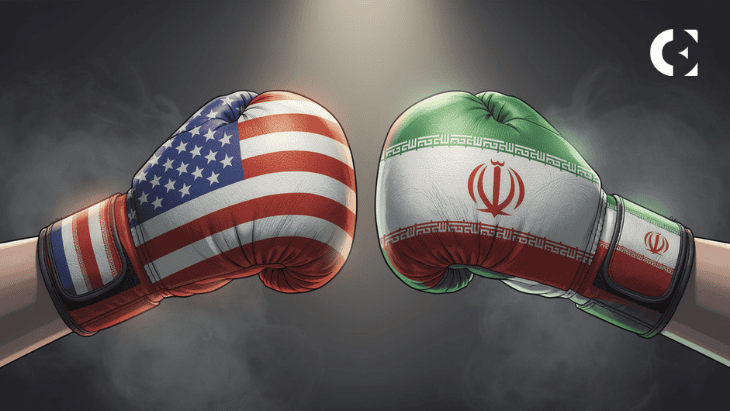
For context, $XRP and the broader crypto market fell approximately 2% following the US Vice President J.D. Vance’s announcement that peace talks in Pakistan failed. $XRP slid toward the base of the sideways range, consolidating around $1.30, before making a slight rebound to trade for $1.35 at the time of writing, according to data from TradingView.
Investors Treat $XRP Like a High-Risk Asset
With the US-Iran war lasting over several weeks, $XRP investors appear to be treating the cryptocurrency as a high-beta risk asset, selling it in favor of traditional safe havens like the US dollar and Gold. This pattern is observed whenever the conflict escalates, either by intensified bombing or failed negotiations.
In addition to the impact of intensified bombing and failed negotiations, macroeconomic factors triggered by the war’s fallout, such as fears of the blockade of the Strait of Hormuz, are weighing in on $XRP. For instance, high oil prices resulting from Iran’s actions around the trade route are causing inflation, which may force the US Federal Reserve to keep interest rates “higher for longer,” resulting in a bearish environment for crypto.
$XRP’s Current Situation
It is worth noting that institutional demand alone has not been able to sustain $XRP’s price stability. Despite a strong demand from that sector of the market in March, $XRP experienced a $3.03 million net outflow in March due to geopolitical uncertainty that caused institutions to de-risk.
However, it is crucial to note that $XRP has reflected significant resilience amid overwhelming negative circumstances. The cryptocurrency has proved its bounce-back potential with every pullback, boosting investors’ confidence in the digital asset’s potential to rally as soon as external factors reflect a positive change in dynamics.
Related:Why $XRP and Crypto Markets May Stay Weak: Three Key Reasons

 coinedition.com