Following periods of dominance, Bitcoin and Ethereum are seeing capital outflows, with some of that capital temporarily moving into smaller, more neutral assets like $XRP. $XRP is advantageous because it occupies a middle ground: it is big enough to be liquid, but it is not linked to the same narratives that are currently affecting ETH and BTC.
Second, the ETF structure for $XRP is more sensitive and smaller. Just because the baseline is lower, a few million dollars in inflows can drastically distort the daily comparison. When $XRP outperforms Bitcoin in a single-day flow metric, it indicates that Bitcoin is currently losing money more quickly rather than attracting more capital overall.
XPR wakes up
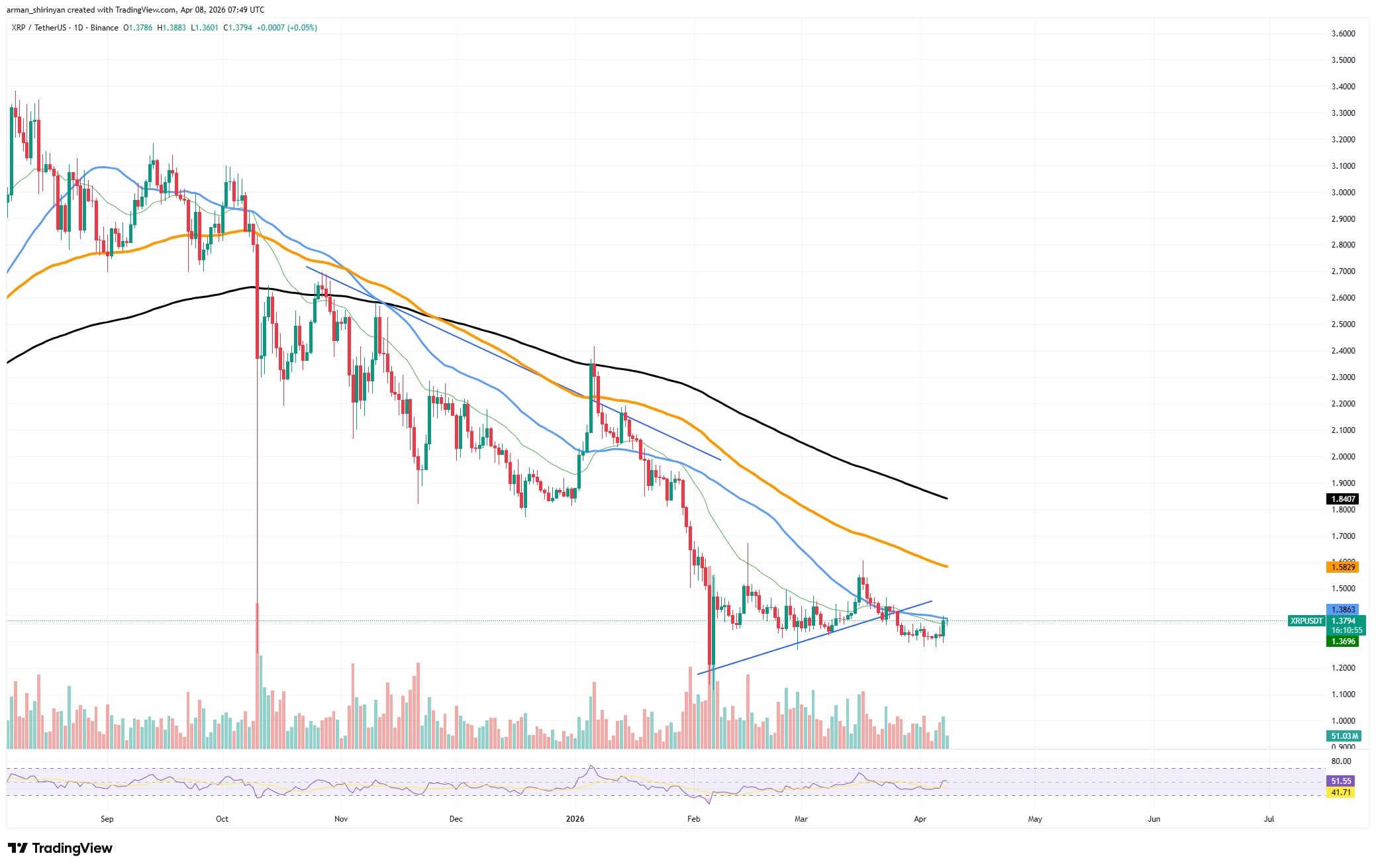
Given its shaky price structure, the more intriguing question is why investors are purchasing $XRP at all. With $XRP trading below important moving averages and failing to reach higher highs, the chart continues to display a protracted downtrend. Technically speaking, it is not a desirable asset.
Positioning, not conviction, is probably key. A mean-reversion or contrarian strategy is frequently applied to $XRP. Some participants are placing bets on a rebound simply because the asset has already been beaten down, with average traders reportedly down over 40% and sentiment severely depressed. Compared to some altcoins, $XRP is also more accessible for institutional products due to its regulatory clarity in some jurisdictions.
Interest, but not necessarily strength, is indicated by ETF inflows. The move should be handled carefully until $XRP’s price structure improves and corresponds with these inflows. At the moment, $XRP is profiting from capital rotation rather than a real change in market dominance.

 u.today