
 ambcrypto.com

On the 7th of April, $RIVER surged 19.93% to $12.23 as trading volume jumped 62.15% to $53.55 million. It pointed to aggressive market participation from buyers returning at key demand levels.
The move followed a strong reaction from the $11.1 demand zone, where the price had previously stabilized after downside pressure.
As capital flowed back into the market, the market cap climbed to $239.84 million, reinforcing the strength behind the recovery. This shift reflected renewed interest rather than isolated volatility, as buyers stepped in with conviction.
However, the structure of the move still required deeper evaluation beyond the immediate $RIVER price expansion.
Short squeeze fuels $RIVER price expansion
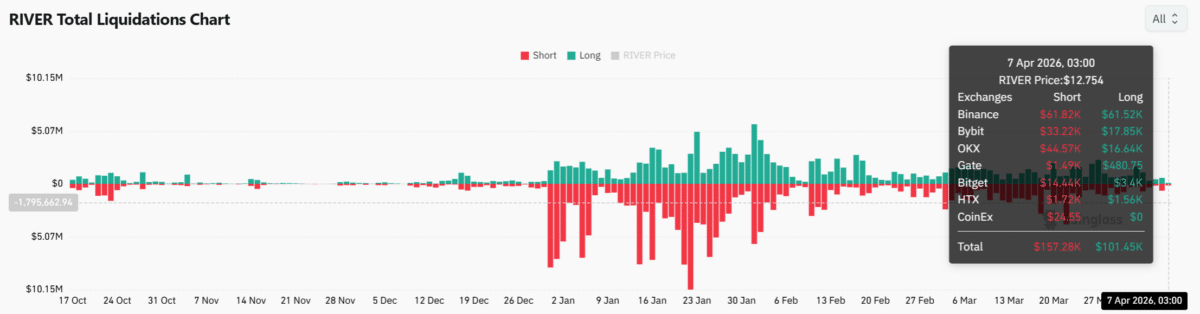
Short liquidations reached $157.28K, exceeding long liquidations of $101.45K, which indicated that bearish positions had been forced out during the rally.
This imbalance contributed directly to the upward movement, as traders covering short positions added buying pressure into the market.
As price continued rising, more short positions likely faced liquidation, which reinforced the expansion further.
However, this type of move often relied on positioning imbalances rather than steady accumulation.
While the squeeze strengthened the rally in the short term, it also introduced a layer of fragility, since the continuation depended on whether fresh demand could sustain the move after liquidation pressure eased.
Demand holds, but sellers still lead
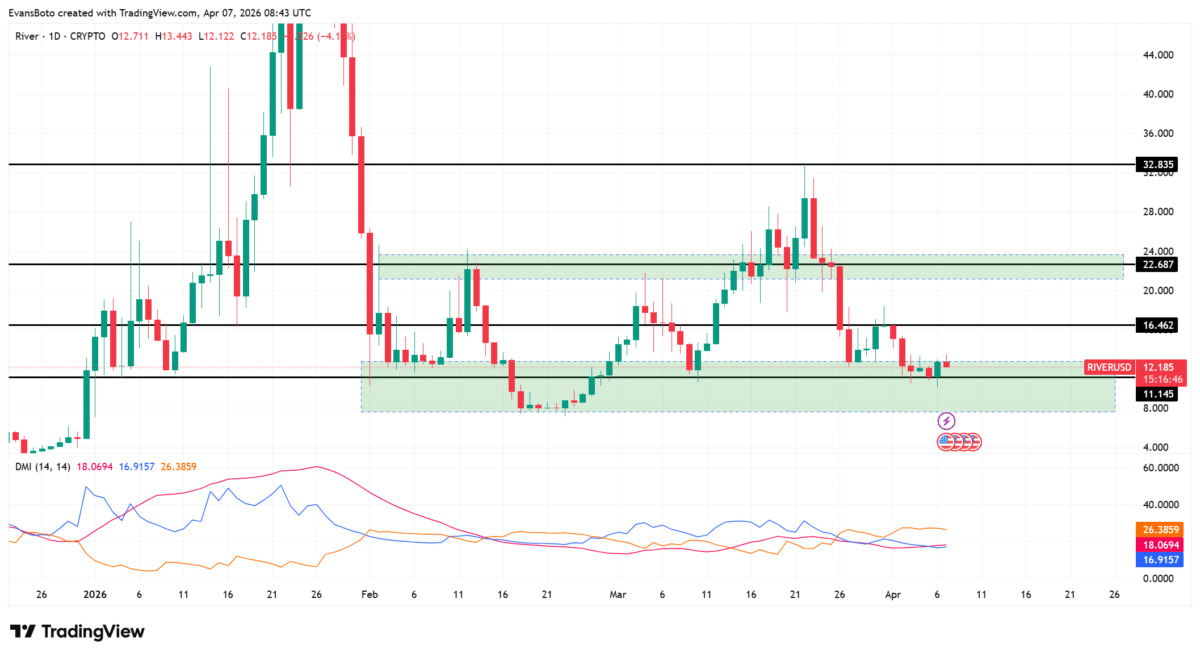
$RIVER maintained its position within the $11.1 demand zone, which showed that buyers had successfully defended key support levels during the recent move.
This reaction confirmed that accumulation had taken place at lower levels, which allowed the price to rebound sharply.
However, the DMI structure revealed that -DI remained above +DI, which meant sellers still held directional control across the broader structure.
In addition, ADX held at 18, which confirmed that the trend lacked strong conviction despite the ongoing recovery.
As a result, the market reflected a fragile balance, where price recovery existed within a structure still influenced by sellers and lacking strong directional strength.
$RIVER liquidity zones dictate short-term moves
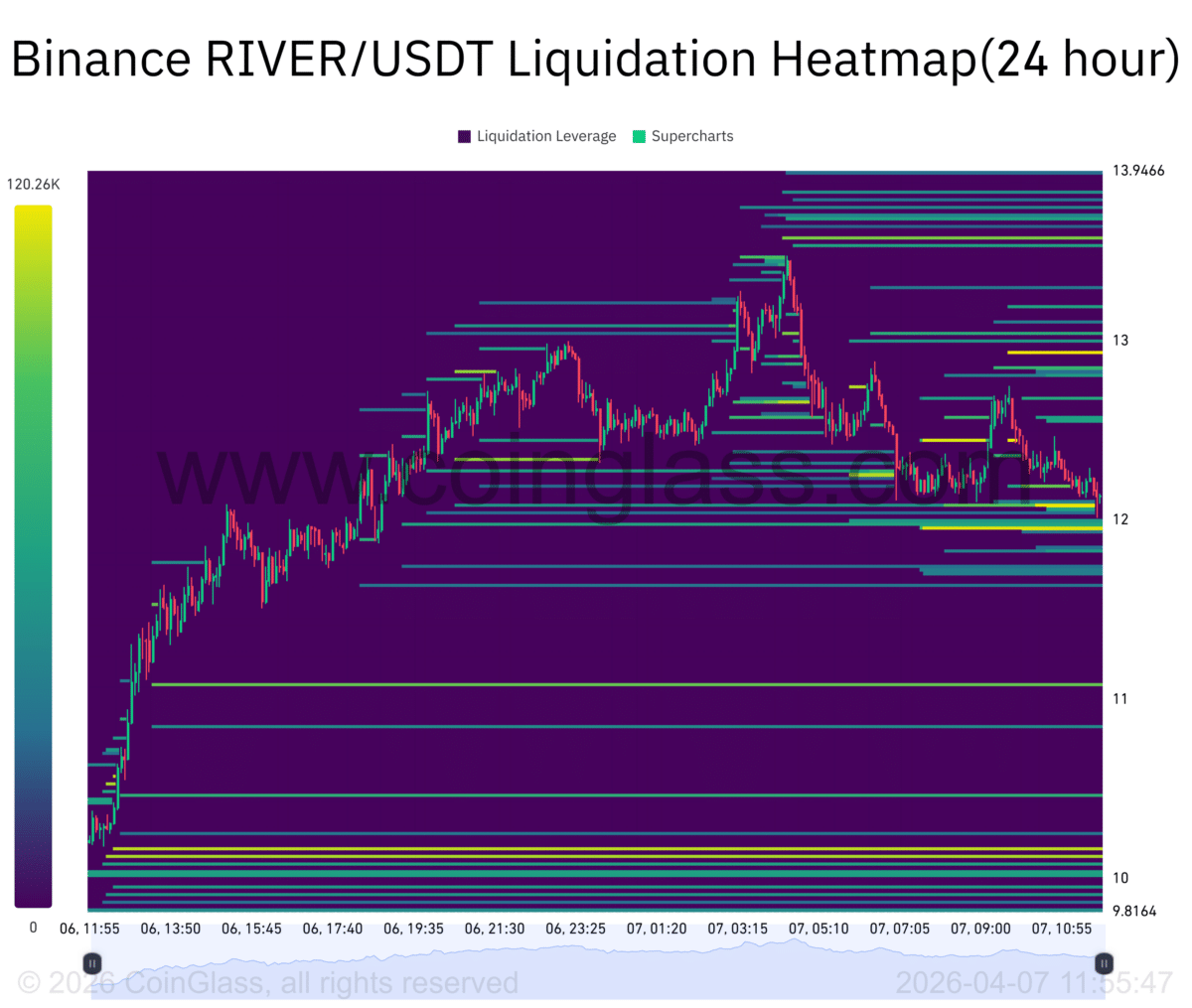
The Liquidation Heatmap showed dense liquidity clusters forming around the $12 and $13 levels, which shaped the short-term movement of price.
As $RIVER approached $13, it encountered a concentration of short-side liquidity, which attracted upward movement as the market targeted those positions.
However, the $12 region continued acting as a base where liquidity supported pullbacks, keeping the price anchored within this narrow range.
This interaction between liquidity zones created a reactive environment, where the price oscillated based on positioning rather than sustained directional expansion.
As a result, volatility remained elevated, but structure continued reflecting localized liquidity-driven movements instead of broader trend development.
$RIVER’s rally developed from demand and liquidation pressure, which supported the initial recovery.
However, sellers still influenced the structure while trend strength remained weak. Therefore, continuation depended on whether buyers could sustain control beyond liquidity-driven moves.
Final Summary
- $RIVER’s jump was driven by real buying at the $11.1 level, not random price spikes.
- The rally accelerated because short sellers were forced to exit, adding extra buying pressure rather than steady long-term accumulation.