
 cryptoticker.io

In a market often dominated by volatile meme coins and complex DeFi protocols, UNUS SED $LEO ($LEO) has quietly climbed the ranks to become a heavyweight in the digital asset space. Originally launched as a utility token for the iFinex ecosystem, $LEO has transitioned from its initial $1 exchange offering to a valuation exceeding $10 per token.
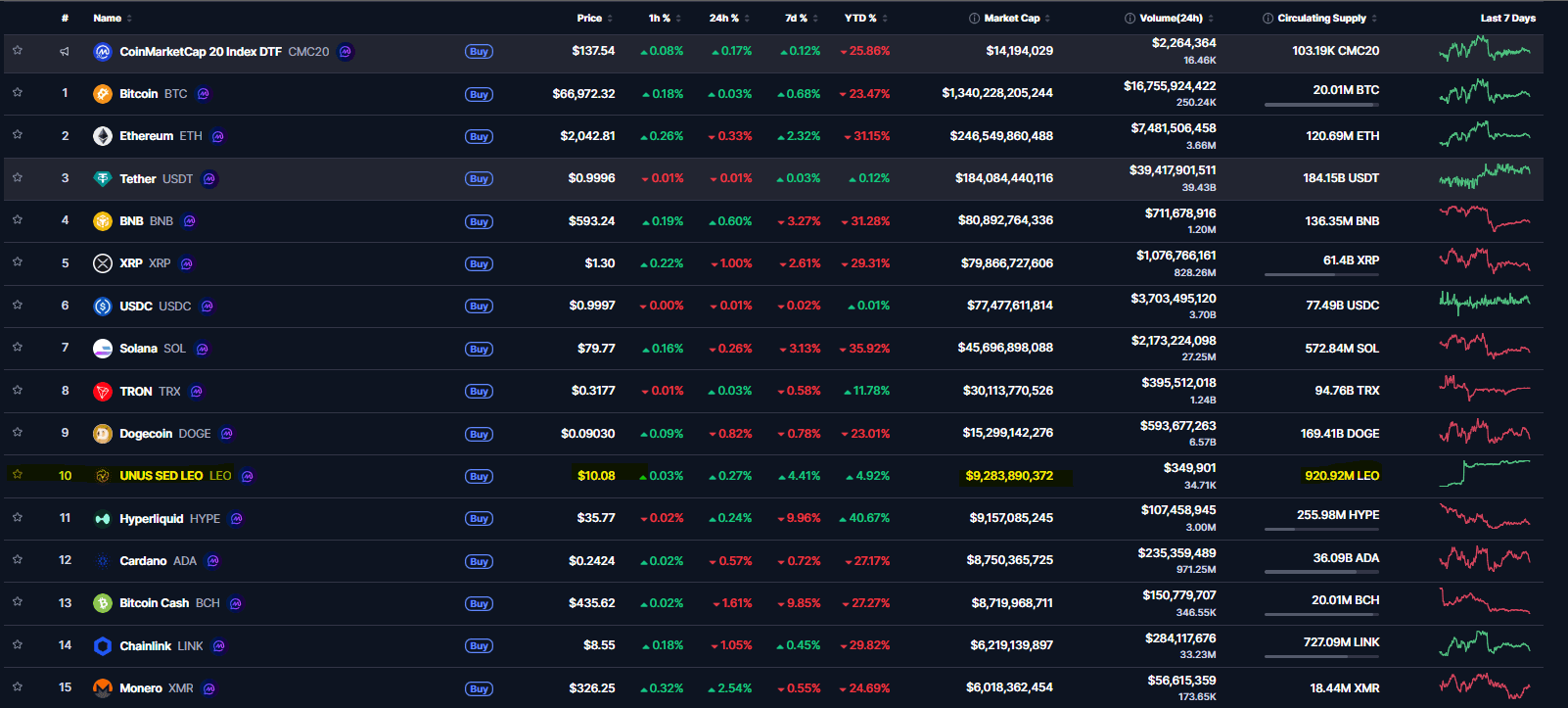
As of April 2026, $LEO has officially broken into the top 10 largest cryptocurrencies by market capitalization, boasting a valuation of approximately $9.3 billion. This article explores the unique fundamentals, the aggressive deflationary model, and the institutional backing that have fueled this 1,000% journey.
What is UNUS SED $LEO?
UNUS SED $LEO is the native utility token of the iFinex ecosystem, which includes the prominent Bitfinex exchange. Launched in May 2019, the token was designed to provide holders with significant fee discounts and a variety of benefits across the platform's services. Unlike many other assets, $LEO is a multi-chain token, existing on both the Ethereum and EOS blockchains to maximize accessibility.
Why is it named like this?
The token's name, "Unus Sed Leo," is Latin for "One, but a lion," a motto emphasizing quality and strength over quantity. It was born out of a crisis: iFinex launched the $LEO token to raise $1 billion in capital after a payment processor's funds were seized by government authorities.
While it started as a recovery mechanism, it evolved into a pillar of exchange-based utility. Its primary function is to offer:
- Trading fee reductions: Up to 25% discount for holders.
- Lending fee discounts: Significant reductions for peer-to-peer lenders.
- Withdrawal/Deposit perks: Faster and cheaper transactions on Bitfinex.
The Path from $1 to $10: Why is the Price Rising?
The rise of $LEO from its $1 launch to the current $10.05 level is not merely speculative; it is driven by one of the most transparent and aggressive buyback and burn mechanisms in the industry.
1. The 27% Revenue Burn
iFinex is contractually committed to using at least 27% of its consolidated monthly revenue to buy back $LEO tokens from the open market and permanently destroy them. This creates a perpetual buy-side pressure. As Bitfinex remains a top-tier exchange for professional traders, this revenue stream provides a "floor" for the token price.
2. The Bitcoin Recovery Catalyst
A major factor in the 2024–2026 rally has been the legal resolution regarding the 2016 Bitfinex hack. Following court orders, nearly 94,643 BTC were earmarked for recovery. According to the token's whitepaper, 80% of recovered funds must be used to repurchase and burn $LEO tokens. With $Bitcoin prices reaching new heights, the sheer dollar value of this buyback program has caused massive supply shocks.
3. Low Volatility and Institutional Trust
Unlike highly liquid assets that fluctuate wildly, $LEO often shows "resilience" during market crashes. Because so much of the supply is held by long-term investors or is being systematically burned, the circulating supply (currently around 920 million $LEO) continues to shrink, making each remaining token more valuable.
How $LEO Price Reached the Top 10 Cryptos
Reaching the #10 spot by market cap is a feat of endurance. $LEO's ascent was accelerated by the downfall of other exchange tokens (such as FTT) and the growing demand for "safe haven" utility assets.
| Feature | UNUS SED $LEO ($LEO) |
|---|---|
| Current Price | $10.05 |
| Market Cap Rank | #10 |
| Circulating Supply | ~920.9 Million |
| Max Supply | Decreasing Monthly |
By maintaining a steady growth trajectory while the broader altcoin market experienced massive drawdowns, $LEO became a "non-correlated" asset. This attracted portfolio managers looking for stability.