
 newsbtc.com

$XRP is struggling around key demand levels. The market is preparing for a decisive move. And the data beneath the price is describing a contest between two groups of participants who have reached completely opposite conclusions about what comes next.
A CryptoQuant report has identified a divergence in $XRP’s market structure that makes the current price level more consequential than it appears on the surface. Spot CVD on Binance has climbed to $451 million — real capital, exchanged for real $XRP, building steadily on the buy side. The participants behind that number believe in the current price. They are putting money behind that belief.
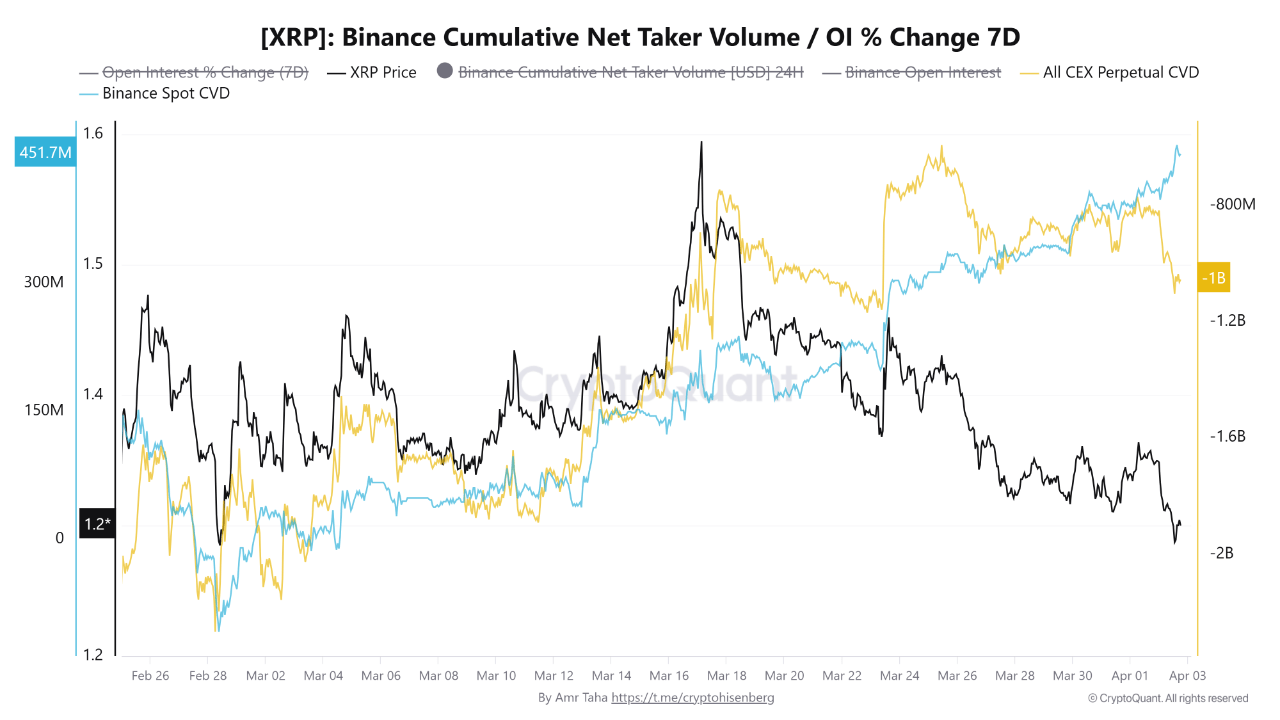
Simultaneously, Binance Perpetual CVD sits at approximately -$1.5 billion, while All CEX Perpetual CVD hovers near -$1 billion. The derivatives market is not neutral. It is actively bearish — leveraged traders positioned for $XRP to fall, with conviction strong enough to sustain nearly $1.5 billion in negative cumulative positioning.
Two markets. Two verdicts. One price level caught between them.
The spot buyers are absorbing what the derivatives traders are betting against. That dynamic — real demand meeting leveraged skepticism at the same price — is not a stable condition. One side is accumulating fuel for the other’s forced exit. The article ahead explains which side history tends to favor.
The Spot Side Is Absorbing What the Derivatives Side Is Selling. That Is Not Nothing.
The report’s forward interpretation is where the divergence becomes most consequential. Spot demand building against bearish futures positioning does not simply represent two groups of participants disagreeing — it represents a structural dynamic in which one side’s losses become the other side’s catalyst. When spot buyers absorb sell pressure that derivatives traders are generating, the supply available to push the price lower diminishes. When it diminishes enough, the bearish leveraged positions that were supposed to profit from the decline become a liability — and the process of unwinding them adds buying pressure rather than selling pressure.
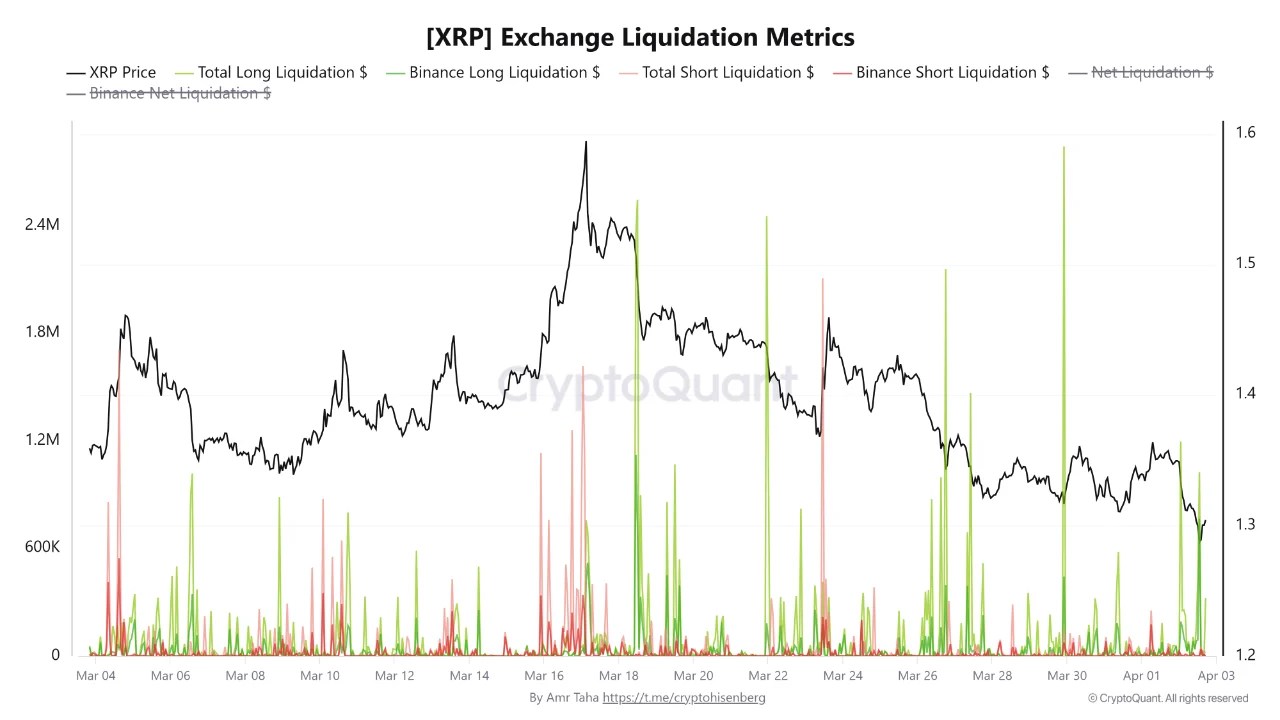
That mechanism — commonly known as a short squeeze — does not require a fundamental catalyst to trigger. It requires only that spot demand continues building while bearish positioning remains crowded. The report identifies liquidation activity as an additional signal pointing to the same fragility: derivatives positioning is not just bearish, it is exposed.
The report is precise about what this does and does not confirm. It is not a bullish signal. It is a pre-bullish structure — spot support forming beneath a market that leveraged traders are still betting against. Those are different things, and the distinction matters.
The gap between $451 million in spot buying and $1.5 billion in bearish futures positioning is the distance between current reality and potential forced reaction. If spot demand keeps building and that gap keeps widening, the bearish derivatives bias stops being a headwind and starts being the fuel.
$XRP Drifts Lower as Sellers Maintain Control
$XRP is trading near $1.31, continuing to show signs of weakness after failing to reclaim higher levels following the February breakdown. The chart reflects a sustained downtrend, with price consistently forming lower highs and lower lows over the past several months, indicating that selling pressure remains dominant.
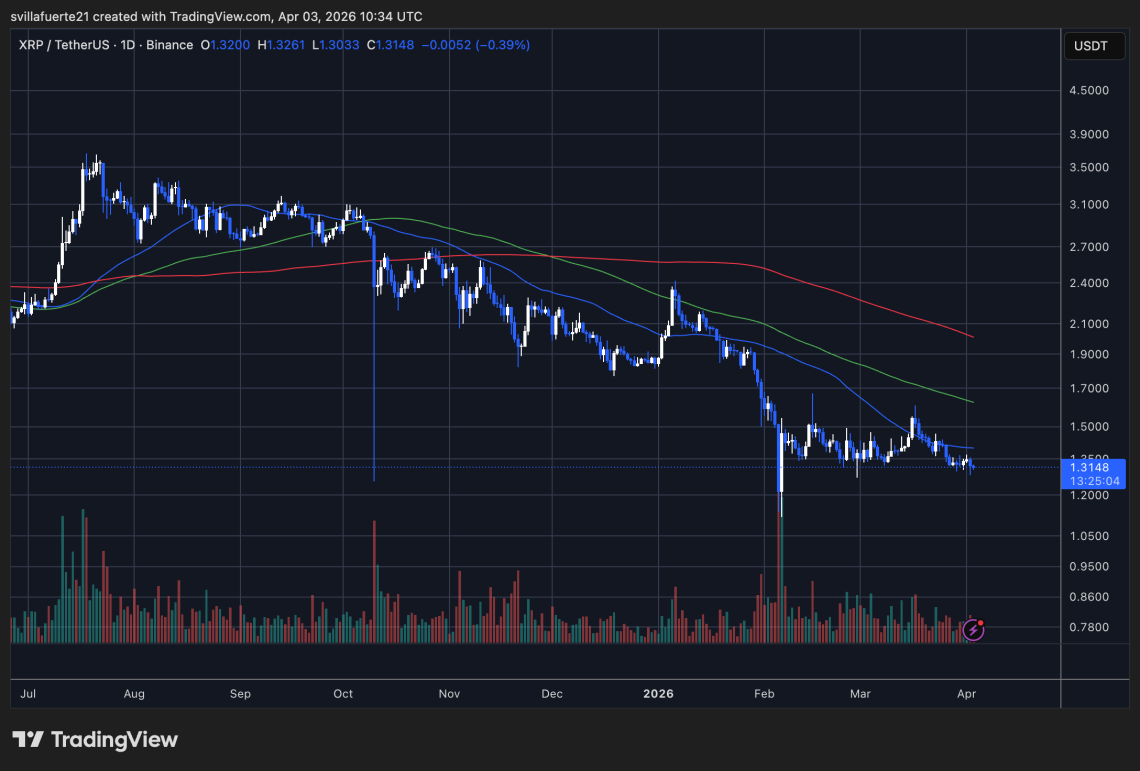
After the sharp capitulation event in early February — marked by a significant spike in volume — $XRP entered a consolidation range between roughly $1.25 and $1.50. However, this range has not produced a meaningful recovery. Instead, recent price action shows a gradual drift toward the lower end of the range, suggesting that demand is weakening rather than strengthening.
The 50-day and 100-day moving averages are both trending downward above the price. Acting as a dynamic resistance and capping any short-term rallies. The 200-day moving average remains significantly higher, reinforcing the broader bearish structure and confirming that $XRP has not yet established a reversal.
Volume has declined during this consolidation phase, indicating reduced participation and limited conviction from buyers. This lack of demand is evident in repeated failures to sustain moves above $1.40.
Unless $XRP can reclaim key moving averages and break out of this range with strength, the current structure favors continued pressure, with a potential retest of lower support levels.
Featured image from ChatGPT, chart from TradingView.com