
 beincrypto.com

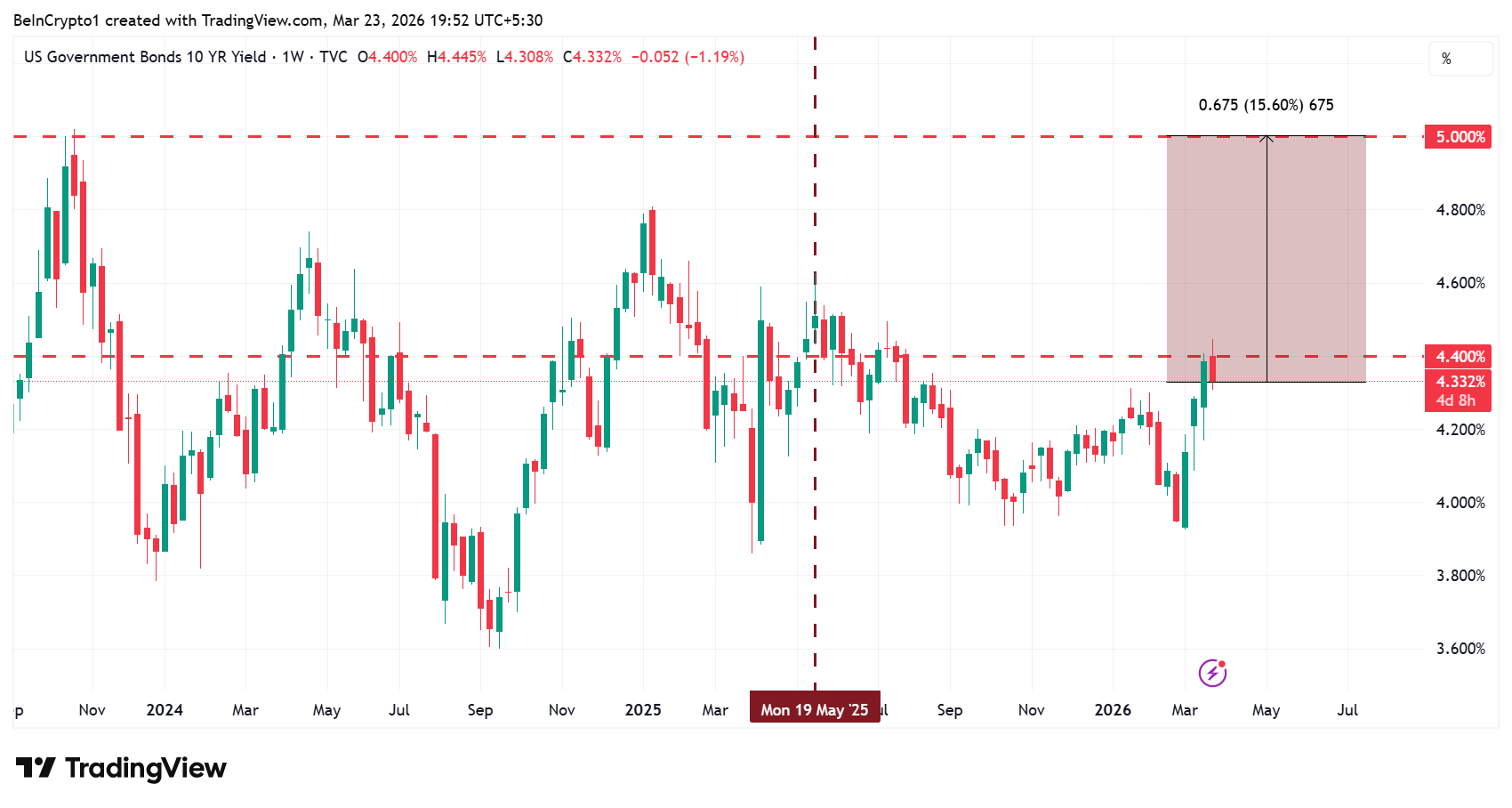
The US 10-year Treasury yield (US10Y) has climbed roughly 48 basis points since the Iran war began on February 28, hitting levels not seen since last summer.
The benchmark rate closed at 4.39% on March 20 and opened this week near 4.40%, according to TradingView data. That pace mirrors the rapid bond sell-off around “Liberation Day” in April 2025, when surging yields forced President Trump to reverse course on tariffs.
The 4.5% Line in the Sand
The yield’s trajectory is turning heads after what happened last April. When the 10Y yield surged past 4.50% and broke above 4.60%, Trump implemented a 90-day pause on reciprocal tariffs on April 9, 2025.
“Oil prices are no longer the biggest threat to markets. It has become increasingly clear that bond markets will dictate just how long President Trump can continue increase pressure in the Iran War,” wrote analysts at the Kobeissi Letter.
Adam Kobeissi of The Kobeissi Letter highlighted the parallel between the current bond market stress and that April episode, noting that the US economy cannot handle a 5% 10Y note yield.
When I made this statement about President Trump's imminent intervention coming "very soon," I meant it.
— Adam Kobeissi (@TKL_Adam) March 23, 2026
3 hours later, President Trump said the Iran War is nearing its end amid "productive discussions" with Iran.
Iran's denial of these claims is even further evidence of such… https://t.co/BR4nEgdD9E
This is a general sentiment among experts, with ex-investment banker Simon Dixon echoing that view. In his opinion, Trump has no choice but to bring yields down by striking a deal in the Middle East.
“Trump will have to TACO…He has no choice but to crash oil and bond yields by announcing a deal,” Dixon indicated.
The consensus among these voices is that a push toward 5% would inflict damage the US economy cannot absorb.
Markets and Mayhem previously warned that 4.5% is a threshold that triggers liquidity constraints across global markets.
Higher yields increase the cost of servicing the enormous volume of debt priced off the 10-year benchmark. That pressure does not show up instantly but erodes available capital until a tipping point arrives.
How Rising Yields Pressure Bitcoin and Gold
The inverse relationship between the US10Y and assets like Bitcoin ($BTC) and gold is one of the most consistent macro patterns of 2025 and 2026.
When yields rise, both tend to fall. When yields decline, both tend to recover. The correlation is not perfect on any given day, but the directional pattern holds across weeks and months.
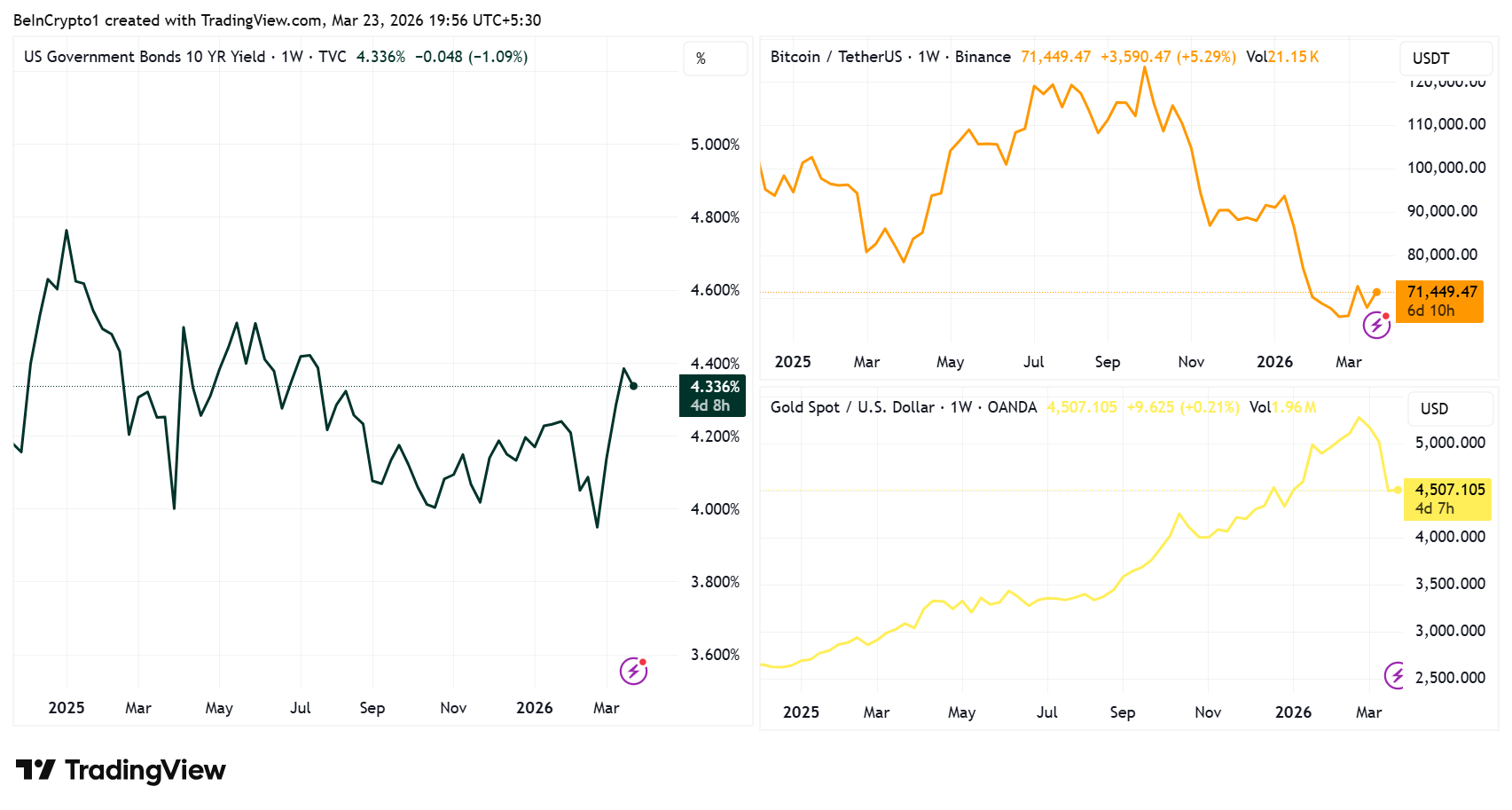
The mechanics behind this dynamic work through several channels. Rising yields make Treasuries, the world’s benchmark risk-free asset, more attractive relative to non-yielding alternatives.
- Gold produces no interest.
- $BTC pays no dividends.
When a 10-year bond offers 4.4% or higher with virtually no default risk, investors face a rising opportunity cost for holding either asset.
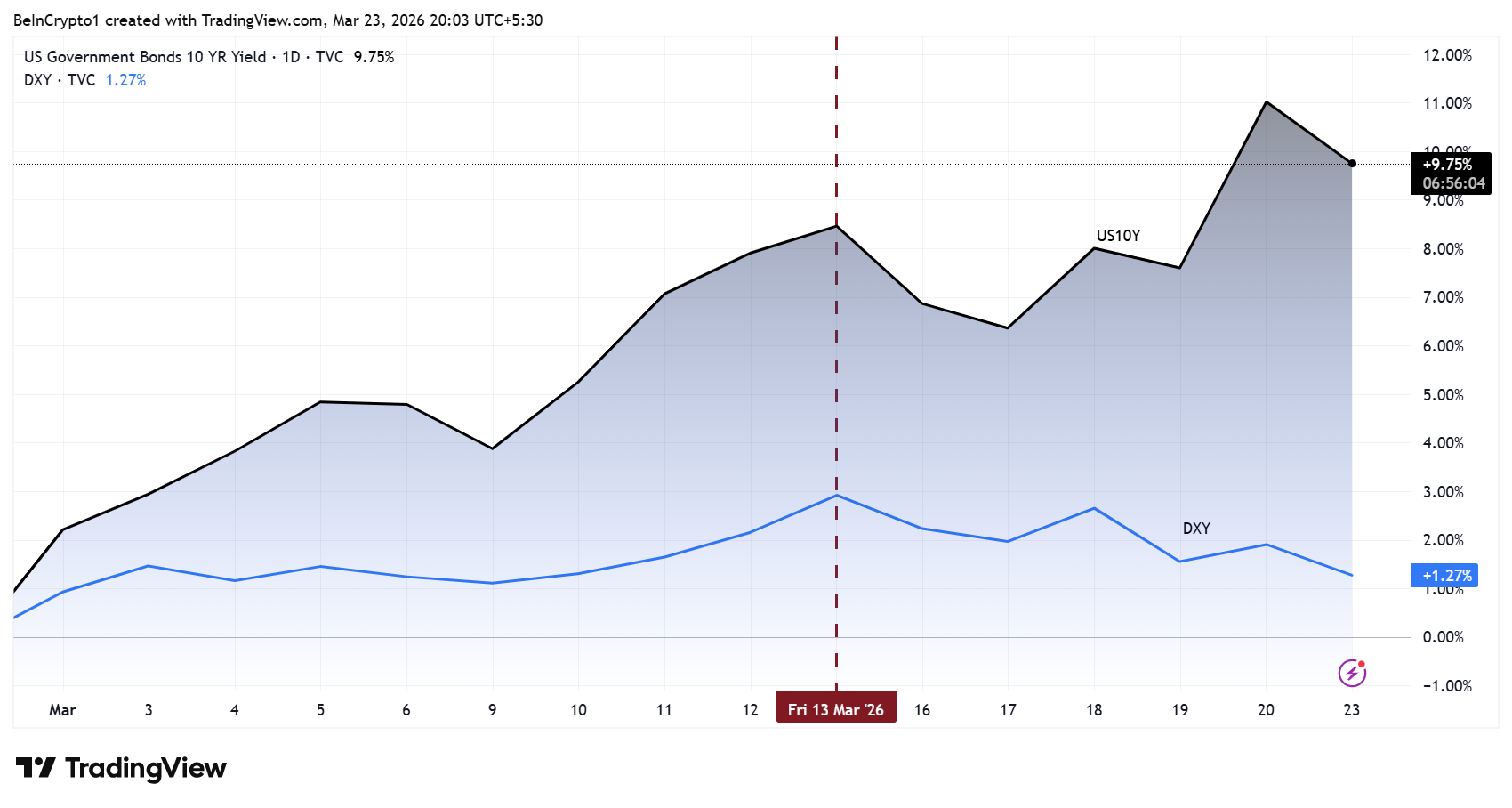
Higher yields also tend to strengthen the US dollar. Capital flows into dollar-denominated Treasuries to capture better returns, pushing the Dollar Index (DXY) higher. Both gold and $BTC are priced globally in dollars.
A firmer dollar makes gold more expensive for non-US buyers and applies similar downward pressure on $BTC. The DXY broke above 100 earlier this month for the first time since late November, illustrating this dynamic in real time.
There is also a discount rate effect. $BTC often trades on expectations of massive future adoption, similar to growth stocks.
- Higher real yields compress the present value of those future expectations.
- Gold is less growth-dependent but still suffers when real yields climb, since rising real returns erode its appeal as an inflation hedge.
However, the two assets do not always move in lockstep. Gold sometimes outperforms $BTC during risk-off episodes because it retains traditional safe-haven demand.
In recent months, gold and silver surged while $BTC bled. If geopolitical tensions ease and the gold trade becomes crowded, capital could rotate toward $BTC as a less saturated allocation.
That rotation depends on whether $BTC’s high correlation with equities finally breaks.
Back in January 2025, Charles Gasparino warned that yields approaching 5% should concern every stock investor. That warning now extends to crypto, where $BTC’s sustained correlation with equities means it absorbs the same macro stress as the Nasdaq and S&P 500.
BREAKING: 10-year yield on the verge of 4.8 percent should have every stock investor worried about a significant selloff. Smart money believes a 5 per yield is both a real possibility and a danger for markets. As I have previously reported, this is not largely Trump-tariff…
— Charles Gasparino (@CGasparino) January 13, 2025
Bond Market Holds the Cards
The situation puts the bond market in the driver’s seat for both policy and asset prices. If yields continue climbing toward 4.5% and beyond, history suggests the administration will face mounting pressure to de-escalate, whether:
- Through diplomatic channels in the Middle East or
- Policy adjustments at home.
Therefore, the watchlist is straightforward for Bitcoin and gold. A yield rollover on de-escalation news or dovish Fed signals could trigger sharp relief rallies across both assets.
Continued acceleration above 4.5%, however, risks deeper drawdowns in $BTC and steeper losses across altcoins.
The 10-year yield forced Trump’s hand once before. The bond market may be preparing to do it again.
The post Can Trump Defy the US10Y Surge or Will Bitcoin and Gold Pay the Price? appeared first on BeInCrypto.