
 beincrypto.com
Gold’s sharpest weekly decline in over four decades is rattling global markets and forcing a rethink of what constitutes a “safe haven” in today’s macro environment.
The precious metal, long viewed as a hedge against uncertainty, has instead become one of the first casualties of a broader liquidity-driven selloff, raising questions about where capital flows next.
Gold’s Collapse Signals a Liquidity-Driven Reset Across Global Markets
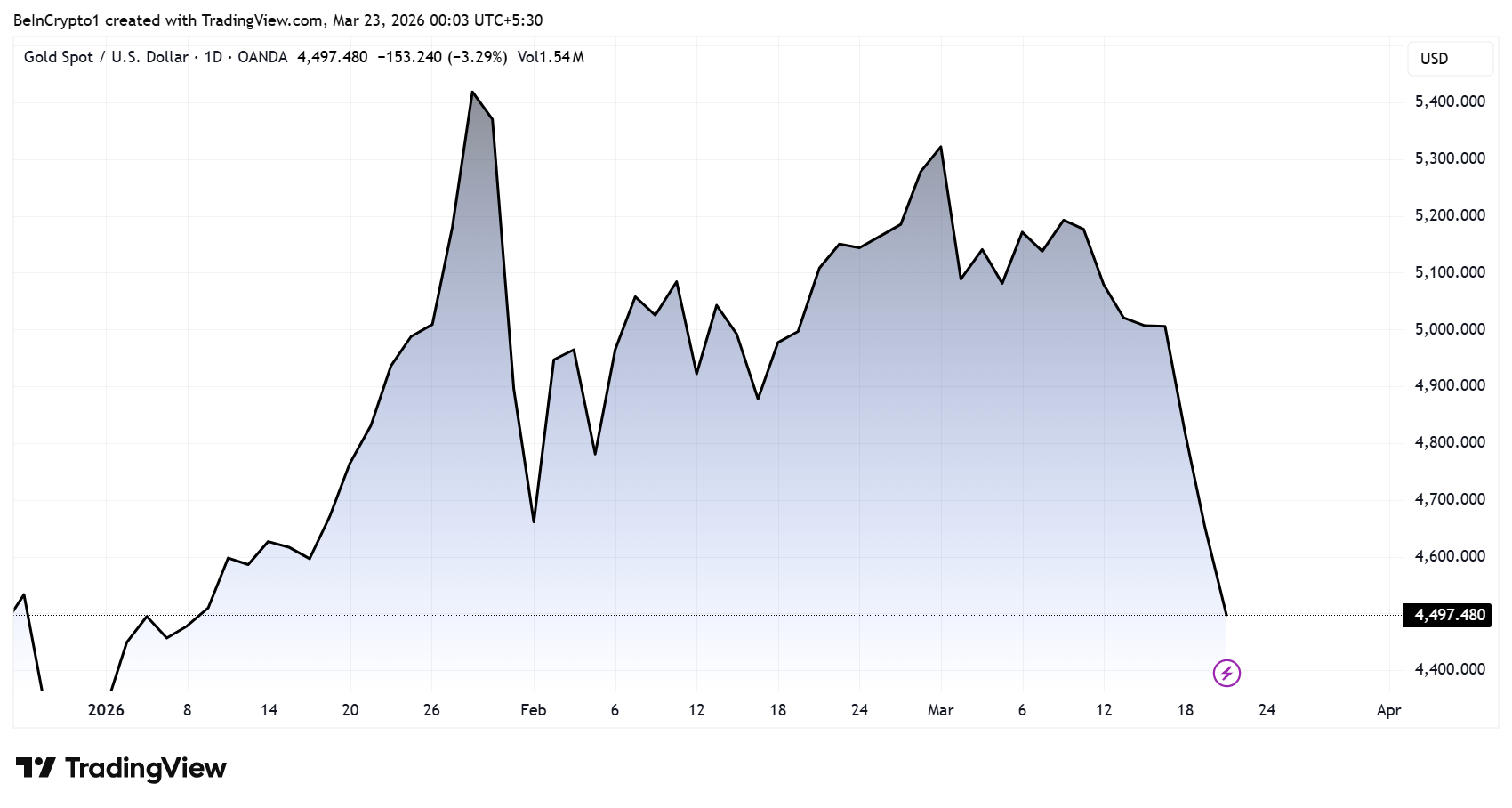
Gold price has suffered its biggest weekly drop in more than 40 years, with the move coming despite ongoing geopolitical tensions.
Ideally, conditions around geopolitical tensions that would typically support prices, suggesting something deeper is happening beneath the surface. Analysts point to an overcrowded trade now unwinding quickly.
“Gold just had its worst week since 1983. During an active war. That’s insane. This was supposed to be gold’s moment. Here’s the logic: Gold at $5,500 wasn’t priced for safety. It was priced for a trade. A very crowded one,” said Nic Puckrin, founder of Coin Bureau.
According to Puckrin, central banks began accumulating gold aggressively after Russia’s assets were frozen in 2022, triggering a wave of buying. This pushed ETF flows to record highs as investors piled into the trade.
However, the dynamic is now reversing. As geopolitical pressures intensify and the war forces central banks to draw down reserves rather than build them, key players, including Gulf oil states facing export constraints, may shift from buyers to sellers.
In this environment, liquidity takes priority over positioning, and when the same institutions that fueled the rally need cash, they are forced to sell the very assets they once accumulated. Puckrin says this explains why gold, as one of the strongest performers in the prior cycle, is now among the first to fall.
The shift reflects a broader market dynamic: when liquidity dries up, even traditional hedges get sold.
$GLD from $5,321 to $4,624 in days.
— Michael A. Gayed, CFA (@leadlagreport) March 22, 2026
That's a $600 drawdown on the "ultimate safe haven."
When everything gets liquidated, nothing is safe.
Not even gold. pic.twitter.com/mxxRMYHyr9
The metal’s quick drop, falling roughly $600 within days, highlights how quickly sentiment can turn in a forced-selling environment.
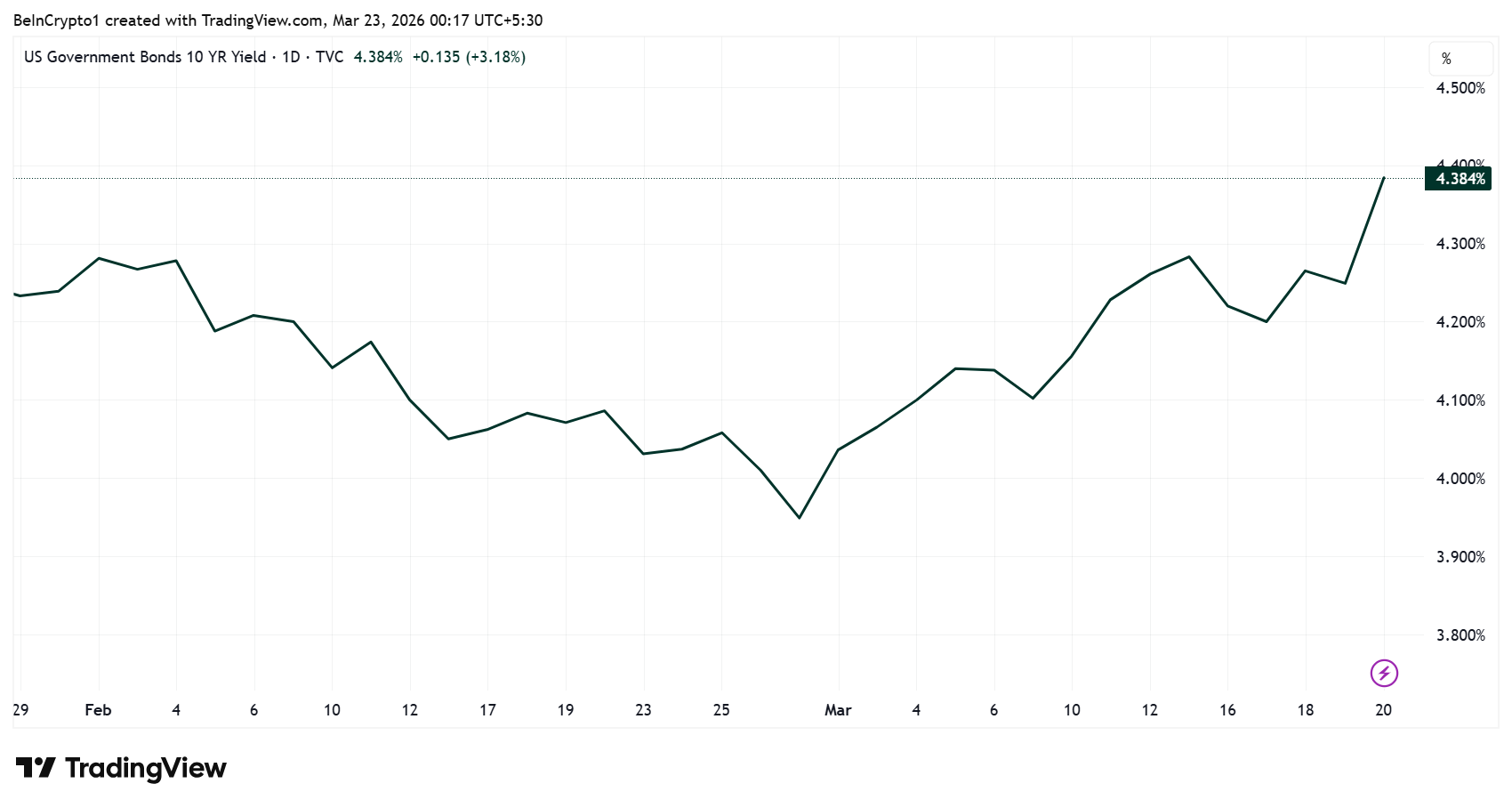
At the center of this stress is the bond market. Yields on US Treasuries have surged in recent weeks, with the 10-year climbing sharply amid inflation fears, hawkish central bank signals, and leveraged unwind pressures.
Analysts warn that further increases could trigger a cascading liquidation across asset classes, forcing institutional investors to quickly reduce risk.
⚠️The biggest elephant in the room IS NOT stocks, it is the bond market:
— Global Markets Investor (@GlobalMktObserv) March 22, 2026
The US 10-year Treasury yield spiked +13 basis points on Friday to 4.38%, the 2nd-largest single-day jump since the April 2025 Liberation Day sell-off.
Since early March, the 10-year yield has surged +45… pic.twitter.com/zYw9AyyBZx
This stress is already visible in sentiment data. According to the Kobeissi Letter, bearish sentiment among retail investors has surged to 52%, the highest since mid-2025.
Bearish Sentiment Peaks as Capital Rotates Toward Alternatives
The deterioration, one of the fastest shifts in recent years, places current conditions in line with prior bear-market extremes.
Against this backdrop, some analysts warn that big money is dumping assets right now, potentially raising cash because something underneath is starting to crack.
🚨 98% OF PEOPLE WILL LOSE EVERYTHING NEXT WEEK
— 0xNobler (@CryptoNobler) March 22, 2026
This won’t be another dip you can “buy.”
This is how people lose everything in hours.
Stocks will dump.
Metals will dump.
Crypto will dump even harder.
If you’re holding any assets today, you MUST know what’s really going on:… pic.twitter.com/mXL4AtTKzL
While such views remain highly speculative, they echo a growing concern that markets are being driven less by fundamentals and more by liquidity constraints. Amid the turmoil, attention is turning to where capital may rotate next.
“Family offices aren’t wasting time with basic stocks and bonds anymore,” stated Jake Claver, a qualified family office professional.
According to Claver, they are moving into private deals, frontier markets, and digital assets. This shift suggests institutional investors are already repositioning for a different return environment.
“That’s where the real returns are hiding,” he noted.
Crypto, in particular, is re-entering the conversation. Chad Steingraber argued that following gold’s decline, “the rotation of capital will begin moving to another asset class,” adding that crypto “remains undervalued.”
—LAW DAY 245—
— Chad Steingraber (@ChadSteingraber) March 22, 2026
Gold has its worst decline in 40 years and the rotation of capital will begin moving to another asset class.
Crypto is the only one that has not had its run and remains undervalued. https://t.co/LR2BOFw3WL pic.twitter.com/IYiDXIFgvy
While still volatile, digital assets are increasingly seen by some as a potential beneficiary once forced selling subsides.
In the meantime, the dominant theme remains liquidity. Markets appear to be in a “sell first, rotate later” phase, where assets are liquidated to raise cash before new trends fully emerge.
Whether this marks the beginning of a deeper systemic reset or simply a sharp repricing cycle remains uncertain.
What is clear, however, is that gold’s historic collapse has broken a key pillar of market psychology, signaling that in today’s environment, no asset is immune when liquidity becomes the priority.
The post Gold Just Had Its Worst Week Since 1983: Here’s Where Smart Money May Go Next appeared first on BeInCrypto.