
 thecryptobasic.com
$XRP has held up better than most “safe haven” alternatives, such as gold and silver, since the Israel-Iran conflict began.
The conflict in the Middle East has dealt a blow to global markets while leading to massive volatility across energy prices. Notably, risk assets like cryptocurrencies often perform poorly compared to traditional “safe haven” alternatives such as gold (XAU) and silver (XAG), as investors pool their funds into more stable options to hedge against the impact of the tension.
However, this time, the reverse seems to be happening. Specifically, $XRP, one of the most volatile crypto assets in the market, has held up better than gold, silver, and the SPX (S&P 500) since the Israel-Iran conflict escalated on Feb. 28.
Key Points
- $XRP has recorded a 2.22% increase since the Israel-Iran conflict began on Feb. 28, as it demonstrates resilience amid the volatile market period.
- While this represents a modest rise compared to $XRP’s capabilities, the figures confirm that the crypto asset has performed better than most “safe haven” alternatives.
- During the same period, gold has increased by just 0.4%, while silver has only recorded a 0.15% rise.
- $XRP has also outperformed the S&P 500 index, which has declined by more than 1% since the conflict started.
- However, data shows the broader crypto market recovery push could be behind $XRP’s resilience, rather than its unique properties.
$XRP’s Volatile Reactions to the Middle Eastern Conflict
Following the joint attack from Israel and the U.S. on Iranian facilities on Feb. 28 and Iran’s subsequent retaliation, global markets went into panic mode, as investors attempted to hedge against what they believed could be a long-lasting escalation.
As a result, the global crypto market cap crashed to a low of $2.16 trillion, with $XRP dropping to a floor of $1.27 that day. Before then, the only time $XRP had seen this low since 2025 was during the market crash of early February. However, after reaching $1.27 on Feb. 28, $XRP and the rest of the crypto market recovered almost immediately.
While this was a positive reaction, it caught investors off guard, as most expected the regional conflict to exert more pressure on crypto prices, especially considering the market’s weak performance since the ongoing downturn began in Q4 2025.
Interestingly, this rebound effort persisted despite facing occasional pullbacks, with $XRP soaring to a high of $1.47 by March 4 before facing resistance. After another pullback, $XRP recovered again this week, rising to $1.4 at press time. From the $1.35 price on Feb. 28, this indicates that $XRP has gained 2.22% since the Israel-Iran conflict started.
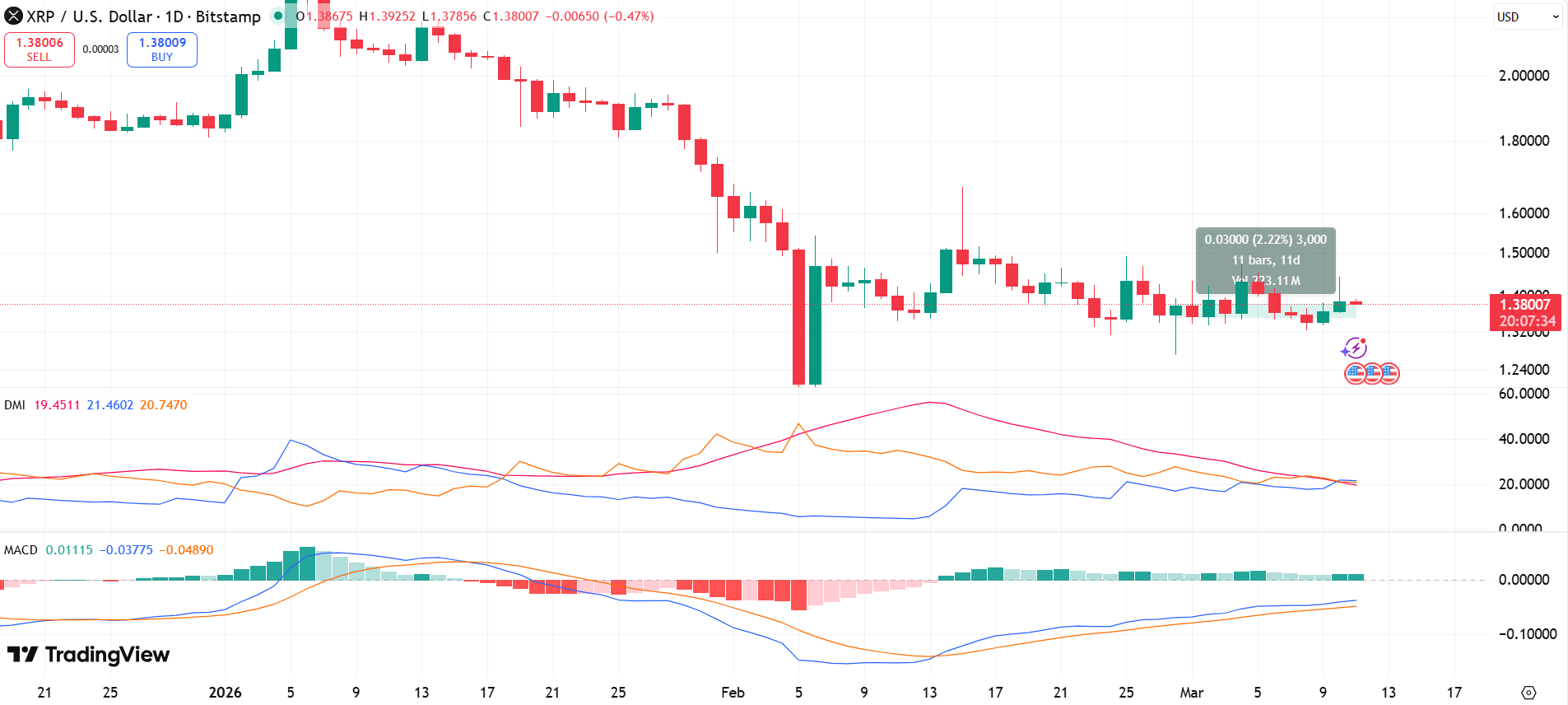
$XRP Holding Better Than Gold, Silver, and S&P 500
While a 2.22% increase over nearly two weeks may seem modest, considering $XRP’s potential to record greater returns, market data shows the altcoin has held up much better than traditional “safe haven” assets such as gold and silver.
Specifically, gold has only increased from $5,182 to $5,204 per ounce since the conflict started, up a meager 0.42%. Meanwhile, silver has risen just 0.16% from $88.13 to $88.27 per ounce during the same period. As for the S&P 500, the U.S. stock index has actually dropped 1.1% to 6,781 points amid the conflict.
Interestingly, U.S. Treasury yields have also seen declines in prices, as highlighted by The Crypto Basic in a recent report. These “safe haven” alternatives seem to be reacting adversely to the conflict in the Middle East, while crypto assets like $XRP have successfully hedged against the impact of the war.
However, $XRP’s performance has little to do with its unique strength and more to do with the broader crypto market’s recovery, led by the Bitcoin (BTC) resurgence. In fact, $XRP seems to be underperforming the rest of the crypto market, which has risen 4.8% since the war started.