
 thecryptobasic.com

An $XRP community figure recently suggested that Coinbase’s lower $XRP reserves mean modest inflows could push prices higher.
$XRP has dropped 25% this year to $1.37 amid a broader market downturn, and community commentators have been searching for recovery catalysts. One of those individuals, game designer Chad Steingraber, recently argued that small inflows into Coinbase could move $XRP’s price due to the exchange’s limited $XRP reserves.
Key Points
- Amid $XRP’s ongoing downturn, Steingraber argued that Coinbase’s lower supply means modest inflows could help push prices higher.
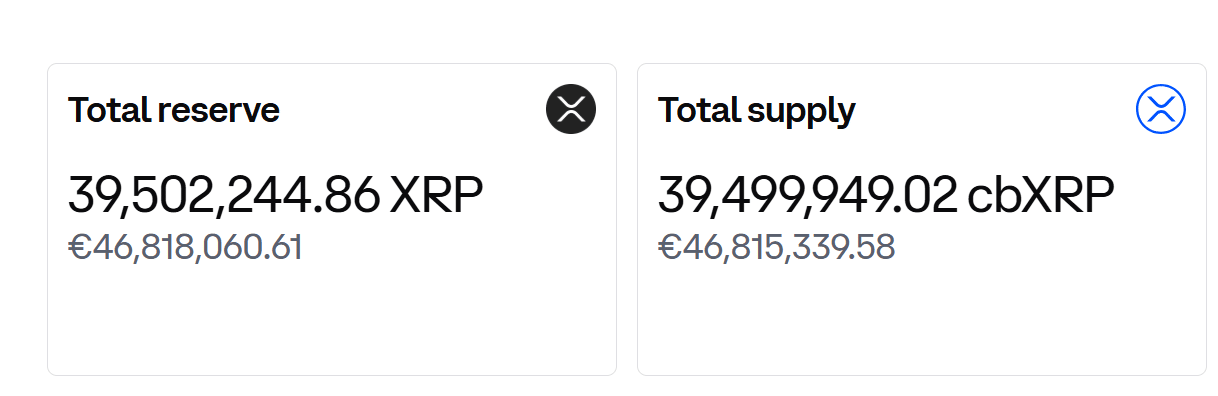
- Steingraber’s data suggested Coinbase held just over 3 million $XRP in reserve, but Coinbase’s own proof-of-reserves disclosure puts the figure significantly higher at 39.5 million $XRP tokens.
- While thin order books can genuinely drive short-term price movement on an individual exchange, $XRP trades across platforms holding over 16 billion tokens, and any single-exchange price move would be short-lived.
- Exchange inflows typically signal selling pressure, not buying pressure, meaning Steingraber’s bullish interpretation of Coinbase inflows is against conventional market analysis.
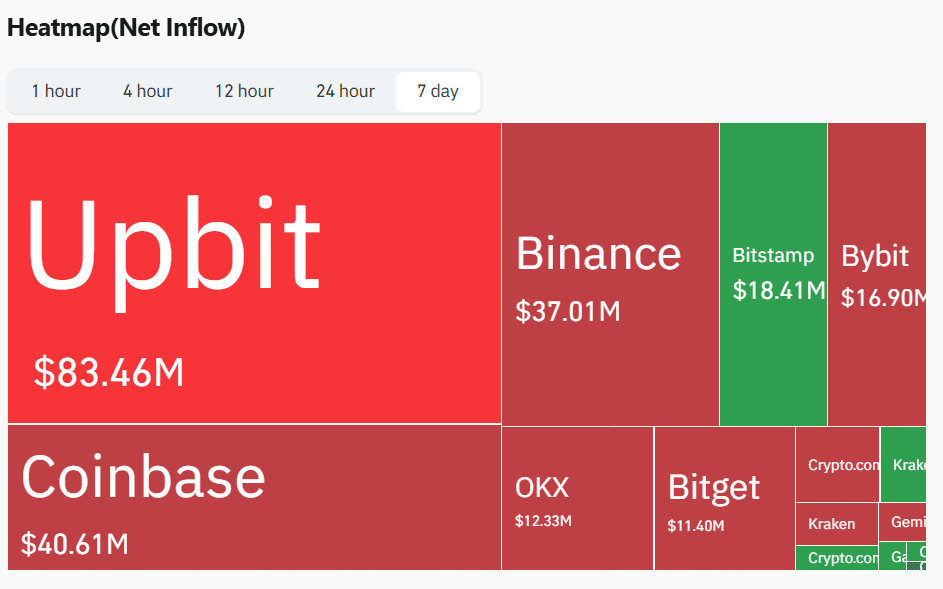
- Over the past week, Coinbase recorded $40.61 million in $XRP outflows, joining Upbit’s $83.46 million and Binance’s $37.01 million in outflows.
Can Modest $XRP Inflows on Coinbase Push Prices Higher?
Chad Steingraber shared his opinions during a recent commentary on X. He suggested that even modest inflows of $XRP into Coinbase could be enough to push the token’s price higher. The pundit based his argument on what he claimed was a thin $XRP supply on the platform.
He argued that because Coinbase does not hold a large volume of $XRP, it would not take an enormous wave of buying pressure to produce a noticeable price shift. From his assessment, when just the right amount of capital starts flowing in, the $XRP price could respond with a quick upthrust.
Steingraber presented this argument while citing data from Coinglass, a market analytics platform, which showed approximately $631,000 worth of $XRP flowing into Coinbase across a four-hour window.
Also, further data from him suggested that Coinbase held just over 3 million $XRP in reserve at the time. However, this contrasts with Coinbase’s own proof-of-reserves disclosure, which places the figure at a considerably larger 39.5 million $XRP tokens.
How Thin Order Books Can Influence Price Movements
While Steingraber’s theory is in the right direction, there are important caveats to note. Every exchange operates through an order book. When a market buy order comes in, it works through available sell orders from the lowest price upward.
If sell orders near the current price are scarce, a single large buy can cut through the available supply, pushing the price up through several levels in a short period.
For instance, if only 800,000 $XRP worth of sell orders sit between $1.00 and $1.02, a market purchase of 600,000 $XRP could sweep through most of the liquidity and send the price higher. This is the condition traders refer to as thin liquidity or low market depth.
In this sense, Steingraber’s reasoning is in the right direction. Specifically, if Coinbase’s $XRP order books are as lean as he claimed, a comparatively modest inflow could determine $XRP’s price action on that platform.
Why Coinbase May Not Be Able to Influence $XRP Price Globally
However, $XRP does not trade exclusively on one platform, as it also runs on dozens of major exchanges worldwide, including Binance, Upbit, Kraken, and Bitstamp, many of which hold far greater volumes of $XRP than Coinbase.
Across all centralized exchanges combined, total $XRP holdings exceed 16 billion tokens. This makes it very difficult for a single exchange, however thinly stocked, to drive the global $XRP price in any sustained way.
The moment a price discrepancy opens up between Coinbase and a competing platform, arbitrage traders move almost immediately to buy where the price is lower and sell where it has risen, closing the gap within seconds.
Exchange Inflows Different from Order Book Activity
Moreover, exchange inflows and order book activity are different concepts in market structure, and treating them as equivalent can produce misleading conclusions. Steingraber highlighted deposits into the Coinbase exchange.
When a trader deposits $XRP into an exchange, the most common motivation is to sell it or make it available for trading, which adds to the platform’s potential selling pressure rather than its buying pressure.
As a result, market analysts often read large inflows as a bearish signal rather than a bullish one. Simply depositing tokens onto an exchange does nothing to shift the order book or generate buying pressure unless the depositor subsequently places an actual trade.
$XRP Seeing Outflows Across Exchanges
Meanwhile, $XRP has continued to see outflows across exchanges over the past week, a trend most analysts believe could be bullish for its price action.
Specifically, Upbit recorded $83.46 million in $XRP outflows during this period, while Binance saw $37.01 million leave its platform, and Coinbase itself logged $40.61 million in $XRP outflows. Only Bitstamp recorded $18.41 million in $XRP inflows over the same window.
Market analysts generally interpret sustained exchange outflows as a bullish signal for price, since tokens moving off exchanges typically indicate that holders are transferring them into cold storage rather than positioning to sell.