
 thecryptobasic.com
Cardano remains one of the largest digital assets by market capitalization, yet questions persist about the rate of its actual network activity.
According to CoinMarketCap, Cardano ($ADA) ranks 10th by market cap, with a valuation of $9.18 billion. Despite this, some believe the ecosystem surrounding the blockchain has developed more slowly than many competing platforms, raising questions about whether its market position reflects strong usage or primarily speculative interest.
Key Points
- Cardano remains one of the largest digital assets by market capitalization, yet questions persist about the extent of actual network activity.
- Analysis cited the meager amount of capital locked in DeFi applications on the network, compared to major competitors, as a reason Cardano is considered useless.
- The total value locked across Cardano’s DeFi protocols has historically remained below $1 billion, which is a small fraction of Ethereum and Solana.
- Another factor is the pace at which the platform introduces new capabilities, as it took it 4 years to integrate smart contract functionalities.
- Technically, the $0.245 region is an important area to monitor for Cardano, and a break below it paves the way for a steeper decline.
Cardano “Dead Chain” Narrative Remerges
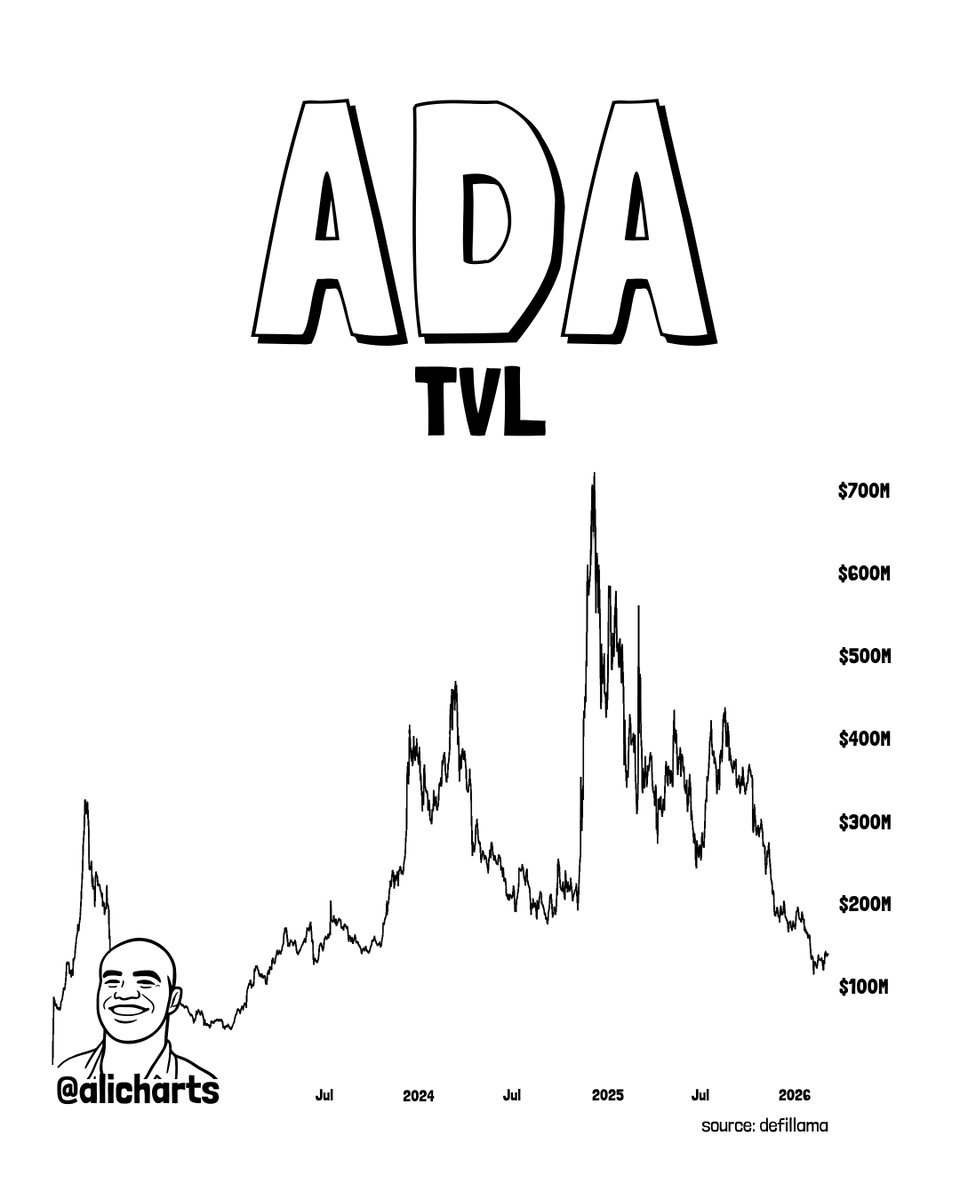
Prominent market analyst Ali Martinez resurrected this argument in an X post over the weekend, where he branded Cardano the “most useless network” in the digital asset market. Notably, one of the indicators he cited for this sentiment is the amount of capital locked within decentralized finance (DeFi) applications on the network.
According to him, the total value locked across Cardano’s DeFi protocols has historically remained below $1 billion. In contrast, other major platforms have attracted significantly more liquidity and application activity. Even newer blockchains, such as the Sui Network, have already reached higher levels of on-chain activity in a relatively short period.
Is $ADA Driven by Speculation?
Martinez highlighted that when a blockchain holds a multi-billion-dollar valuation but relatively small amounts of capital circulate within its ecosystem, the price reflects speculative drive rather than widespread adoption. In the case of Cardano, critics argue that the number of active decentralized applications and the overall level of user engagement remain modest compared with some of its competitors.
For context, platforms such as Ethereum have established a strong presence in decentralized finance, while Solana has gained traction through high-speed, consumer-focused applications and large developer communities. These networks have built ecosystems that continually attract developers, liquidity, and users, reinforcing their market position through sustained activity.
By comparison, Cardano has struggled to establish a single dominant sector that consistently drives adoption. Martinez suggested that although the ecosystem is large in valuation and receives support from its community, the overall scale of applications and liquidity across the network remains meager.
Development Pace and Competition Shape the Outlook
Another factor Martinez highlighted is the pace at which the platform introduces new capabilities. Notably, Cardano follows a research-focused development model that emphasizes academic review and formal verification before releasing major updates.
Proponents argue that this approach can strengthen long-term reliability and security. However, critics note that the process has also slowed the introduction of features compared with other blockchain ecosystems.
Although Cardano launched in 2017, the network did not introduce smart contract functionality until 2021. Prior to the debut, competing platforms had expanded rapidly, establishing detailed DeFi applications, liquidity pools, and developer communities.
Interestingly, founder Charles Hoskinson has repeatedly mentioned this as one of the mistakes Cardano made in its growth roadmap. Because digital asset platforms often benefit from early network scaling, ecosystems that build first tend to continue attracting new participants.
Proponents Disagree
Meanwhile, Cardano proponents do not agree with Martinez’s analysis. One notable argument highlighted that $ADA has maintained its status quo not because of speculation but for safety reasons.
The user emphasized that the network has never experienced a breach or hack, making it trusted by many. The rewards for staking $ADA are also low risk, offering users a stable means of earning passive income. He added that holding the coin in some countries minimizes taxes. In conclusion, each blockchain has its strengths and weaknesses; hence, judging Cardano from a standpoint alone was biased.
Others also highlighted its fixed supply and non-inflationary model as a strength. With the concept of Cardano serving as a DeFi bridge for Bitcoin strengthening, supporters expressed confidence in an impending influx of new users.
Cardano Technical Analysis
From a market perspective, Martinez noted that price behavior remains closely tied to key support levels. He identified the $0.245 region as an important area to monitor for Cardano. If the asset were to fall decisively below that level, it could expose deeper historical zones near $0.112 and potentially $0.051.
For now, that support remains intact, meaning the market has not confirmed a further breakdown. At the time of writing, it trades at $0.256, up 2% in the past 24 hours.