
 beincrypto.com
The probability of a US recession in 2026 is rising on prediction markets as oil prices climb and geopolitical tensions intensify.
The ongoing US-Israel-Iran conflict has rattled global markets, with risk assets, from stocks to cryptocurrencies, facing mounting pressure as investors turn increasingly defensive. This has raised concerns about whether the US economy can absorb the impact without contracting.
Prediction Markets Signal Growing US Recession Concerns in 2026
On Polymarket, traders are pricing the probability of a US recession by the end of 2026 at approximately 40%. The market resolves to “Yes” if the US records two consecutive quarters of negative real GDP growth between Q2 2025 and Q4 2026, according to the Bureau of Economic Analysis, or if the National Bureau of Economic Research officially declares a recession.
Follow us on X to get the latest news as it happens
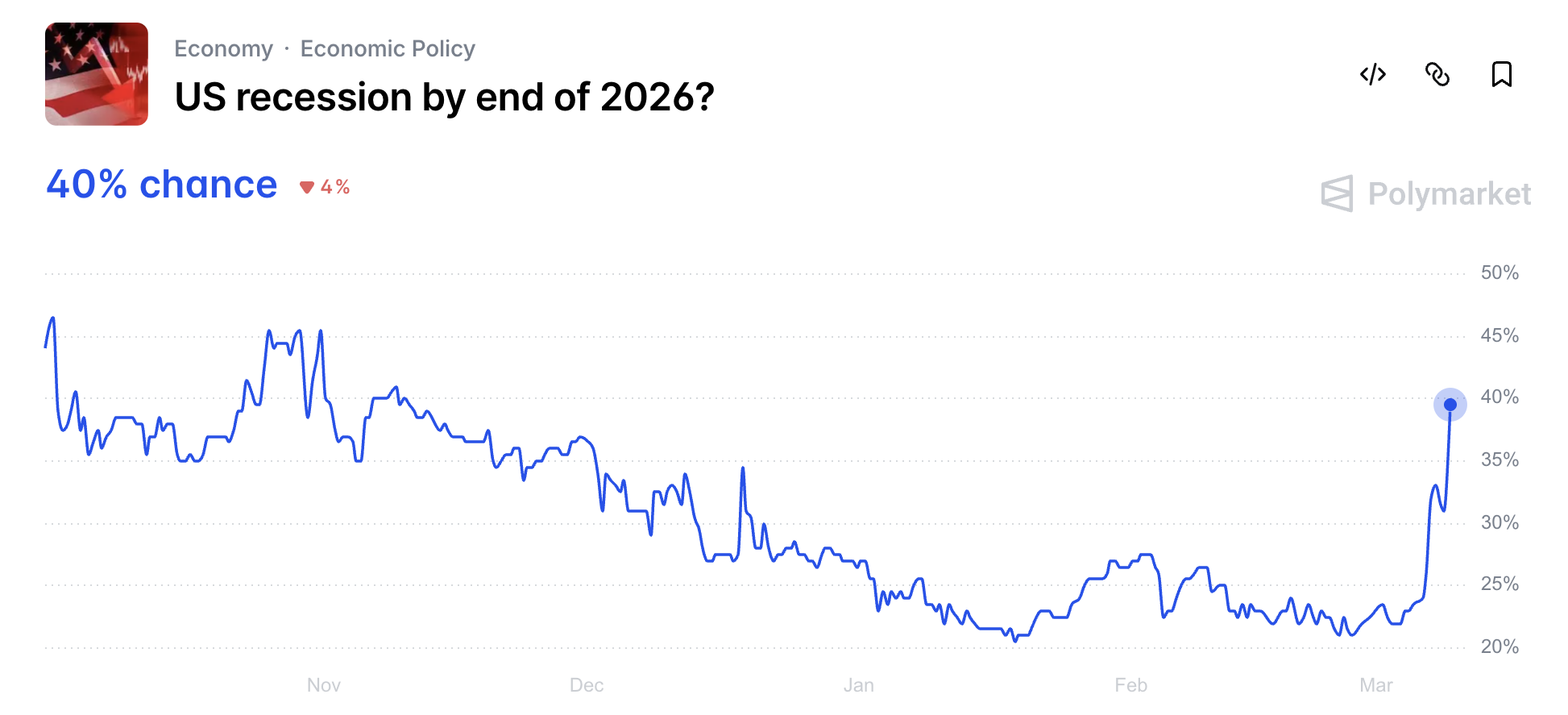
Kalshi’s “Recession this year?” market sets recession risk at about 36%. It also resolves if the US records two consecutive quarters of negative GDP growth in 2025 or 2026.
The odds on both platforms have surged in recent weeks, reflecting a broad repricing of US economic risk. The jump coincides with the escalation of the US-Israel-Iran conflict, which has directly disrupted global energy supply chains.
BeInCrypto reported that oil prices crossed $100 a barrel for the first time in nearly four years. The price surge is driven by production cuts from major Middle Eastern producers, the closure of the Strait of Hormuz, and concerns about further escalation of the ongoing conflict.
Rising oil prices have amplified concerns about a potential recession.
“Soaring oil prices won’t cause higher inflation. They will cause a recession. It’s the fiscal and monetary policies that will follow soaring oil prices that will cause higher inflation,” Economist Peter Schiff wrote.
'73-'74 recession and bear market (worst one since 1929 at the time) and the '90 recession and bear market were both caused by an accelerated rise in oil prices.
— Ted Zhang (@TedHZhang) March 6, 2026
Crude Oil breaking out of a 4 year range. pic.twitter.com/dru62SlKoU
Labor Market Deterioration Triggers Warning Signals
The pressure is not confined to energy markets. Stress signals are emerging across labor markets. According to the Bureau of Labor Statistics, nonfarm payrolls dropped by 92,000 in February.
The unemployment rate rose to 4.4%. Notably, this is the third payroll decline in five months.
The US lost an average of 1k jobs per month over the last 6 months, the 4th of the last 5 months with a negative 6-month moving average. This is the 12th time we've seen this much weakness in the jobs market since 1950. In the 11 previous times the US economy was in a recession. pic.twitter.com/j38Fqb7dls
— Charlie Bilello (@charliebilello) March 6, 2026
Market analyst Henrik Zeberg added a technical dimension to the macro concern. His business cycle model’s Coincident Indicator (COI) has signaled “Recession Imminent.”
“The previous 5 times it has flashed – a Recession began within 1-3 months – however only recognized 9-12 months later by NBER,” he said. “The Economy is not in Recession at this point. We need to await the signal from the short-term “Imminent Recession Indicators”. But – we are getting very close!”
Labor and macroeconomic weakness are joined by stress in private credit markets. BlackRock has capped withdrawals in its $26 billion private credit fund.
In addition, Blue Owl has halted quarterly redemptions on its Blue Owl Capital Corp II (OBDC II), instead choosing to distribute cash through periodic payments tied to asset sales. The moves come amid rising withdrawal pressures.
Against this backdrop, hedging activity picked up sharply. Put options on four major US credit ETFs reached a record 11.5 million contracts earlier this month. Moreover, the S&P 500’s 1-month put-call skew jumped to around 0.53, its highest level since the 2022 bear market.
The combination of weakening employment, flashing macro indicators, and market stress is now a major challenge for policymakers. As prediction markets adjust recession odds, the time ahead will show whether warning signals turn into real economic contraction.
The post US Recession Odds Surge on Prediction Markets: Here’s What’s Driving It appeared first on BeInCrypto.