
 coinfomania.com
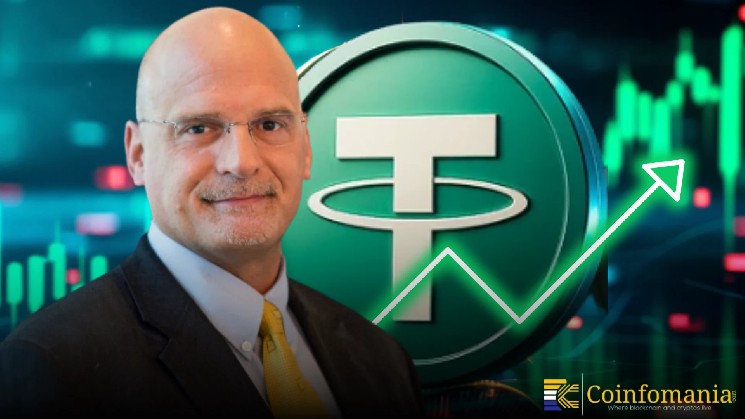
The cryptocurrency market never stands still. Every cycle brings new leaders, fresh narratives, and unexpected shifts in power. Now, a bold forecast has reignited debate across the industry. Bloomberg Intelligence analyst Mike McGlone believes the $USDT stablecoin could eventually surpass both Bitcoin and Ethereum in overall market dominance.
This prediction does not revolve around hype or speculative rallies. Instead, it reflects deeper structural changes shaping crypto market trends. McGlone argues that stable assets tied to the US dollar may gain stronger traction as investors seek safety, liquidity, and global access. His outlook positions the $USDT stablecoin as a potential long-term leader rather than a supporting player.
Such a scenario would mark a historic turning point. For over a decade, Bitcoin and Ethereum have defined the industry’s hierarchy. If stablecoin dominance rises above them, the meaning of leadership in crypto could fundamentally change.
LATEST: ⚡ Bloomberg analyst Mike McGlone says Tether's $USDT stablecoin is on track to eventually flippen both Ethereum and Bitcoin. pic.twitter.com/kiAbF30dbb
— CoinMarketCap (@CoinMarketCap) February 13, 2026
Why The $USDT Stablecoin Continues To Expand Globally
The $USDT stablecoin operates differently from traditional cryptocurrencies. Tether issues $USDT as a dollar-pegged digital asset. Each token aims to maintain a one-to-one value with the US dollar. This stability attracts traders, institutions, and emerging market users alike.
Many participants rely on $USDT for liquidity. Traders park funds in it during volatility. Exchanges use it as a primary trading pair. Cross-border users leverage it to move value instantly. These functions strengthen stablecoin dominance in daily activity.
Unlike Bitcoin and Ethereum, $USDT does not depend on price appreciation for relevance. Instead, its strength lies in usage. The more people transact with it, the larger its footprint becomes. That utility-driven growth aligns closely with current crypto market trends.
The Shift From Speculation To Stability
Bitcoin and Ethereum built their reputations on innovation and scarcity. Bitcoin represents digital gold. Ethereum powers decentralized applications and smart contracts. However, market cycles often expose their volatility. Sharp drawdowns push investors toward safer alternatives.
The $USDT stablecoin benefits during uncertainty. Investors convert holdings into $USDT when markets fall. Institutions prefer stable pricing for settlement. In regions facing currency instability, people use stablecoins as dollar substitutes.
Can Stablecoin Dominance Truly Surpass Bitcoin And Ethereum
Today, Bitcoin and Ethereum maintain higher market capitalizations than the $USDT stablecoin. However, market leadership shifts across cycles. If stablecoins capture increasing transaction volume and institutional reliance, their capitalization could expand significantly.
Stablecoin dominance already reflects rising demand. $USDT frequently ranks among the highest daily traded assets. Its liquidity often exceeds that of individual cryptocurrencies. These metrics signal growing structural importance.
If global finance integrates digital dollars more deeply, the $USDT stablecoin could scale further. Governments debate digital currencies. Payment systems explore blockchain rails. Stablecoins stand at the center of these developments. That strategic positioning strengthens McGlone’s thesis.
How Crypto Market Trends Support This Narrative
Several crypto market trends favor stablecoins. First, regulatory clarity increasingly targets stable assets rather than volatile tokens. Policymakers view dollar-backed coins as more predictable instruments. That perception encourages institutional engagement.
Second, decentralized finance relies heavily on stablecoins. Lending platforms, derivatives markets, and yield protocols use $USDT as collateral. This foundational role embeds it deeply into crypto infrastructure.
Third, global remittance demand continues to rise. Users in developing economies value instant dollar access. The $USDT stablecoin provides speed, accessibility, and familiarity. These factors fuel long-term expansion beyond speculative cycles.
The Bigger Picture For The Digital Asset Economy
McGlone’s perspective underscores a broader shift. Crypto no longer revolves solely around decentralization ideals. It increasingly integrates with traditional finance. Stablecoins bridge that gap efficiently.
Stablecoin dominance reflects maturation. It signals growing practical use rather than speculative frenzy. If this trajectory holds, the $USDT stablecoin may symbolize the next phase of digital finance.
Whether it ultimately surpasses Bitcoin and Ethereum remains uncertain. Yet the conversation itself highlights a turning point. Crypto leadership may soon reflect stability and scale rather than volatility and vision alone.