
 cryptopolitan.com

Robinhood, one of the largest commission free mobile trading platforms that lets users buy and sell stocks, options, ETFs and cryptocurrencies is seeing its stock plummet over the past few weeks. Year to date, Robinhood stock (HOOD) is down -25% leaving investors befuddled. The recent drop, however, is a result of a combination of earnings expectations, slowing crypto activity, regulatory uncertainty and an overall shift in market sentiment toward trading driven fintech companies.
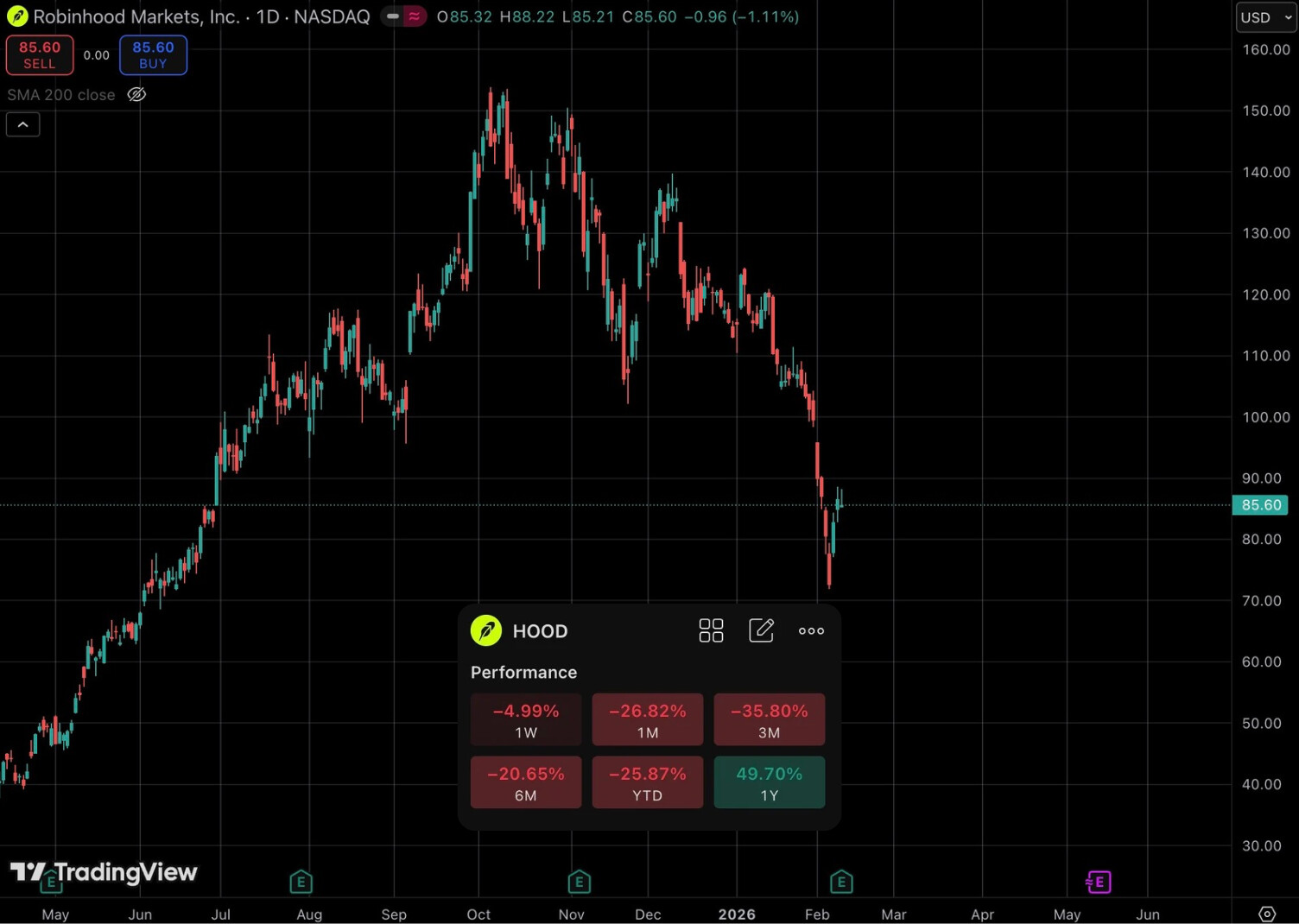
The latest earning results clearly show this gap between growth and expectation. Despite reporting record revenue growth in Q4, it still disappointed analysts at Wall Street after missing forecasts. The slowdown has largely come from a decline in crypto trading volumes which was once a powerful growth engine for the platform.
The real question that most investors are grappling with at the moment is whether the company’s long term expansion story matters more than the short term pressures hitting its core business. To answer this question, it’s important to understand the different structural concerns and cyclical factors that are currently being a detriment to Robinhood’s stock.
Earning Expectations and Revenue Pressures
While the crypto markets have experienced a volatile period since Q4, specifically since the liquidation cascades of October 10th, global markets including U.S. indices have also felt higher degrees of volatility during this period. A combination of geopolitical tensions, news around an AI bubble brewing and recently, the potential of a hawkish Fed chair with the appointment of Kevin Warsh which could have a direct impact on future interest rate decisions, have all triggered uncertainty across markets.
The reality of why Robinhood is seeing such a steep sell off since posting an all time high in October is actually quite simple to understand. Robinhood’s revenue is deeply intertwined and influenced by market activity. In other words, when transactions and trading volumes are strong, the business can grow quickly. Conversely, when activity cools, revenue becomes a lot more unpredictable.
The fact is even though markets have experienced a volatile backdrop, equities and options trading rose on the platform, but overall results still fell short of revenue expectations of $1.34 billion. What did swing the pendulum here was crypto activity. Reports show that cryptocurrency transaction revenue fell sharply with quarterly revenue coming in at $221 million and missing analysts’ expectations $248 million. This matters because crypto trading has historically acted as a major growth engine during bull markets. However, this slowdown has reminded investors of just how cyclical Robinhood’s revenue can be, driving the shift in sentiment toward the stock.
At the same time, interest income has quietly become a huge stabilizer for the business. Net interest rose sharply by 39% year-over-year to $411 million as the company earned more from customer cash balances, margin loans and securities lending. It’s important to note here that this actually creates a new dynamic. As net interest revenue becomes a bigger part of the business, a bigger chunk of its profits now depends on where interest rates go.
Regulatory and Policy Overhang
Another dynamic at play for Robinhood’s stock valuation is the presence of regulatory and policy uncertainty toward the trading platform. Scrutiny from regulators around investor protection, disclosures and compliance remains a constant for trading apps. In 2025 alone, Robinhood agreed to pay $45 million in SEC penalties for multiple securities-law violations which included reporting failures and gaps in compliance. Ongoing investigations and regulatory actions highlight a simple reality for Robinhood stock investors in that this is still a heavily monitored business operating in a constantly changing policy environment.
Another practice that has garnered stern questions from regulators is the payment for order flow (PFOF) practice. Questions around conflicts of interest continue to come up with regulators exploring a potential rule change or tighter oversight. Ultimately, any regulatory shift that can introduce new rules acts as a persistent headwind for Robinhood. Therefore, even when the company executes well operationally, policy uncertainty can cap investor enthusiasm.
Crypto Exposure Adding Volatility
The crypto market has witnessed structural reset to the downside ever since peaking in October last year. Sentiment in the crypto market is currently the weakest it has been since the 2022 bear market lows and search trends reveal that retail interest has been waning as well. Crypto trading on Robihood has become a meaningful revenue contributor, however the swings in crypto directly translates to volume on the platform and thereby the pace of revenue growth. This link reinforces the perception that the stock is increasingly tied to how crypto moves and is in tandem with the overall performance of the broader digital asset market.
Broader Fintech and Market Sentiment
Robinhood’s stock decline is happening at a time when there is a noticeable change in sentiment toward growth and fintech stocks. The tech sector has faced increasing pressure as investors reassess valuations, rising economic uncertainty, and the pace of returns from heavy AI spending. Recent market volatility and a wider tech selloff highlight how risk appetite has cooled, particularly for companies seen as high-growth or sentiment-driven.
Expectations around future interest-rates are another crucial factor shaping sentiment. The appointment of Kevin Warsh as the new Fed chair and his hawkish reputation has further added to this narrative. As markets price in the possibility of a tighter monetary policy and a slowing economy, investors are increasingly rotating toward safer and more predictable businesses.
The risk-off sentiment is particularly coming down hard on fintech platforms where growth trajectories depend a lot on retail participation, market trends and trading activity. In this sort of backdrop, the decline in Robinhood’s stock reflects not just company-specific concerns but a broader recalibration of how investors view retail-focused, growth-oriented financial platforms.
When it comes to Robinhood’s crypto vertical and ambitions, there seems to be no signs of slowing down despite the recent sharp drop in the crypto markets.
The Robinhood Chain public testnet is live 🛠️
— Robinhood (@RobinhoodApp) February 11, 2026
Developers can now build on a financial-grade Ethereum Layer 2 built on @arbitrum— designed to support tokenized real-world and digital assets.
Start building with the core foundation of Robinhood Chain: https://t.co/yHCQRh5x3j…
Today’s announcement on the launch of its own chain, an Ethereum layer 2 built on Arbitrum to bring tokenized assets, 24/7 trading and deeper integration between TradFi and DeFi shows their long-term crypto strategy. For investors, on the face of shifting sentiment, this is a clear indication that the company is doubling down on its efforts to invest in the next phase of its growth story.