The decision was linked with reports of spamming and low-quality interaction. X leadership referred to incentive-based posting as one of the contributors to reply spam and automated content, and the API action was meant to eliminate the financial incentive behind the behaviors.
InfoFi projects were typically based on robotic gathering of X activity posts, reactions, likes, and other indicators of interaction - as such platforms could verify conduct and issue rewards. As soon as automated tracking is not reliable anymore or banned, the reward loop fails apps will be unable to verify activity at scale, run transparent leaderboards demonstrating who won what. That organizational problem is why tokens declined soon after the API crackdown story was adopted.
That reasoning appeared in commentary on the market also near the industry. Not only were traders responding to the sentiment of fear, but to a shift in the general premises of how those systems worked on a daily basis.
InfoFi vs leaderboards are dead
The response on X was divided into two camps. One camp believed that the model is not viable without platform native rewards and automatic access to data. The posts made after the crackdown said that InfoFi was basically based on mindshare harvesting of X, and APIs as the engine that enabled tracking and distribution, so disabling the engine destroyed the category of product as it was known.
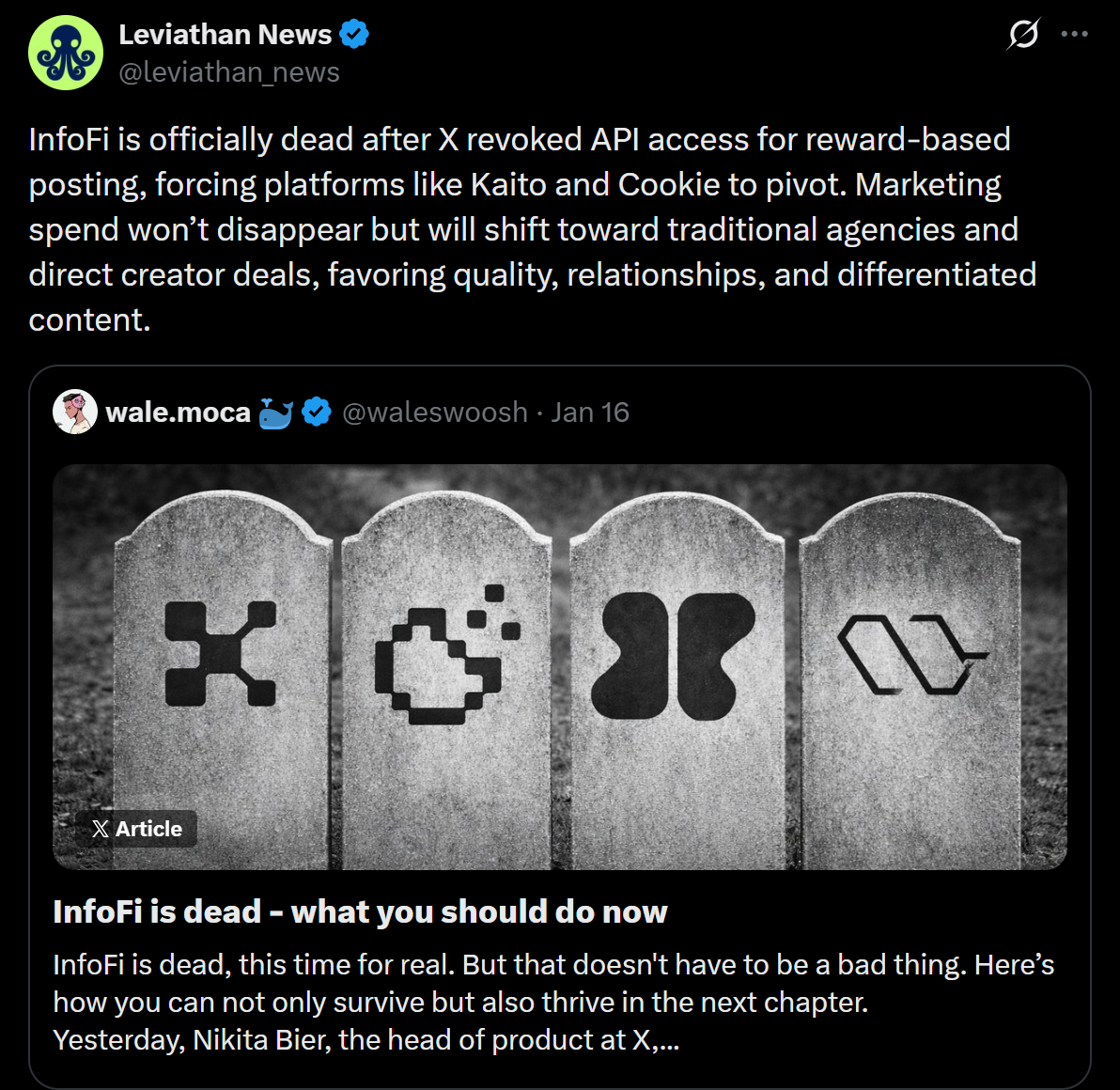
A more limited perspective was held by another camp, the disappearance of public leaderboards does not necessarily mean the decline of demand on social data and social listening. Within that perspective, although open farming mechanics are being nuked, it is possible to sell data feeds and analytics to users who desire greater market insight out of social chatter but without the same reward-intensive, gamified package.
This latter view also indicates that the crackdown can change the competition towards the quality of products. When rewards cease to subsidize attention, websites might need to keep users with superior analytics, superior filtering, and superior delivery of insight. Other commentators interpreted it as an experiment in real-life, whereby teams of different kinds created long-lasting tooling or those teams did not need to be offered much in terms of incentives to keep the people moving.
The next thing $KAITO and other projects claim to do
The answer by Kaito, as reported by a number of publications, was to close or phase out its incentive and leaderboard program and switch to a different product orientation dubbed Kaito Studio. It is said that Kaito Studio is a more selective, leveled approach to pairing brands with creators and going beyond one social platform, including a future program of covering spots such as YouTube and Tik Tok.
It is that pivot, which transforms the project into a post-to-earn on X, into a more expansive creator delivery and promotion workflow, where rewards, in the potential event, are not on the basis of public leaderboards, but on the basis of selective partnerships and cross-platform measurement.
Projects related to InfoFi, such as Cooki,e attracted the same questions. It was reported that reward campaigns were shutting down and that the trend was moving to enterprise analytics products as opposed to open incentive programs, where teams were attempting to retain some of their business that does not need permissionless reward checking on X.
The concise response to the market is not like its original mindshare mining, not on X at least, where there are open incentives. The decision made by X addresses the specific feedback loop that has brought InfoFi into the public view of automated tracking, public leaderboards and rewarding engagement in terms of tokens. Nevertheless, some of the three larger thesis can be repackaged.
Analytics-first social listening summarization, sentiment, narrative, and trending data tools can continue to generate paying customers, particularly when they ingest compliant data feeds or have partnerships or multi-platform feeds instead of single APIs.
Privatized or managed incentives may be taken to back rooms, which are less open, more selective and more difficult to harvest in case the teams are more concerned about maintaining the quality and retention rather than participation.
Cross-platform measurement projects can seek to decrease reliance on X by ensuring other networks are available and construct blended datasets, but this would also come with additional technical and compliance challenges.

 cryptonews.net