The downtrend shows traders withdrawing cash from the crypto market, a trend that coincides with institutions pulling billions out of U.S.-listed spot bitcoin exchange-traded funds.
Stablecoins like $USDT and $USDC, tied to the U.S. dollar, act as an easy door for regular money to flow into digital assets, funding crypto buys and DeFi yield plays, but now that's reversing. Think of these like casino chips.You swap regular cash (fiat) for chips before hitting the gaming floor, play your games, then cash out whatever chips you have left back to dollars when you're done and head home.
"Money is leaving crypto instead of waiting on the sidelines: Normally, when traders sell Bitcoin or altcoins, that money stays in crypto as stablecoins. A falling stablecoin market cap shows that many investors are cashing out to fiat instead of preparing to buy dips," blockchain analytics firm Santiment said in an explainer post on X.
The firm added that the dwindling stablecoin supply raises questions about the sustainability of market gains, especially in alternative cryptocurrencies.
"Stablecoins are the main source of liquidity used to buy crypto. When their supply drops, there is less capital available to quickly push prices back up, making rebounds weaker or slower," it noted.
In short, shrinking stablecoin supply could hinder the price rebound of bitcoin and other cryptocurrencies. Bitcoin, the leading cryptocurrency by market value, has bounced to nearly $89,000 from the weekend low of $86,000.
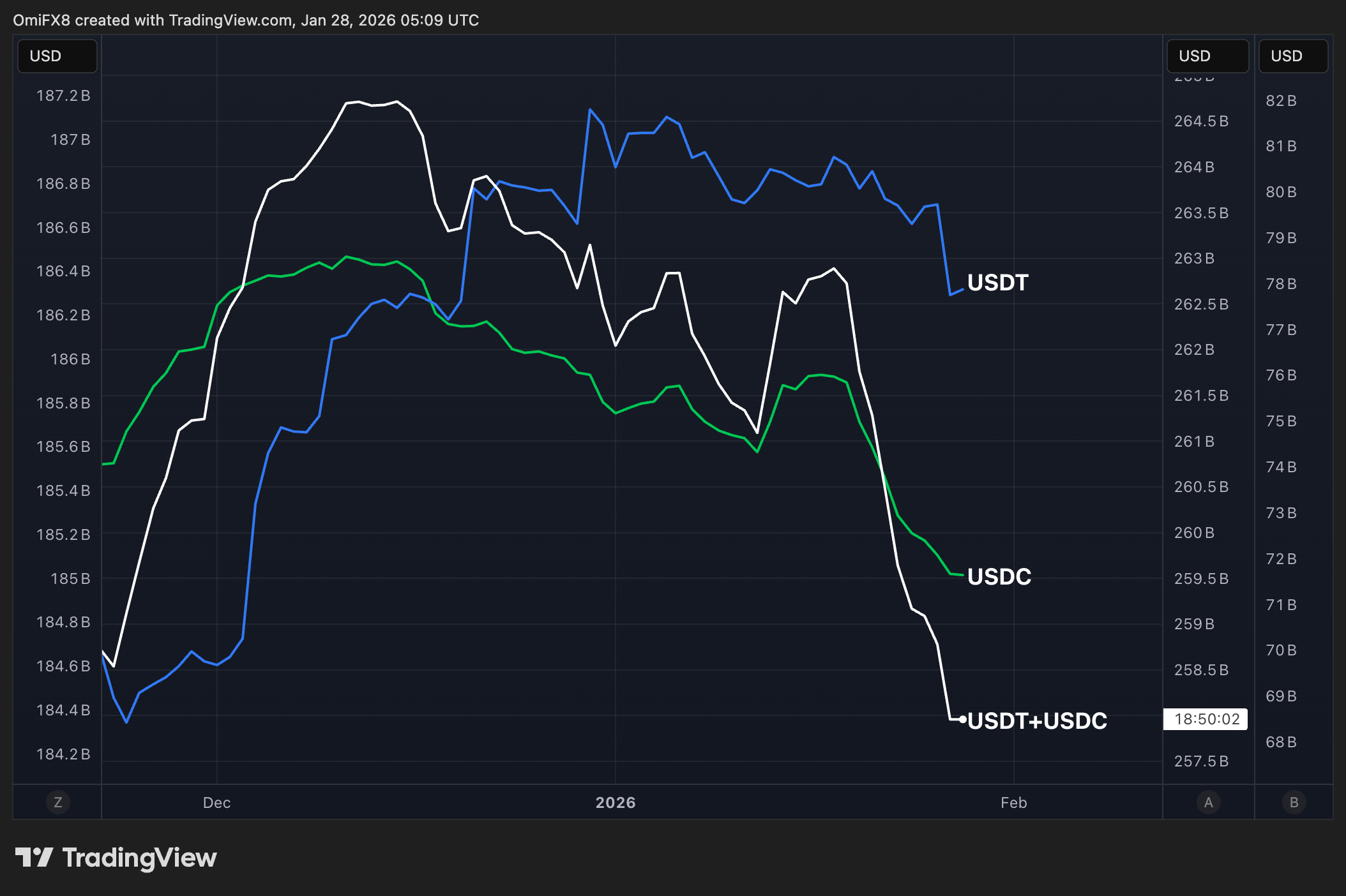
Market cap of top stablecoins. (TradingView)
The drop in stablecoin supply, especially $USDC, which the U.S.-regulated Circle Internet Financial issues, could be a reflection of investor frustration over delays in the Clarity Act – a proposed law to regulate these dollar-tied tokens in the U.S.
"Narrative-wise, investors and traders appear to be pricing out the U.S. crypto mojo. The CLARITY Act remains stuck in the Senate, while Republicans are prioritizing purchasing-power-focused legislation ahead of the midterms, reducing near-term regulatory momentum for crypto," Aurelie Barthere, principal research analyst at Nansen, said in an email.
She added that the passage of the bill would be a meaningful upside catalyst for the market.

 coindesk.com