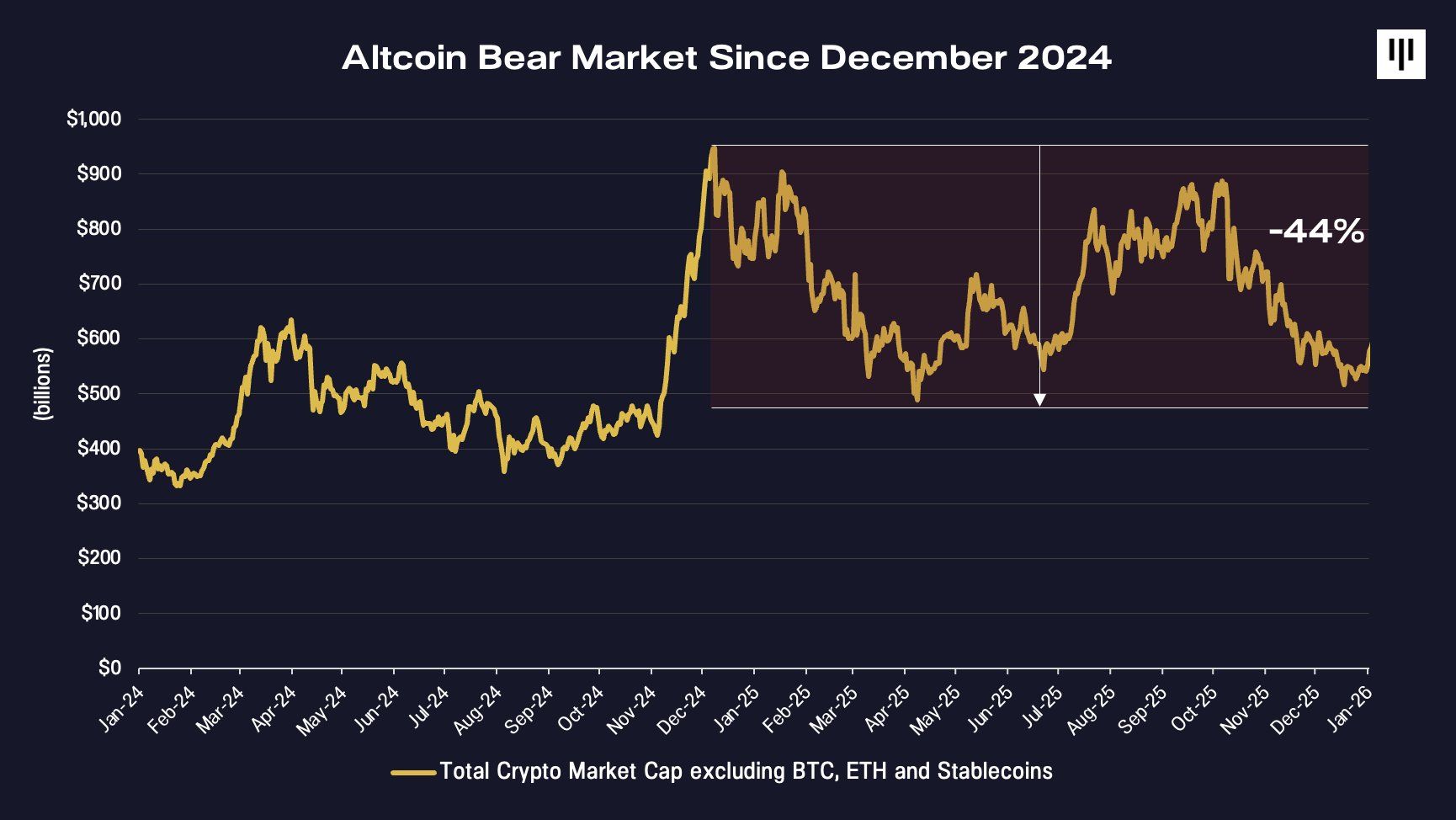
While bitcoin finished last year only modestly lower, Pantera said the rest of the market endured a grinding and largely unresolved drawdown.
The dispersion was extreme.
Bitcoin ended 2025 down roughly 6%, while $ETH fell about 11% and $SOL declined 34%. The broader token universe, excluding $BTC, $ETH, and $SOL, dropped close to 60%, with the median token down roughly 79%. Pantera described 2025 as an exceptionally narrow market where only a small fraction of tokens generated positive returns.
Rather than fundamentals, Pantera said macro shocks, positioning, flows, and market structure dominated price action. The year featured repeated whipsaws tied to policy developments, tariff threats, and shifting risk appetite, before culminating in a major liquidation cascade in October that wiped out more than $20 billion in notional positions, larger than during the Terra/Luna and FTX collapses.
Structural issues compounded the pressure. Pantera highlighted unresolved questions about token value accrual, noting that governance tokens often lack clear legal claims to cash flows and residual value available to equity holders.
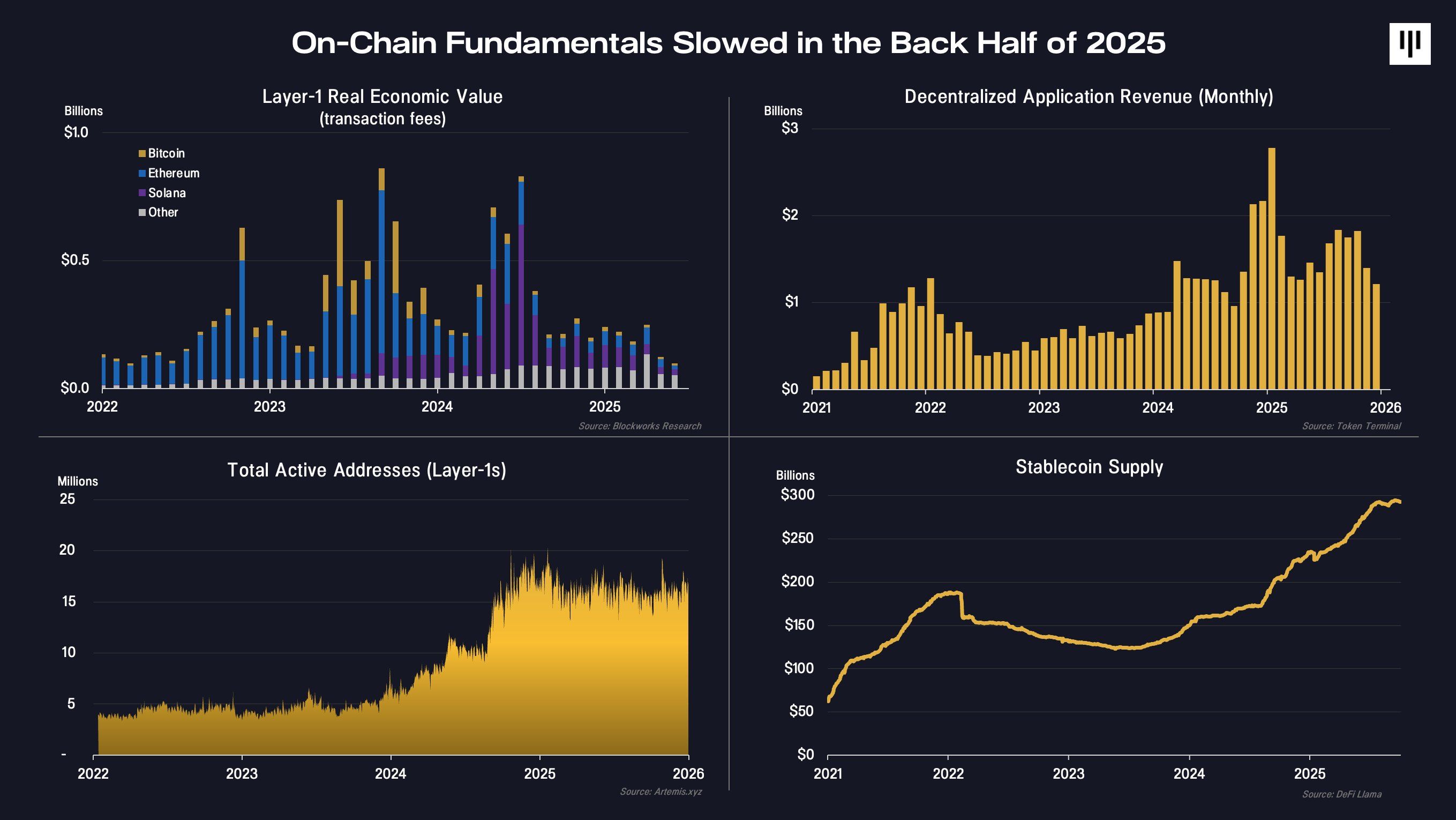
That dynamic helped digital asset equities outperform tokens during the year. On-chain fundamentals also softened in the second half, with declines in fees, application revenue, and active addresses, even as stablecoin supply continued to grow.
Pantera said the duration of the drawdown in the wider market now mirrors prior crypto bear markets, setting up a potentially more favorable backdrop for 2026 if fundamentals stabilize and market breadth returns beyond $BTC.
Rather than offering price targets, Pantera frames 2026 as a capital-allocation shift, with bitcoin, stablecoin infrastructure, and equity-linked crypto exposure positioned to benefit first if fundamentals stabilize and risk appetite returns.
In December, Pantera’s Paul Veradittakit said the firm expects 2026 to be defined by institutional adoption, with growth concentrated in real world asset tokenization, AI-driven on-chain security, bank-backed stablecoins, consolidation in prediction markets, and a surge in crypto IPOs rather than a broad return to speculative token rallies.

 coindesk.com