
 u.today

It appears that Shiba Inu is currently undergoing a necessary reset rather than a failure. The price did not descend into a continuation sell-off after being rejected in the vicinity of $0.000009. Rather, $SHIB reanchored itself around the 26 EMA, a level that frequently defines short-term trend structure during recovery phases and pulled back in a controlled manner. This action is important.
Implications behind rejection
Sharp rejections that cause lower lows right away typically indicate distribution. That is not the situation at hand. The price swiftly stabilized rather than declining, the pullback was orderly and volume cooled rather than increased. This indicates that instead of gathering urgency, sellers are losing it. Now the 26 EMA serves as a dynamic pivot.
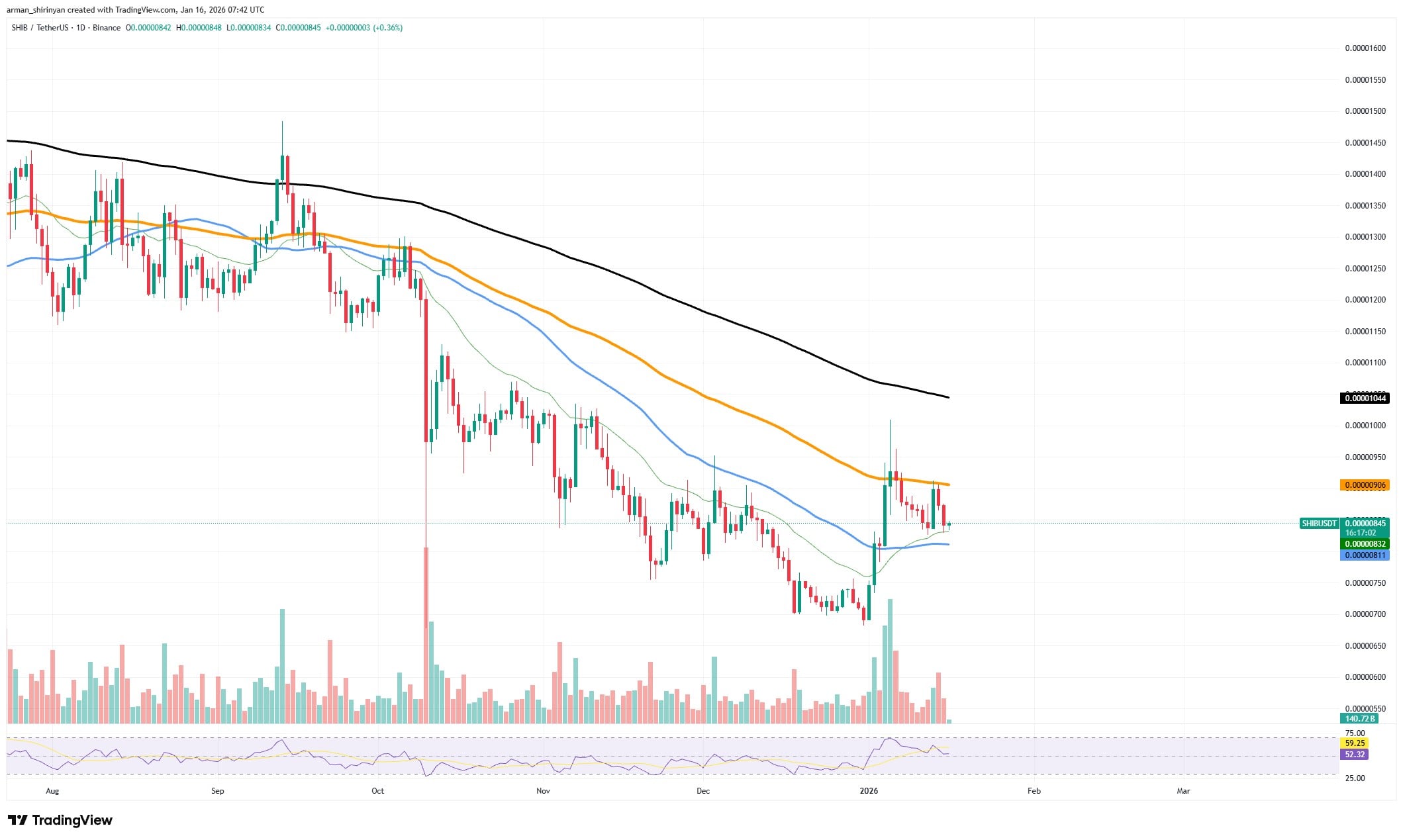
Holding above it implies that rather than starting a new bearish leg, the market is trying to regain momentum. Sustained interaction with this average following a sell-off frequently preceded multiweek recoveries in previous $SHIB cycles, particularly when the overall market was not aggressively risk-off. It is crucial to put the $0.000009 rejection in perspective. That level was always going to be contested because it corresponds with heavier moving averages above.
Failing there merely indicates that $SHIB requires time to absorb supply; it does not negate recovery potential. The crucial point is that the price did not plummet following the rejection. This distinguishes trend rejection from structural resistance. This interpretation is confirmed by momentum indicators.
Momentum resetting?
RSI has retreated from regional highs without going back to an oversold position. This implies that momentum is not breaking but cooling. To put it another way, the market is strengthening rather than weakening. In terms of market structure, $SHIB is currently compressing between overhead resistance close to the 50-100 EMA cluster and short-term support at the 26 EMA.
Once volume returns, this compression raises the likelihood of a directional expansion. Only after this reset phase is finished does the path of least resistance become more apparent.
All of this does not ensure a breakout right away. But compared to a simple rejection-and-dump scenario, the current arrangement is materially healthier. Recovery is still the more likely result as long as $SHIB keeps defending the 26 EMA and stays clear of a high-volume breakdown below it.