thecryptobasic.com
Recent developments suggest that XRP may be moving toward a fully connected, multi-chain future that could massively change its role in the crypto market.
In a recent video commentary, Brad Kimes of Digital Perspectives called attention to multiple developments that may lead to growing interoperability for XRP across dozens of blockchain networks.
Ripple Executive Highlights Importance of Interoperability
During the episode, Kimes highlighted comments from Luke Judges, Ripple’s Global Partner Success Lead, delivered at the Solana Breakpoint conference. Notably, Judges compared crypto assets and national currencies, suggesting that blockchains act as separate countries. He explained that no currency can gain global dominance if it only works in one region.
Applying this idea to crypto, Judges suggested that expanding XRP into other blockchain ecosystems could dramatically increase its usefulness. The Ripple executive then mentioned that Solana is a strong starting point for this sort of expansion.
For context, Judges’ comments came on the back of the wXRP project from Hex Trust. Responding, Kimes argued that Judges’ words show that Ripple sees interoperability as an important part of its strategy.
XRP to Connect to 50+ Chains?
From there, the Digital Perspectives host spotlighted a newer project called Bridgers, which seeks to connect XRP and Ripple’s RLUSD stablecoin to more than 50 blockchain networks.
According to reports discussed in the video, Bridgers allows users to perform one-click cross-chain swaps involving XRP, RLUSD, and other assets issued on the XRP Ledger. The platform reportedly supports hundreds of tokens across dozens of chains to remove the friction that separates blockchain ecosystems.
The report noted the timing of the development could not be better. Notably, XRP remains one of the most widely held digital assets worldwide, while RLUSD exists as a compliance-focused stablecoin.
It also highlighted Ripple’s conditional approval to form a national trust bank in the United States. According to the report, this strengthens the regulatory foundation behind RLUSD. In this context, expanding both XRP and RLUSD across multiple chains could align with Ripple’s broader regulatory and infrastructure ambitions.
Meanwhile, the report also highlighted some risks involved. It cautioned that cross-chain systems often introduce security concerns, liquidity challenges, and trust issues.
Per the report, Bridgers plans to rely on open-source smart contracts and a transparent liquidity routing model. Still, the project must prove its reliability at scale before the market can fully trust it. Also, being a less proven project, Kimes asked investors to be careful and carry out proper research.
Despite these challenges, the benefits to XRP’s direction could be bullish long-term. Specifically, XRP and RLUSD are no longer limited to the XRP Ledger alone. Instead, they now operate as assets designed to move freely across multiple blockchains.
Possible XRP Price if XRP Secures Such Interoperability
Meanwhile, to assess how this change could affect XRP’s price, we asked xAI’s Grok AI to evaluate a hypothetical scenario in which XRP secures broad interoperability and becomes a leading bridge asset for the crypto scene.
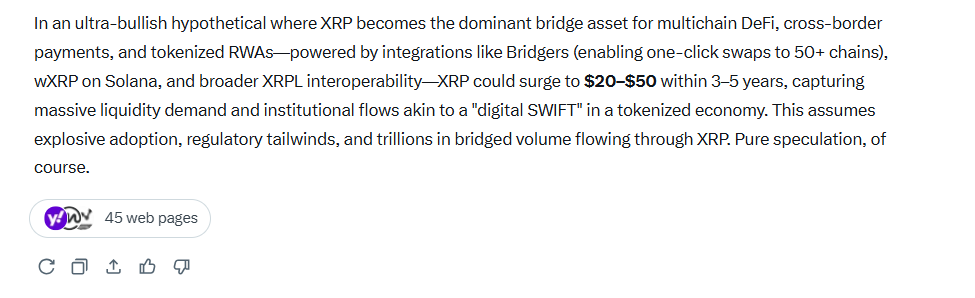
In response, Grok suggested that under an extremely bullish and purely speculative outlook, XRP could trade between $20 and $50 within the next three to five years. This assumes XRP sees strong institutional adoption, rising liquidity demand, and becomes a settlement layer comparable to a digital version of SWIFT. However, this remains merely speculative and unguaranteed.