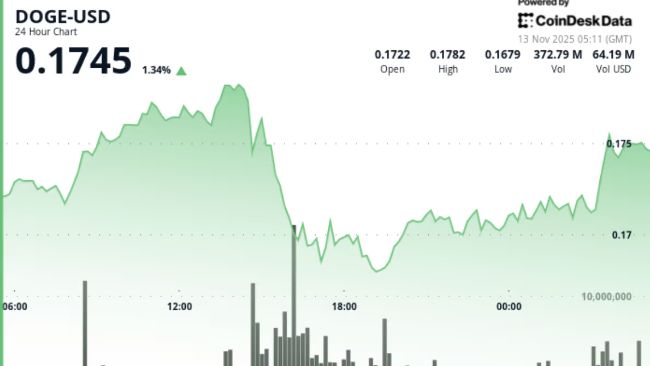
Despite modest stabilization late in the session, $DOGE remained pinned near the lows. Attempts to rebound toward $0.1732 met immediate selling pressure, while elevated activity of 12.5 million tokens per hour during the recovery phase suggested distribution rather than accumulation.
Price Action Summary
$DOGE’s session structure reflects deteriorating momentum with declining support strength. The failure to reclaim $0.1789 resistance validates a near-term bearish trend, while compression around $0.1730 highlights uncertainty among short-term traders.
The $0.1719 zone absorbed multiple retests, forming a fragile base that may define the next pivot for directional traders. Volume tapering from peak levels hints at temporary seller exhaustion, but without follow-through buying, the market remains vulnerable to another downside test.
Technical Analysis
With no major fundamental triggers, price action remains purely technical. $DOGE’s breakdown below its short-term moving averages reinforces the broader bearish bias that has persisted since early November. The hourly RSI sits near 38, indicating mildly oversold conditions but not yet capitulation.
Market analyst Kevin (@Kev_Capital_TA) highlights the weekly 200-EMA near $0.16 as Dogecoin’s structural “line in the sand.” That level has held through six previous retests since summer, marking the boundary between cyclical pullback and long-term trend reversal.
A decisive close below $0.17 would shift sentiment decisively bearish, while sustained defense above $0.1720 may allow for a near-term consolidation phase or relief bounce toward $0.1760.
What Traders Should Know
The immediate focus is whether the $0.17 handle can hold under continued pressure. Institutional order-flow metrics suggest systematic de-risking rather than panic liquidation — leaving room for a technical rebound if volume subsides further.
Failure of the $0.1720–$0.1719 support cluster could expose the $0.1650–$0.1600 zone, where the weekly moving average sits as last-ditch structural support.

 coindesk.com