
 beincrypto.com

Over the past decade, $XRP (by Ripple) and $XLM (by Stellar) have shown a strangely persistent price correlation. While $XRP often grabs more headlines, $XLM’s price performance has kept pace.
What explains this sustained correlation? Let’s break it down based on expert opinions.
Unique Common Traits Between $XLM and $XRP That Few Altcoin Pairs Share
Data from CoinMarketCap shows that for more than 10 years, even though the price volatility patterns of $XLM and $XRP differ at times, their up-and-down trends have almost mirrored each other.
Both assets typically experience a short price surge, followed by an extended decline, before the cycle repeats.
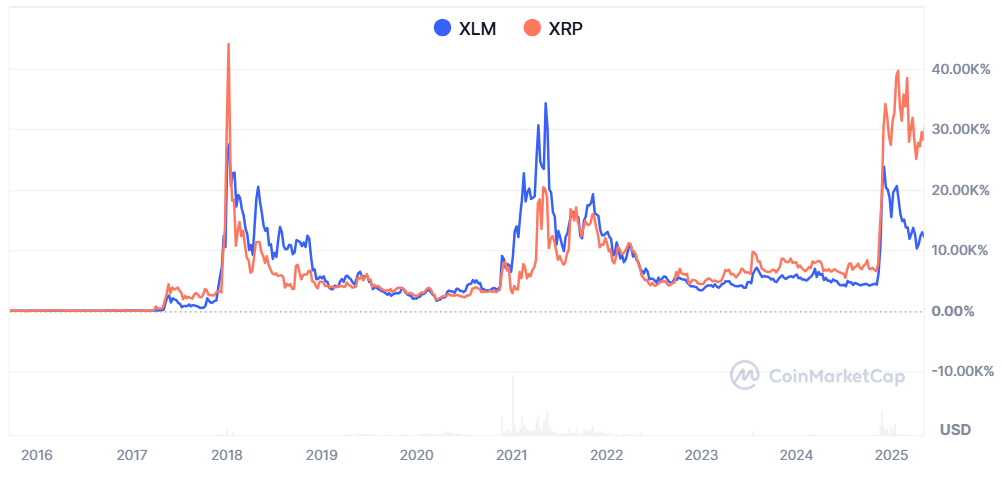
According to the Defillama correlation calculator, the correlation coefficient between the two assets stood at 0.97 over the past month and 0.87 over the past year, both high figures.
Ripple’s CTO, David Schwartz, himself acknowledged this phenomenon in August 2024. Yet he admitted he didn’t fully understand what drives it.
“I have no idea what factors drive the price of $XRP. The only real objective data point I have is that $XRP tracks the price and market cap of $XLM incredibly well over all time frames,” David Schwartz said.
However, the crypto investment community knows that $XLM was created by Jed McCaleb, who previously worked on Ripple’s founding team.
When Jed McCaleb left Ripple in 2014 and launched Stellar Development, he received over $9 billion worth of $XRP. Amidst this background, it appears investors often consider both $XRP and $XLM together when evaluating the founding teams.
The second reason, raised recently, involves automated trading bots. Vincent Van Code, a well-known software engineer on X, argued that these bots react to news within milliseconds. When $XRP’s price fluctuates sharply, these bots simultaneously trade correlated assets like $XLM.
Lastly, both $XRP and $XLM share a similar story of improving cross-border payments. Recently, the US Federal Reserve officially adopted the new financial messaging standard ISO 20022 through the Fedwire system, drawing renewed attention to both assets.
“Two currencies, but same use cases,” investor Sushil Pathiyar commented.
$XLM vs. $XRP – Which One Is Better?
By 2025, $XRP had become one of the market’s brightest stars, attracting attention from retail and institutional investors alike. Thanks to this, $XLM also emerged as a parallel choice.
Some investors even argue that $XLM could outperform $XRP. This view seems reasonable when comparing certain on-chain data points, such as daily active addresses and total value locked (TVL). For instance, since early July, $XLM has surged 100%, while $XRP has gained 35%.
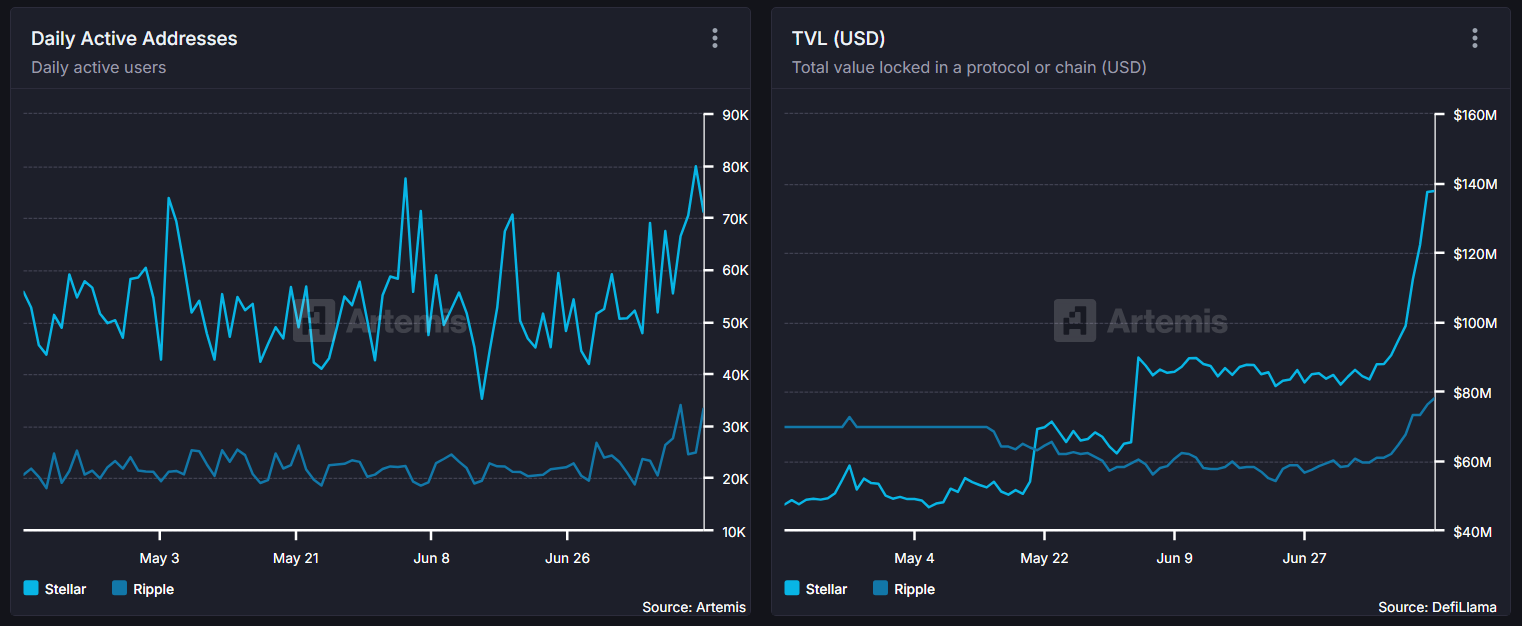
Artemis data shows that $XLM recently had about 80,000 daily active addresses, while $XRP had roughly 33,000. Moreover, $XLM’s TVL stands at over $137 million, which is double $XRP’s.
In May, $XLM’s TVL was below $XRP’s, but it has since overtaken $XRP, highlighting fierce competition in on-chain adoption between the two.
“$XLM does everything $XRP does. Just better,” investor Gordon said.
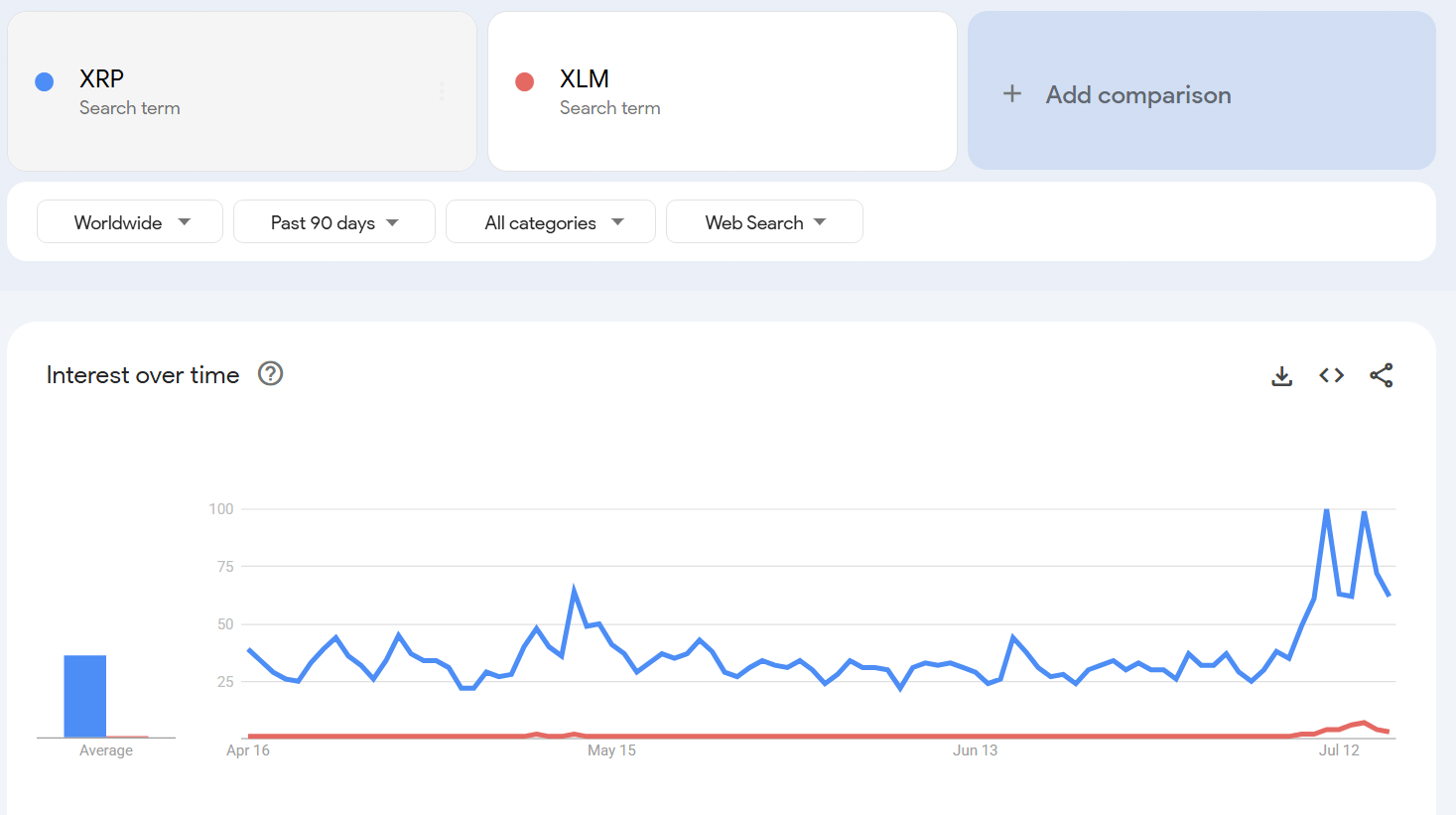
However, when examining popularity using Google Trends, it’s clear that $XLM significantly lags behind $XRP. This trend indicates the level of interest from retail investors.
Consequently, $XLM finds it challenging to compete with $XRP in terms of trading volume on exchanges. As a result, $XRP has a daily trading volume exceeding $6 billion, while $XLM only reaches about $1.3 billion.
$XRP may benefit from positive news about a potential $XRP ETF and Ripple’s connections with political figures.
It’s difficult to determine which asset is superior because it depends on the criteria used. However, it seems likely that these two assets will remain correlated in the future.