Signing Safely on Lighter: Lessons from November 16 — an attacker gained control of a trader’s API keys, the keys leaked through the accounts’ own signatures, and Guardian paused withdrawals while the Security Council returned ~5MM $USDC.
— Lighter (@Lighter_xyz) November 16, 2026
Lighter’s announcements channel put the all-clear at 18:31 UTC the same day: “Deposits and withdrawals are back to normal following the deactivation of Guardian Mode by the Lighter Security Council.” Eleven minutes separate the explainer from the resumption notice.
Three things are missing from the record. Lighter does not publish the time Guardian triggered, so the length of the withdrawal freeze is unknown outside the company. It does not state the total value taken, only the amount returned. And it does not say whether the returned $USDC came from funds recovered from the attacker or from the Security Council’s own resources. Those are not stylistic gaps. They are the difference between a recovery and a discretionary bailout of one account, and nothing in the public post distinguishes the two.
The permission an API key does not carry, and the route that worked around it
Lighter’s API key documentation draws the boundary explicitly. A key can trade, cancel, modify orders, adjust leverage, manage sub-accounts and authorise secure withdrawals. It cannot, on its own, transfer to another L1 owner, execute a fast withdrawal, or approve an integrator with fees, because those actions also require a signature from the wallet that owns the account. “Secure withdrawals only need the API key because they can only go back to the L1 address that created the account,” the documentation reads.
So the leaked key could not simply send the balance to an address the attacker controlled. What it could do was operate inside the account’s own perimeter, and a public pool sits inside that perimeter. Per Lighter’s public pool documentation, whitelisted operators create pools, depositors receive pool shares, and shares are redeemed on withdrawal with no lockup period. A separate protocol liquidity pool carries a five-minute withdrawal cooldown; public pools do not.
The permission surface of an API key rarely appears in venue comparisons. A comparison of ApeX Omni and Hyperliquid, for instance, sorts perpetual venues by trading model, collateral and fees rather than by what a leaked key is permitted to do inside an account. November 16 is a case study in why that column belongs in the table.
Lighter’s post describes the sequence that followed in four steps. The attacker created a public pool from the affected account, minted pool shares in a separate account they controlled, transferred the affected account’s funds into the pool in a way that raised net asset value without minting matching shares, then redeemed those shares and withdrew. Each step is a legitimate operation. Taken together they converted a trading-only key into a cash exit, which is why “an API key can’t withdraw funds to anyone else’s wallet” is true at the transaction level and incomplete at the value level.
The venue is candid about the broader risk a live key creates even without the pool route. Whoever holds a key can place orders that trade against the owner at bad prices in thin markets, or open large and highly leveraged positions that expose the account to liquidation. Both outcomes move value from the account holder to the key holder without any withdrawal at all.
Nonce reuse puts the failure in client code, not in the venue
The cryptographic detail is the reason this incident will be cited by other venues. Every Lighter transaction is authorised by a signature from an API key, and each signature needs a one-off random value called a nonce that must be unique and unpredictable. Signatures are public. If the same nonce signs two different transactions with the same key, the private key can be computed from the pair. “This issue isn’t specific to Lighter,” the post notes, applying to Bitcoin and Ethereum signatures as well.
That places the defect in the signing software the affected accounts chose to run, which Lighter says was not its own SDK: “The official Lighter SDKs generate nonces safely and were not affected.” The practical exposure sits with traders who wrote their own signers, adapted an unofficial library, or run automated agents against the exchange API. Those are exactly the users least likely to read a post written for a general audience and most likely to have the exposure, which makes the distribution of this advisory as important as its content.
Guardian, the Security Council, and a pause with no published rulebook
The intervention is the part a supervisor would read twice. “Our smart contract Guardian was triggered by the anomaly, which temporarily paused withdrawals and allowed ~5MM $USDC to be returned to the affected trader by the Lighter Security Council,” the post states. A venue-level halt of customer withdrawals, decided by a council, executed through a privileged contract path, and disclosed afterwards in a social post, is a recognisable pattern in crypto market infrastructure and an unfamiliar one in regulated venue practice.
On a regulated derivatives venue, a trading halt has a written trigger, a named decision-maker, a maximum duration, and a reporting obligation to the authority that licenses the venue. None of those elements is public here. Lighter has not published the standard its council applied, the vote or authority under which it acted, or whether the pause extended to every account or only to pool operations. It also has not said whether any regulator was notified.
That is a description of the record, not an allegation of misconduct. Perpetual futures venues operating outside US registration have no statutory duty to publish a halt protocol, and emergency powers written into a smart contract are a design choice rather than a breach. The contrast with the regulated perimeter is structural: the CFTC registered Backpack Clearing by commission order on November 13 and designated its exchange arm a contract market three days later, which places a named operator on a public register with the reporting duties that follow from it. The relevant question for users of an unregistered venue is narrower and more useful: when a council can return funds to one account after an incident, what is the standard it applies to the next account, and is that standard disclosed in advance?
Three timestamps, one unpublished one
The public record of November 16 is short enough to lay out in full. Everything below is stated by Lighter in its own post or its own announcements channel.
The single empty cell is the one that would let a user estimate how long their funds were frozen. A venue that publishes the resumption minute but not the trigger minute has disclosed the end of an outage without its duration.
What $LIT’s price series can and cannot say about the cost
$LIT traded at $2.87 at 03:58 UTC on November 18, down 4.4% over 24 hours, with a market capitalisation of about $718 million and $81.1 million of 24-hour volume, according to CoinGecko. The token sits 63.5% below its December 30, 2025 record of $7.86, and 250 million of a 981.9 million total supply are circulating, or 25.5%. Against those figures, $5 million returned to a single trader equals roughly 0.70% of market capitalisation and 6.2% of one day’s volume: large for the account, small for the asset.
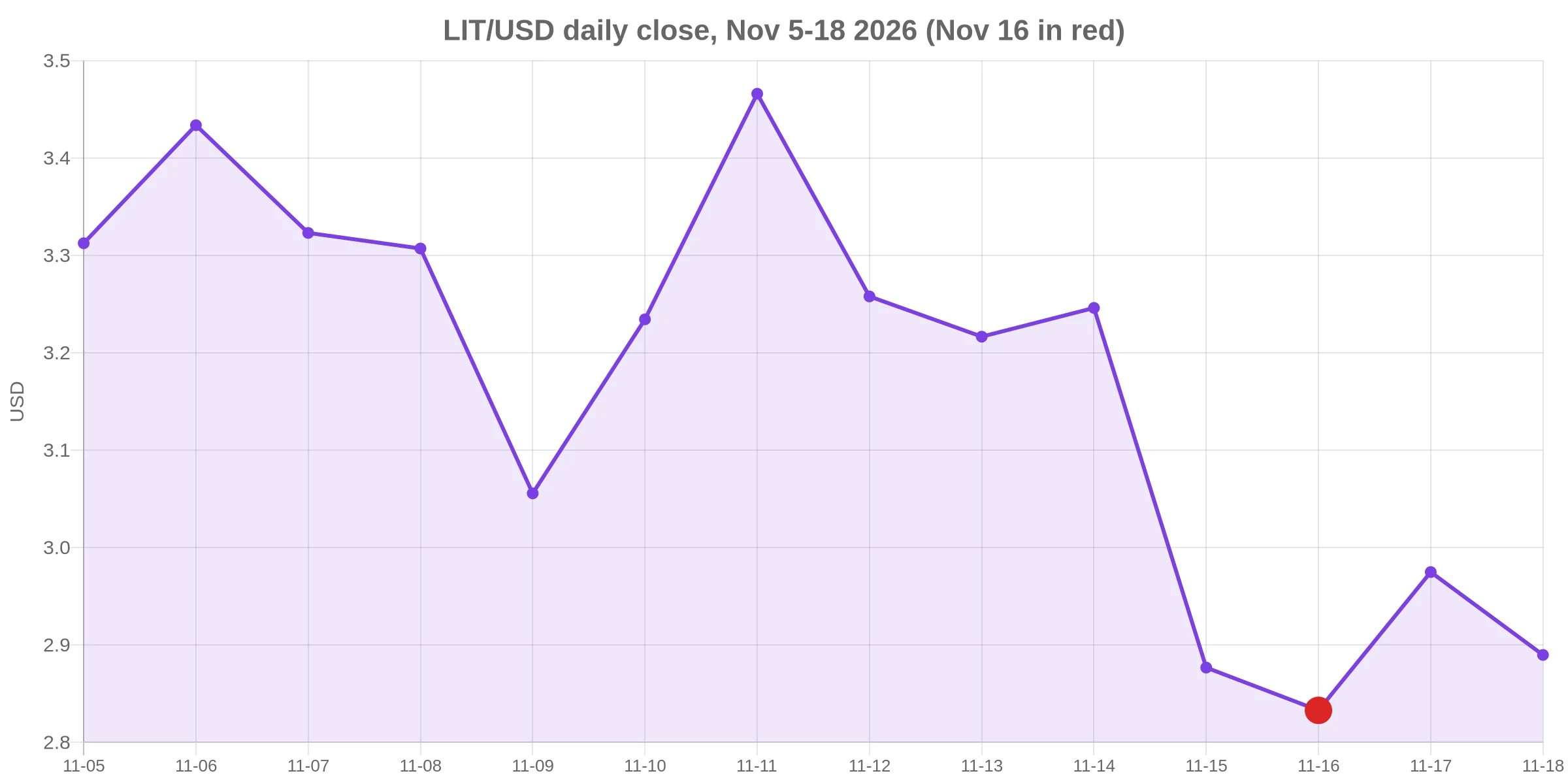
The chart above is BlockchainReporter’s own compilation of CoinGecko daily closes, with November 16 marked. It is included to prevent a claim the data does not support. $LIT fell 12.7% between the November 14 and November 16 closes, but most of that move happened on November 15, the day before the incident was disclosed, and bitcoin fell 4.4% over the same two days. A single venue incident cannot be isolated from that backdrop, and no causal link between the disclosure and the price is established by the series.
Data: CoinGecko.
Who carries the loss when the signing code belongs to the user
The allocation of responsibility in Lighter’s account is clear and, for traders, uncomfortable. The venue points to third-party signing code, states that its own SDKs were unaffected, and reports that its council made the affected trader whole to the tune of about $5 million. Nothing in the post establishes a general compensation policy. A trader running a homemade signer on a different venue, with the same nonce flaw and no council standing behind the account, has no equivalent recourse, and no regulator has published a rule that would require one.
The operational instruction that follows is blunt: “If you’re unsure whether your code has ever reused a nonce, rotate all of your API keys and switch to an official SDK.” Rotation is the only step that closes an exposure already created, because a key that has signed with a repeated nonce is compromised whether or not anyone has used it yet. Lighter’s forward-looking list is narrower than the risk: “We’re adding further protections, including IP allowlists and configurable limits per API key, so that a leaked key can do far less damage.” Allowlists and per-key limits reduce the blast radius of a leak after it happens. They do not stop key derivation from public signatures.
The signals that will show whether this was contained
Four observable developments would settle the open questions. The first is whether the IP allowlist and per-key permission controls arrive as shipped features with a date rather than a stated intention. The second is whether Lighter follows the post’s own list and makes API key signatures non-public, a design change that would remove the attack class rather than police it. The third is whether the venue publishes a loss figure and a description of where the returned $USDC came from, since that determines whether other affected accounts exist. The fourth is whether competing perpetual venues issue equivalent SDK advisories, which would indicate the nonce flaw is widespread in third-party signing code rather than confined to one trader’s stack.
Taken together, the evidence points to a client-side cryptographic failure that a privileged emergency control contained inside a day, with one account made whole and no disclosed loss to the venue’s own books. That reading is supported by the venue’s own statements about the protocol, the documentation’s permission boundary, and the speed of the resumption. It is also incomplete, because the operator controls every number that would test it, and the disclosure stops at the amount returned. The defensible conclusion is the narrow one: Lighter’s smart contracts held, its permission model did not prevent value from leaving an account through an authorised route, and the venue’s emergency powers worked without a published standard for when they should be used.
The post Lighter Froze Withdrawals and Returned $5M After Third-Party Code Leaked an API Key appeared first on BlockchainReporter.

 blockchainreporter.net