
 coindesk.com
The team behind Zakura, a newer version of the software that runs the Zcash network, wants to give every $ZEC swap made through $NEAR Intents its own private key.
The change would close a gap that a future quantum computer could use to piece together a user’s payment history, according to a new engineering post from the team.
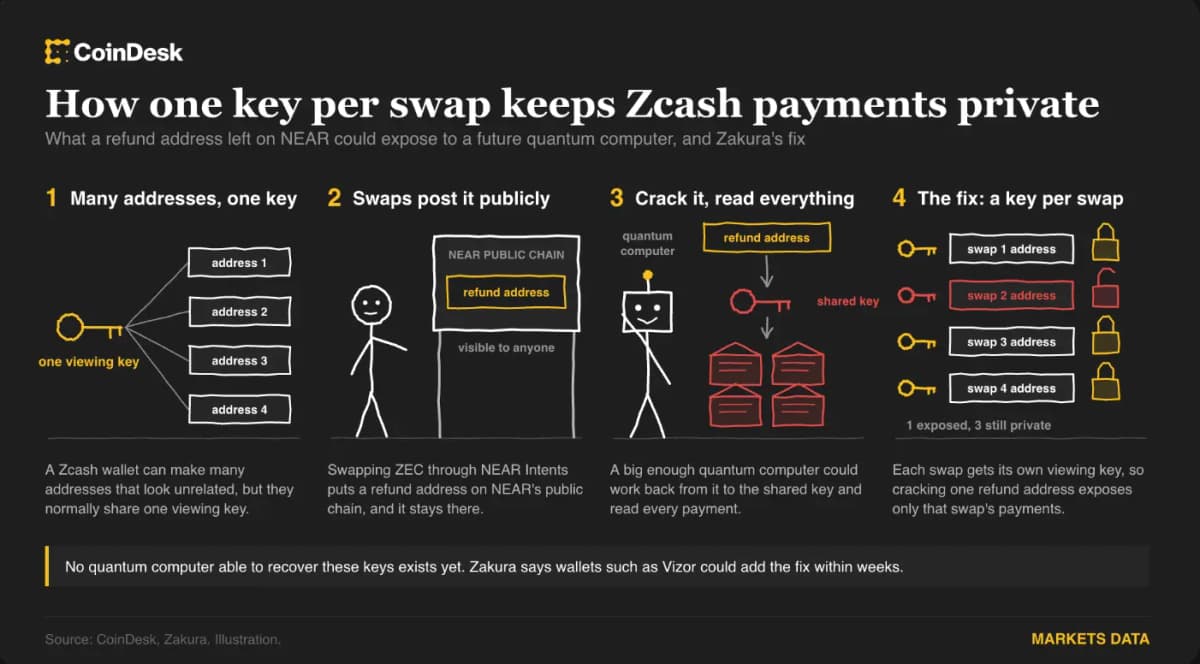
$NEAR Intents is a service that lets users swap tokens across different blockchains. When someone swaps private $ZEC for USDC through it, the service posts one of their private Zcash addresses on $NEAR’s public chain, so it knows where to send back any unused $ZEC. That address goes up as soon as the deposit lands and stays there even if the swap goes through and no refund is ever needed.
Such addresses give away no information on today’s computers. Each Zcash address carries a public key built from the wallet’s viewing key, the secret a wallet uses to spot payments sent to it, using one-way elliptic-curve math similar to what protects bitcoin and ether wallets.
Ordinary computers can’t run that math in reverse, but a large enough quantum computer running Shor’s algorithm, a method published in 1994 for exactly that job, could theroretically work backward from the address to the key.
That’s the real threat hanging over Satoshi-era bitcoin, whose public keys already sit onchain for anyone to copy. Last week, Google said its Willow quantum chip had produced near-perfect versions of one of the components such an attack would burn through, a step toward a machine powerful enough to try it.
Quantum computers capable of that are still likely years away (and no one has a firm timeline for when one could be built), but it’s a problem developers across the industry are rushing to solve.
One key for every swap
Zcash’s architecture gives it a problem of its own. A Zcash wallet can generate many addresses that look unrelated to each other, but they normally share one viewing key.
An attacker who cracks that key from a single published address could link every payment the account ever received and read the amounts and the private notes, or memos, attached to them.
Spending takes a separate key, so the funds themselves would stay safe. Zakura’s fix gives each swap its own viewing key and leaves the spending key with the user’s main account. An attacker who someday cracks a refund address on $NEAR would see only the payments tied to that one swap.
The design also deals with a practical snag.



