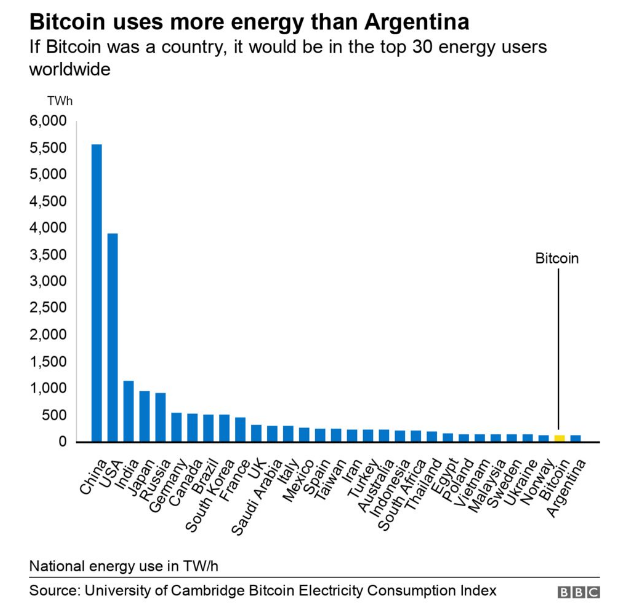
According to the report, as a new mining network added to the network, it leads to an increase in the overall electricity consumption by the hardware. Bitcoin mining consumes approximately 129.09 terawatt-hours (TWh) per year. The difficulty of mining measures the process of cryptocurrency mining. In essence, the difficulty of mining a block never remains the same. Higher difficulty means the increase in difficulty to find the hash of the block. According to the report:
“Rising bitcoin prices make mining more attractive, as the potential reward increases in value. As a result, new mining hardware will get added to the network and lead to increased electricity consumption overall.”
Mechanics of Crypto-Mining
The difficulty of mining $BTC is always in proportion with the competition that participates in $BTC mining. More Bitcoin mined implies more energy consumption. With the increase in machines miners operate, the chances of finding the solution to the puzzle also increase. With the increase in no. of machines, more electricity is needed to operate and cool the hardware resulting in higher carbon production. The report says,
“The more machines a miner operates, the more likely he is to find the solution to the puzzle. However, more machines also mean that more electricity is needed to run and cool the equipment, which in turn results in higher costs for the miner in question,”

 cryptoknowmics.com