
 coindesk.com
A new, minority chain created when BIP-110 supporters split from Bitcoin on Saturday has produced just two blocks roughly eight hours after going live — with no sign that any miner intends to keep it moving.
It sits at block 961,633 while the main bitcoin chain has reached block 961,681, per the BIP-110 situation monitor. The fork happened at 961,632, when computers running BIP-110 software began rejecting any block that did not signal support for the proposal.
A block is a batch of transactions added to bitcoin's ledger roughly every ten minutes, so the gap of 48 represents most of a day's worth of activity on one side and almost none on the other.
BIP-110, short for Bitcoin Improvement Proposal-110, is a move to stop people storing pictures, text and other non-financial data inside bitcoin transactions for a year. Supporters say the practice can clog the network with material that has nothing to do with payments and pushes up costs for people actually sending money.
Opponents argue that anyone paying the fee has bought the right to use the space however they like, and that miners and node operators should not be deciding which transactions count as legitimate.
Bitcoin mining firm AntPool mined the first non-signalling block, which the rest of the network accepted and BIP-110 nodes rejected, and a miner using Ocean produced the alternative that the breakaway chain followed instead. (A miner is an entity that uses massive computing resources to maintain bitcoin and process its transactions, earning newly issued bitcoin and fees for the work.)
AntPool and Ocean are mining pools, where many operators combine their machines and share the rewards.
The stall has a mechanical cause that is hard to escape. Bitcoin recalculates how difficult mining is every 2,016 blocks, aiming to keep blocks arriving roughly every ten minutes.
The breakaway chain inherited bitcoin's current setting but has a tiny share of the machines, so its blocks arrive at long intervals. It cannot make mining easier until it completes 2,016 blocks at that pace. The monitor puts that at 350 days away, against 14 days for bitcoin.
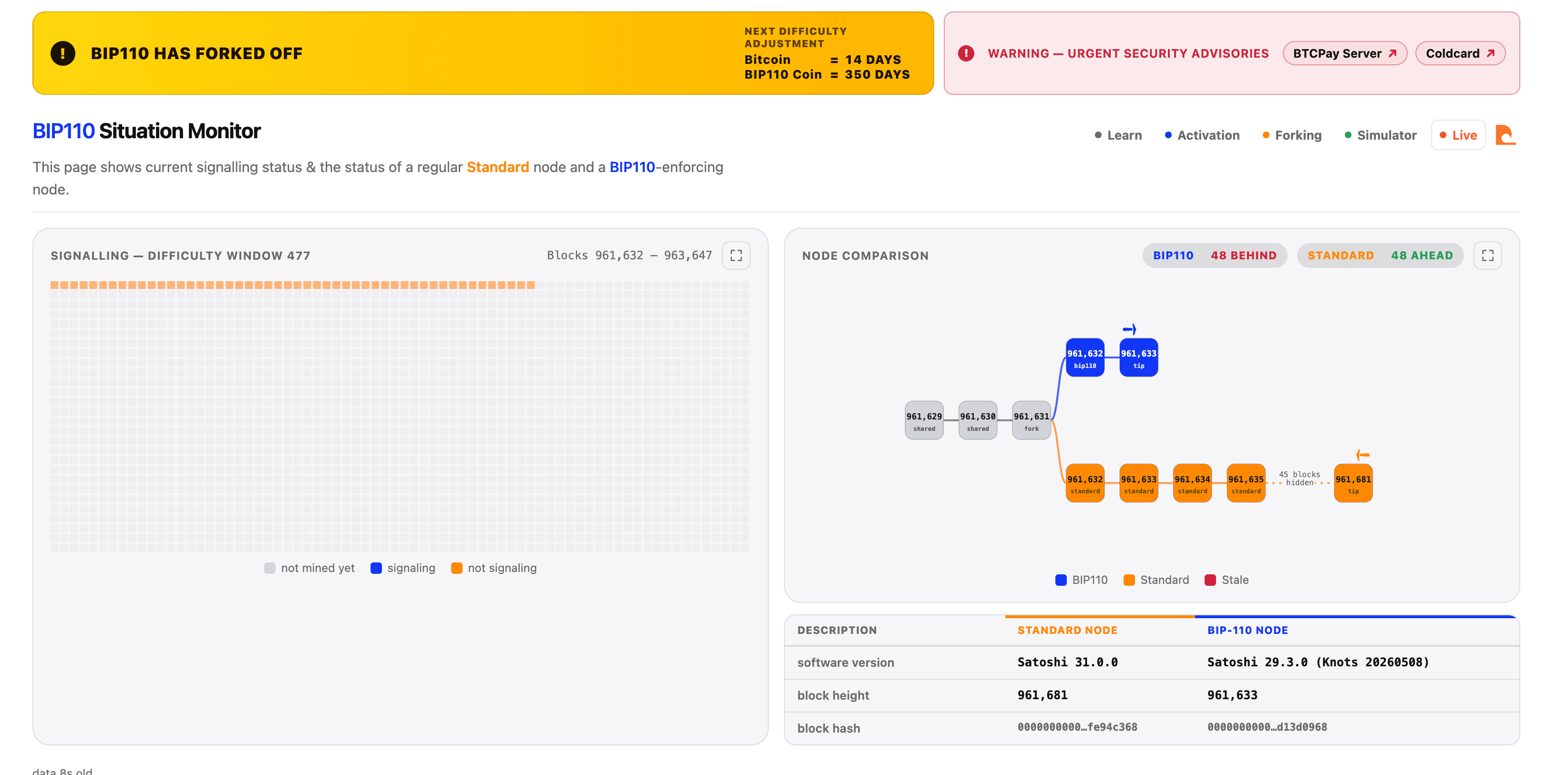
Support was never there. Only 2.53% of blocks signalled for BIP-110 over the past two weeks, against the 55% needed to activate it without a split.
That leaves the fork coin in an awkward position for anyone hoping to sell it. Both chains still accept identical transactions, so a signed transaction sending fork coins also works on bitcoin, and a buyer can rebroadcast it there and collect real BTC from the same seller — opening up the chances of a novel attack method that users should keep track of.