
 coindesk.com
Fresh U.S. and Israeli strikes on Iran have drawn new attention to a financial network Tehran has built in parallel to its battered banking system: bitcoin mining and a fast-growing stablecoin economy.
Iran legalized crypto mining in 2019, allowing licensed operators to use subsidized electricity in exchange for selling mined $BTC to the central bank. Bitcoin has served as a tool for paying for imports and settling trade outside the dollar system, even if indirectly.
Estimates in recent years have put Iran’s share of global bitcoin mining power between 2% and 5%, though much of the activity operates out of public view.
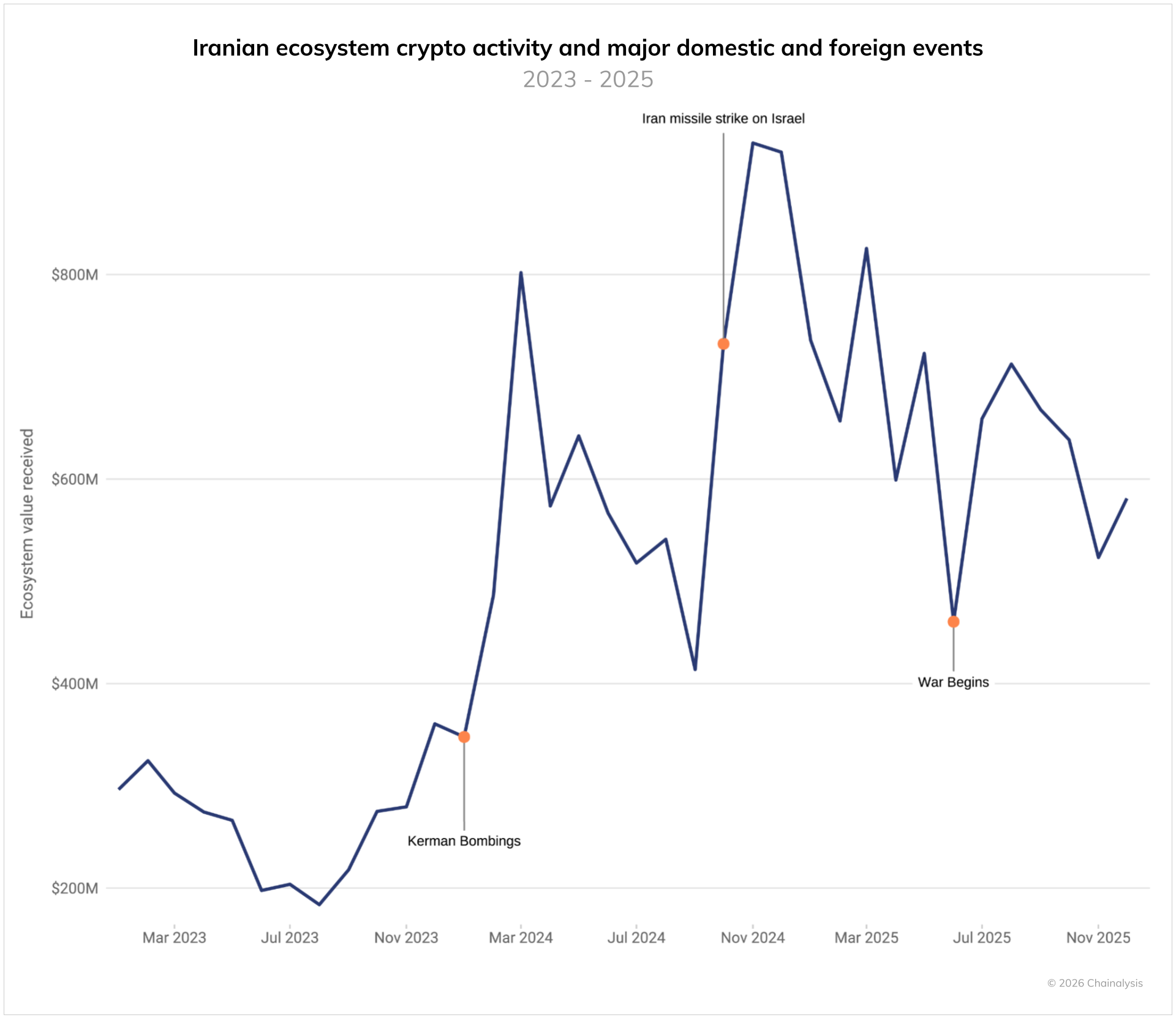
Blockchain analytics firm Chainalysis found that Iran’s crypto ecosystem reached $7.78 billion in 2025, growing faster than the year before. That figure is as large as the GDP of some smaller countries such as the Maldives, or Liechtenstein.
Activity often spiked around military clashes and domestic unrest, including last year’s 12-day conflict with Israel, according to Chainalysis.
The Islamic Revolutionary Guard Corps (IRGC), the primary branch of the country’s military, has since deepened its role in the space. Chainalysis estimates IRGC-linked addresses accounted for more than 50% of total Iranian crypto inflows in the fourth quarter of 2025, with over $3 billion in value received last year.
Those figures reflect only wallets publicly tied to sanctions listings, suggesting the true footprint may be larger.
Adoption mechanics
Stablecoins also play a key role.
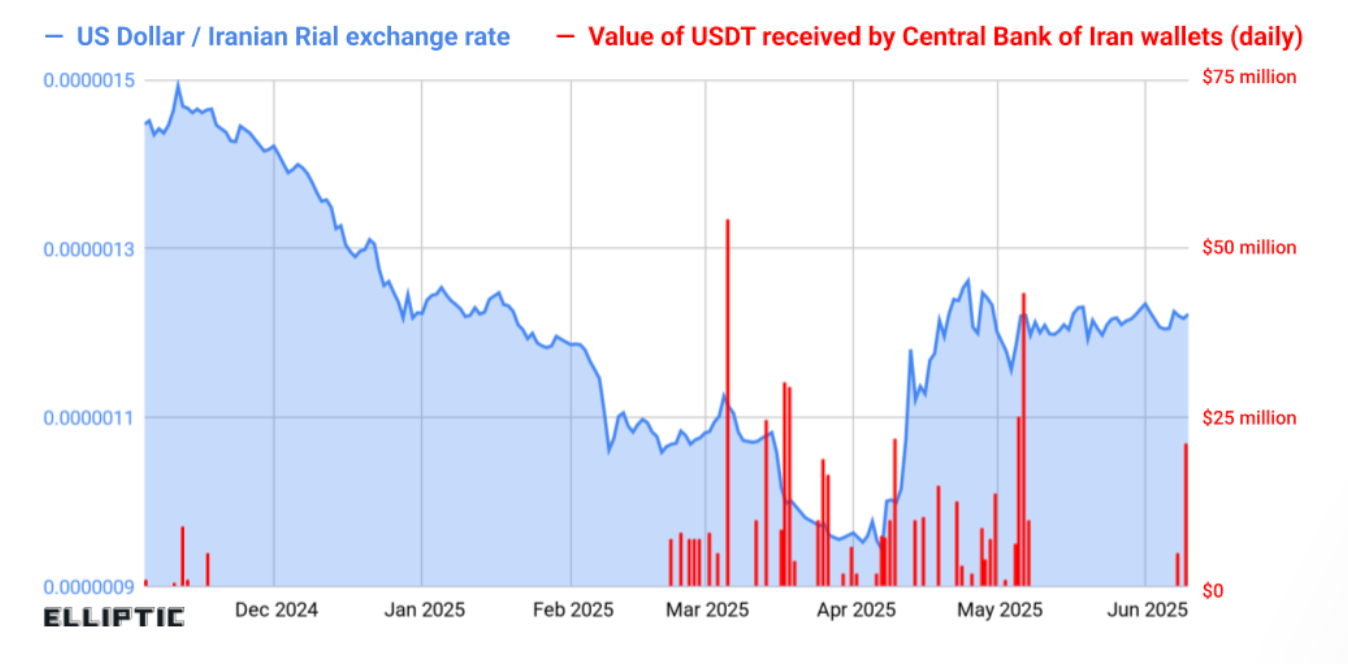
Separate analysis by Elliptic found Iran’s central bank accumulated at least $507 million in $USDT in 2025, likely to steady the rial and finance trade. That effort has mostly failed, with data showing that the rial has lost more than 96% of its value against the USD.
At the same time, ordinary Iranians have turned to bitcoin. During recent protests and an internet blackout, withdrawals from local exchanges to personal wallets rose sharply.
Read more: Iran’s rial collapse mirrors Lebanon’s crisis, driving citizens to bitcoin
If conflict disrupts power grids, mining output could dip in the short term. The Iranian state is believed to be mining $BTC at around $1,300 per coin, which it then sells at current market prices. It’s unclear whether the state has maintained any bitcoin reserves, as there is no treasury dashboard and no official disclosure of holdings.
In practice, mining turns cheap domestic energy into an asset that can move across borders. A licensed miner mints new bitcoin and then sends them to the central bank of Iran. The bank can then transfer it to an overseas counterparty to pay for machinery, fuel or consumer goods without routing funds through U.S.-controlled banks.
While the transactions settle on a public blockchain, the counterparties can remain opaque.
The same pattern appears in stablecoins. $USDT, which is pegged to the dollar, has become a standard settlement tool in sanctioned economies because it offers price stability and faster transfers than bitcoin.
However, it's not always easy to hide such transactions. Crypto exchange Binance recently found itself embroiled in accusations that it fired investigators who raised concerns about funds moving through the exchange to sanctioned, Iran-linked entities. This led to nine U.S. Senate Democrats asking the Treasury and DOJ to probe Binance's illicit finance controls.
Geopolitical risks
Chainalysis data shows that Iranian crypto activity correlates with political flashpoints, including missile exchanges and internal protests. During periods of unrest, exchange outflows rise as users pull funds into private wallets.
For the IRGC, crypto offers another channel to move value across its network of affiliates and commercial fronts. Chainalysis reported that inflows to IRGC-linked addresses totaled $2 billion in 2024 and exceeded $3 billion in 2025.
The renewed military campaign, which has seen the IRGC retaliate against U.S. bases in various countries in the Middle East, adds fresh risk to this system. Large mining operations require steady power. Iran has imposed seasonal bans in the past to ease strain on the grid.
A sustained conflict that damages infrastructure could reduce the hash rate or mining capacity tied to the country, though the global bitcoin network would likely adjust over time as miners elsewhere pick up the slack.