
 cryptoslate.com

Maine's new virtual-currency unclaimed-property rules take effect July 29 with a five-year dormancy clock, while the State Treasurer's current reporting manual still shows three years. The mismatch leaves businesses that hold customer crypto without published transition instructions as the statute becomes effective.
Public Law Chapter 675, approved April 13, creates section 2067-A of Maine's Revised Unclaimed Property Act. The Legislature identifies July 29 as the general effective date for nonemergency laws passed during its 2026 Second Regular Session.
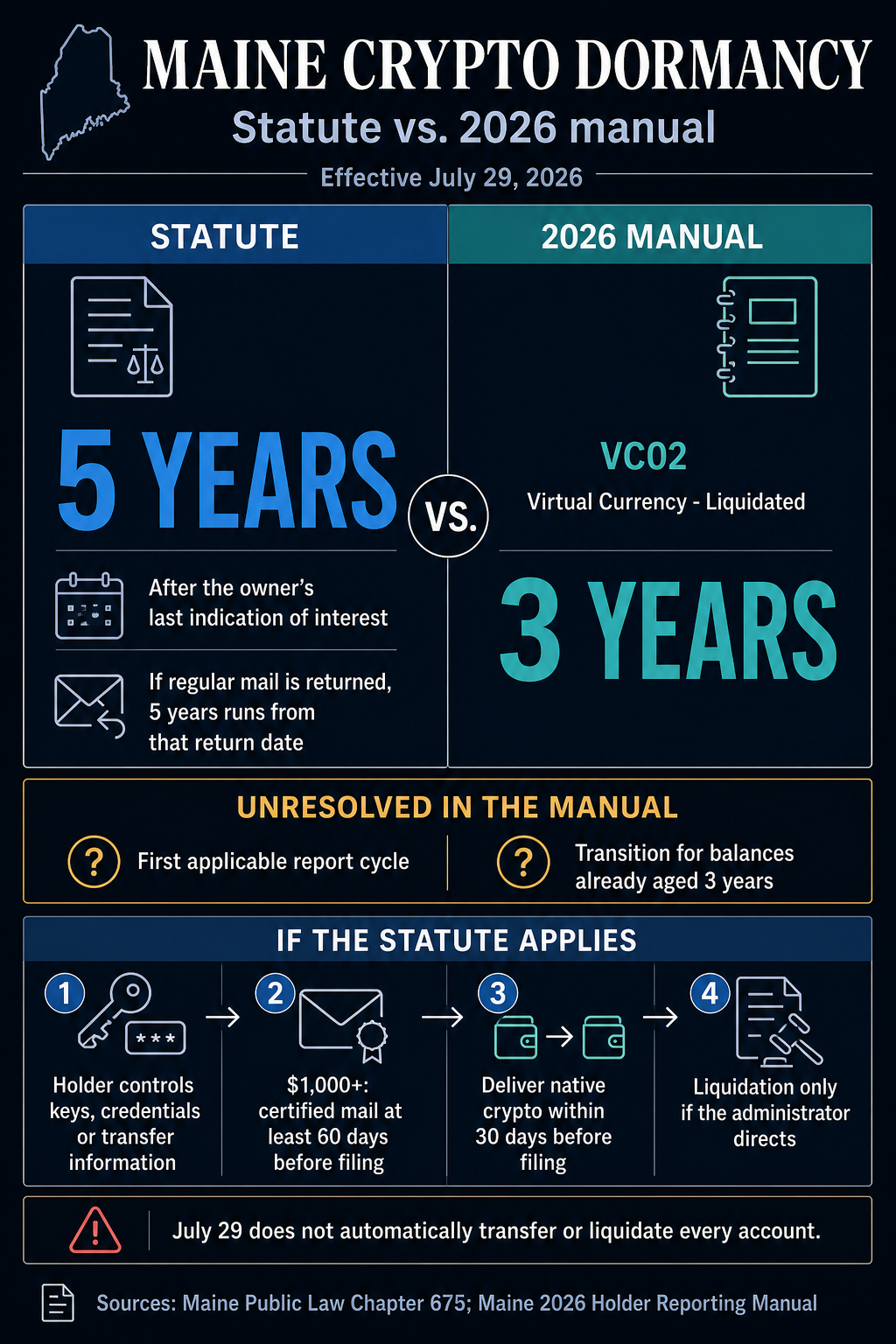
The new section presumes virtual currency abandoned five years after an apparent owner's last indication of interest. If a holder sends first-class mail during its regular course of business, the five-year period instead runs from the date that communication is returned as undeliverable.
The State Treasurer's 2026 Holder Reporting Manual, however, lists “VC02 Virtual Currency – Liquidated” with a three-year dormancy period. The manual reflects LD 1969 elsewhere by giving stored-value obligations a July 29 transition date, but it provides no parallel virtual-currency schedule.
The manual says most holders other than life insurers report by Nov. 1. It does not identify the first virtual-currency cycle under section 2067-A or explain how to treat balances that its table would classify as dormant after three years. Whether VC02 is legacy coding, a distinct category or an entry awaiting revision remains unresolved in the holder guide.
What holders must do under the statute
For a business holding customer crypto, the remittance duty applies when it has private keys, credentials or other information needed to transfer presumed-abandoned assets. It must report the property and deliver the crypto in native form within 30 days before filing, following the unclaimed-property administrator's directions. A holder without sufficient transfer information must retain the assets until a transfer becomes possible. Assets controlled only by an owner using their own wallet are not part of that described third-party transfer process.
For virtual currency worth at least $1,000, a holder must send certified U.S. mail at least 60 days before filing when it has a sufficient owner address that its records do not identify as invalid.
Liquidation is not automatic. The administrator may direct a holder to liquidate within 30 days before filing, decline certain assets, exempt classes by rule or direct another disposition when liquidation is not reasonably possible. An owner cannot recover gains that occur after an administrator-directed holder liquidation.
That pre-filing process differs from native crypto delivered into state custody. The administrator generally may not sell those assets for one year. If the state sells within that period and the owner files a qualifying claim before the year expires, the statute allows the greater of sale proceeds or claim-time market value, plus applicable increments.
July 29 does not itself liquidate or transfer every account. The five-year dormancy, notice and reporting conditions still must be met, while the Treasurer's manual leaves holders without an answer on the first report cycle or the transition from its three-year VC02 entry.