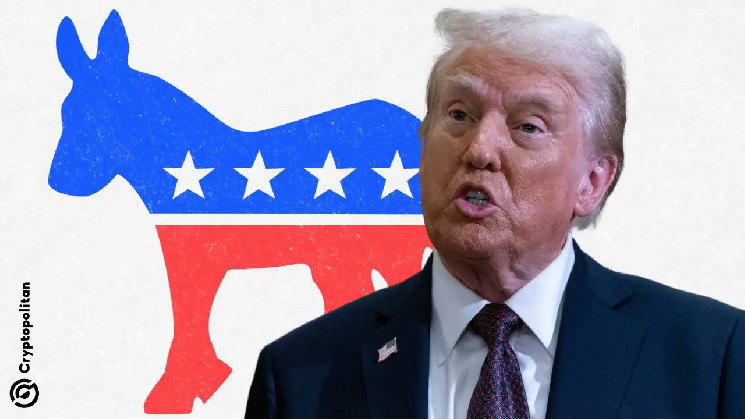
They demanded that the Fed and OCC explain how they plan to prevent Trump from using his office to manipulate financial policy and protect his personal business interests.
Democrats question Fed and OCC over Trump family’s $USD1
The lawmakers said the launch of $USD1 places Trump in a position to interfere with financial regulators just as Congress is reviewing the $GENIUS Act, a bill that would give the Fed and OCC broad powers over stablecoin oversight.
While the bill claims to strengthen crypto enforcement, the version now under review includes no limits on the President’s ability to override regulatory actions that could hurt the profitability of his own token.
The senators warned that Trump could step in to block any OCC decision on $USD1, demand they avoid setting strong rules for stablecoins, or even stop them from investigating World Liberty Financial altogether.
They added that in a crisis, Trump could direct the Fed to launch a liquidity program specifically to prop up stablecoins like $USD1—or worse, give special access to WLF by pushing the central bank to grant it a master account, something that would allow direct ties to the Federal Reserve system.
The group also flagged the risk that Trump could deny this kind of help to other crypto competitors, creating a completely unfair playing field. They pressed both agencies to confirm whether they’ve put internal controls in place to block political interference and keep regulation, enforcement, and supervision free from White House orders.
The senators asked directly: “How will you protect your independence when the President’s own company is the one being regulated?”
$GENIUS Act advances in Congress
Since taking office, Trump has promised to make the U.S. the “crypto capital of the world” and claims the dollar-backed stablecoin is a step toward that goal.
On March 7, Trump met with two dozen crypto executives at the White House and told attendees he wanted Congress to pass stablecoin legislation and send it to his desk by August. Bo Hines, a senior White House adviser focused on crypto, later said the bill could reach Trump for signing by May.
The legislation, known as the $GENIUS Act, passed through the Senate Banking Committee with an 18-6 vote. It even got support from five Democrats. But three of the five senators who signed the Friday letter—Warren, Van Hollen, and Reed—voted against it in committee. The other two, Booker and Wyden, aren’t on the committee but still raised concerns about the bill’s lack of checks on presidential power.
The $GENIUS Act is now headed to the Senate floor. If passed, it would hand stablecoin regulation to the Fed and OCC, but with no clear firewalls to keep the White House out of day-to-day decisions. That’s where the senators see a massive red flag: the very person who signs the bill could also block enforcement actions and tilt the system in favor of his own business.

 cryptopolitan.com