coindesk.com
Happy Thursday, advisors!
In today’s newsletter, Prashant Kher of EY-Parthenon on what new survey data shows about where stablecoins are gaining ground, and what will decide which payment rails scale
Then, in “Ask an Expert,” Sam Boboev of Fintech WrapUp on whether euro stablecoins can challenge the dollar’s lead, and who is best placed to win on distribution.
Happy reading.
- Sarah Morton
Stablecoins are going mainstream
A year ago, the stablecoin debate centered on whether regulatory clarity and a compelling combination of speed, cost and liquidity benefits would drive meaningful adoption. The evidence now points to a market moving decisively from experimentation toward implementation.
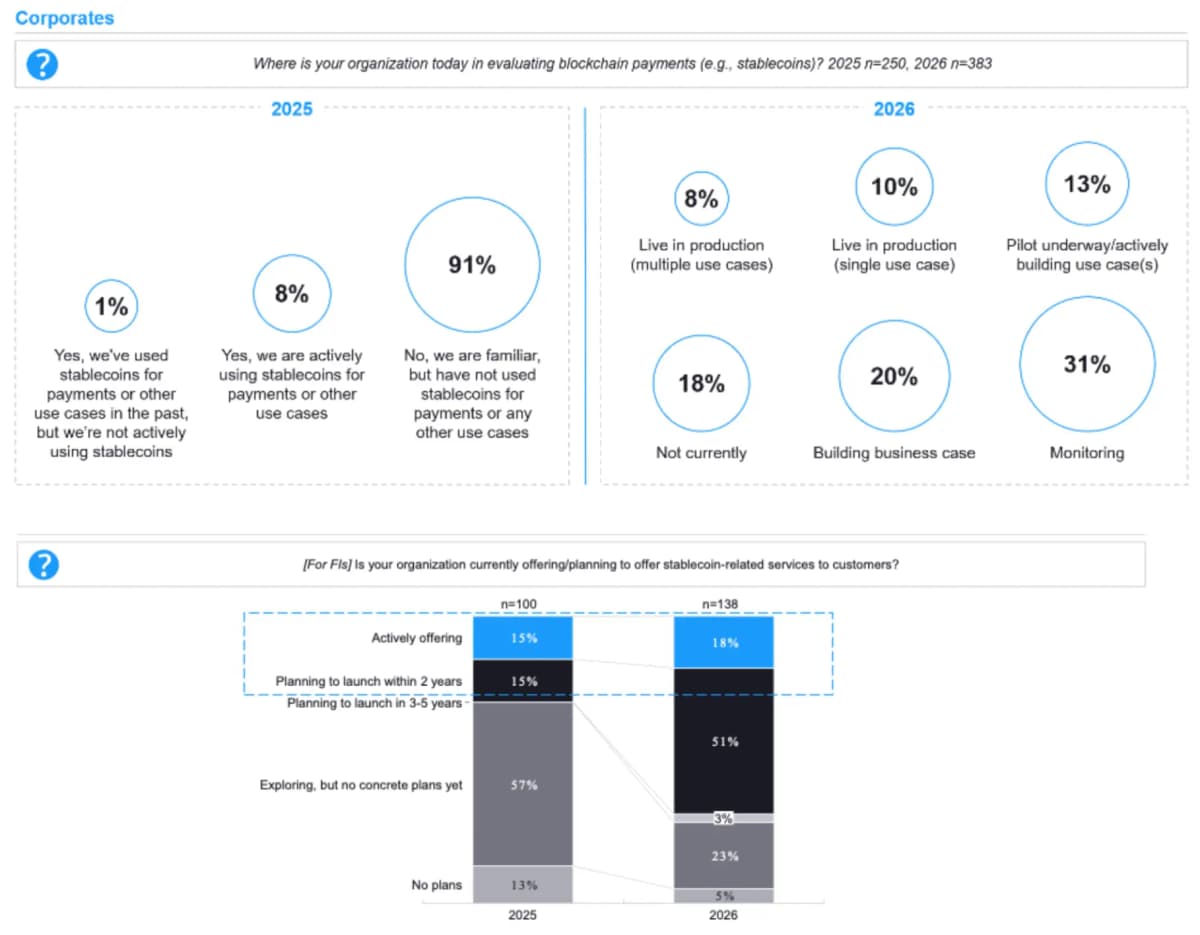
EY-Parthenon’s 2026 Blockchain Payments Survey of 521 corporate and financial institution decision-makers found that 18% of corporates have used stablecoins in production, double the share reported in our 2025 survey. Tokenized deposits are close behind, with 15% of corporates reporting adoption.
Financial institutions are also making firm commitments. A total of 69% offer stablecoin services or plan to launch them within two years, up from 30% in 2025. Among banks, 49% already offer or plan to offer tokenized deposits over the same period.
Although blockchain payments have not yet reached mass adoption, the survey findings provide clear evidence that the market is shifting from technology trials to integrating capabilities into existing payment workflows and treasury operations.
Cross-border payments are the entry point
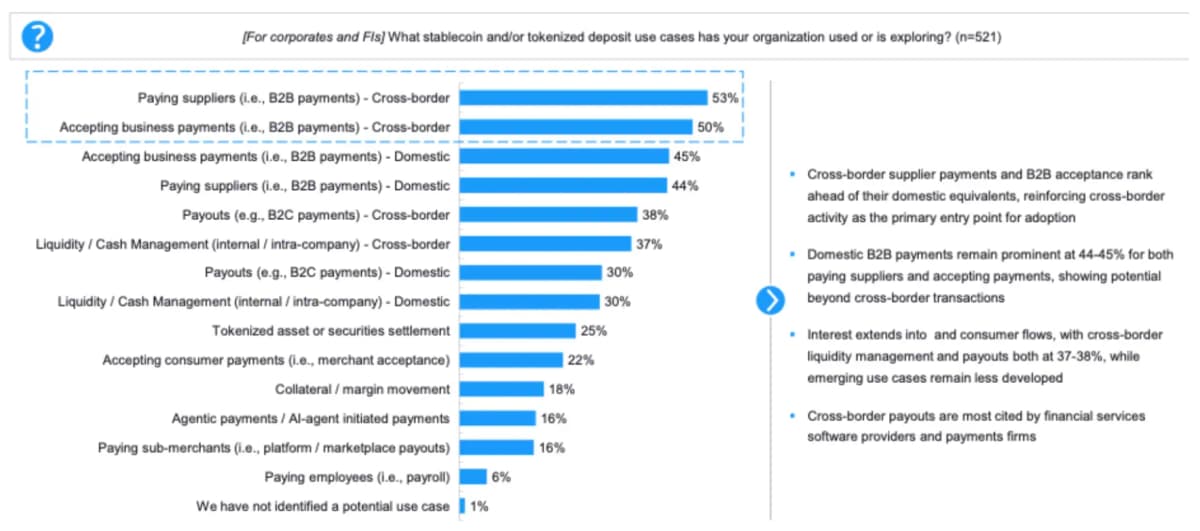
Cross-border business payments remain the most common use case. Across stablecoins and tokenized deposits, 50% to 53% of all respondents have used or are exploring each for cross-border supplier payments or cross-border business-to-business (B2B) payment acceptance.
Overall blockchain payments exploration & adoption
Cross-border B2B flows lead blockchain payment use cases for most respondents, while interest in payouts is concentrated among banks and payments firms.
These applications directly address frictions corporates experience in cross-border payments. A total of 56% cite slow processing and settlement; 52% cite foreign exchange costs or spreads; 48% cite regulatory, sanctions and compliance delays; and 36% cite correspondent banking fees. Financial institutions see the corresponding opportunity, with faster settlement and lower costs ranking among the leading drivers of interest in both stablecoins and tokenized deposits.
The opportunity extends beyond basic money movement. Tokenized asset settlement was the most frequently selected opportunity to add value on top of blockchain payment rails, cited by 63% of respondents from financial institutions, reflecting strong interest in using blockchain-based money as a settlement mechanism.
However, competing with existing stablecoin issuers will require sufficient liquidity and broad distribution.
The real test will be whether these consortiums can convert their existing banking relationships into meaningful transaction volumes.
Q. What is driving the push for euro-denominated stablecoins, and can they challenge the dominance of U.S. dollar stablecoins?
- Euro stablecoins currently represent a tiny share of the market. According to Bank of Ireland, just 0.2% of global stablecoin circulation was euro-denominated in May 2026.
This creates a problem for European businesses that want to use blockchain payments while keeping their transactions and treasury balances in euros.
Using dollar stablecoins introduces foreign exchange costs and currency exposure.
The EU’s Markets in Crypto-Assets (MiCA) regulation has provided a regulatory framework for euro stablecoin issuers, while European banks are developing infrastructure to support euro-denominated settlement.
I see the strongest opportunities in European B2B payments and corporate treasury.
However, challenging dollar stablecoins globally will be difficult. Dollar liquidity and established distribution networks give existing issuers a considerable advantage.
The more realistic opportunity is to build a strong euro stablecoin market serving European businesses and financial institutions.
Adoption will depend on liquidity and integration with existing banking systems.
- Sam Boboev, founder, Fintech WrapUp