
 coindesk.com

Bitcoin, ether and every other major cryptocurrency fell on Friday, with many pointing to a Beijing startup that gave away a model that beat Anthropic's best at writing code.
Moonshot AI released Kimi K3 on Thursday, and by Friday morning, AI and semiconductor stocks were selling off across Asia as traders dubbed it a "Kimi moment," an echo of the DeepSeek shock that erased roughly $600 billion from Nvidia's market value in a single session.
What Moonshot built is a 2.8-trillion-parameter model with a one-million-token context window, roughly four times the size of its previous version. It runs on a mixture-of-experts design, meaning it activates only a small slice of itself for any given task, in this case 16 specialists out of 896, which is how a model that large stays cheap to run.
Moonshot says architectural changes give it roughly 2.5 times the scaling efficiency of its predecessor, according to its technical blog.
On Arena's Frontend Code leaderboard, K3 scored 1,679 against 1,631 for Anthropic's Claude Fable 5 and 1,618 for OpenAI's GPT-5.6, taking first place and ranking top in six of seven categories.
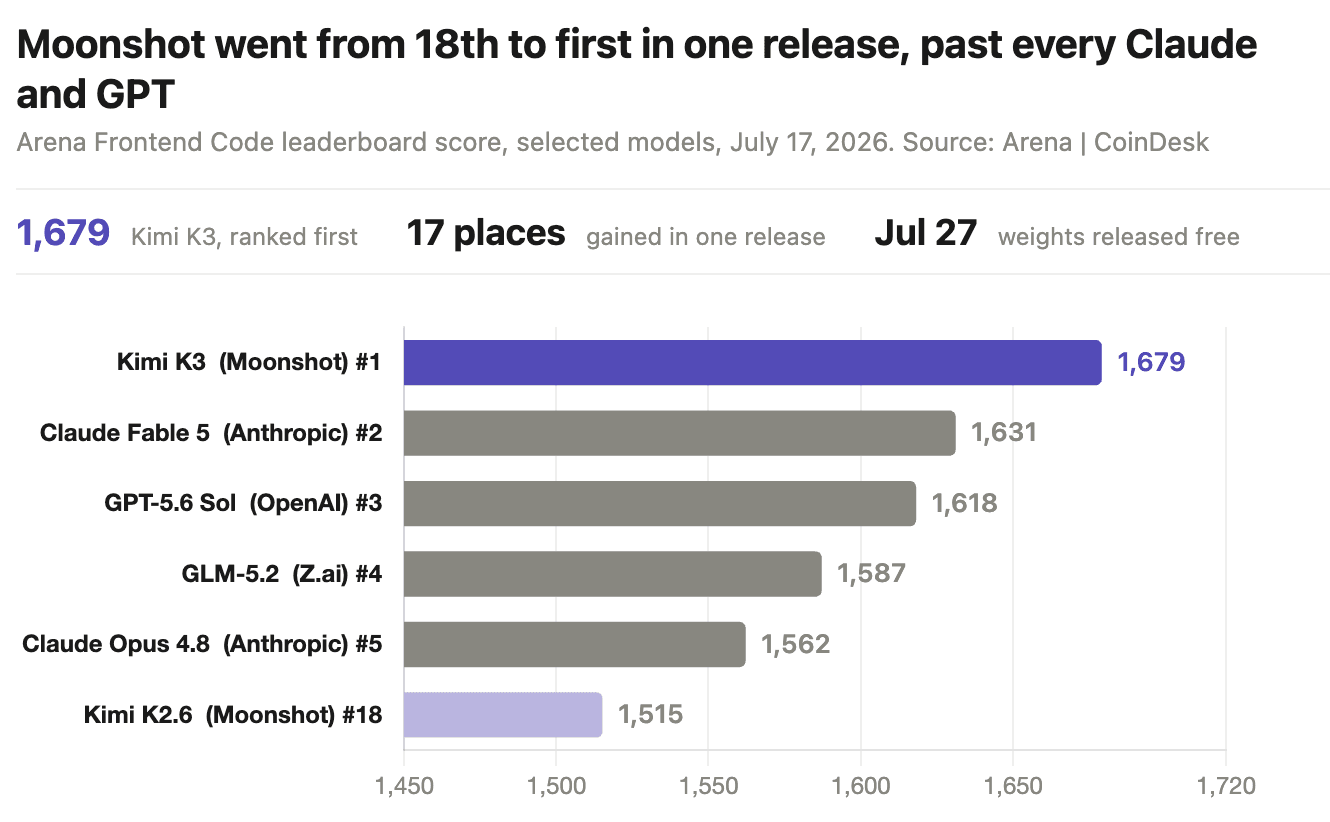
Moonshot's own previous model sat at number 18. That is a 17-place jump in one release. On broader tests of general knowledge work, K3 lands behind the top Claude and OpenAI configurations rather than ahead of them, so this is a win in a specific domain, not across the board.
The part that rattles valuations is the license. K3 is open-weight, with the full model due for public release on July 27. Anyone will be able to download it, run it on their own hardware, and pay nobody.
Anthropic released Fable 5 last month, and OpenAI shipped GPT-5.6 a week ago, both closed and metered. The assumption underwriting hundreds of billions of dollars in AI infrastructure spending is that frontier capability stays scarce, expensive and American.
A free Chinese model at the top of a coding leaderboard is a direct argument against that.
Meanwhile, Moonshot's domestic rivals took it worst, with Z.ai falling about 27% and MiniMax about 16%.
For crypto, the headwinds run through the tape rather than through anything onchain. Bitcoin has spent this entire week taking direction from semiconductors.
Last Friday, it rose 4% on the day South Korea's Kospi jumped 8% and SK Hynix priced $26.5 billion of American depositary shares. This Friday, it fell because a model release in Beijing made the same trade look expensive.
There is, however, a more concrete exposure underneath.
Bitcoin miners have spent two years repositioning themselves as AI data center landlords, signing long-term leases with model developers on the assumption that demand for training and inference compute keeps rising.