en
Back to the list

Ethereum Economic Zone Runs Atomic L1-L2 Transfer on Mainnet

source-logo  news.bitcoin.com 07 October 2026 03:10, UTC
image

EEZ Showcases an Atomic L1-to-L2 Transfer on Ethereum Mainnet

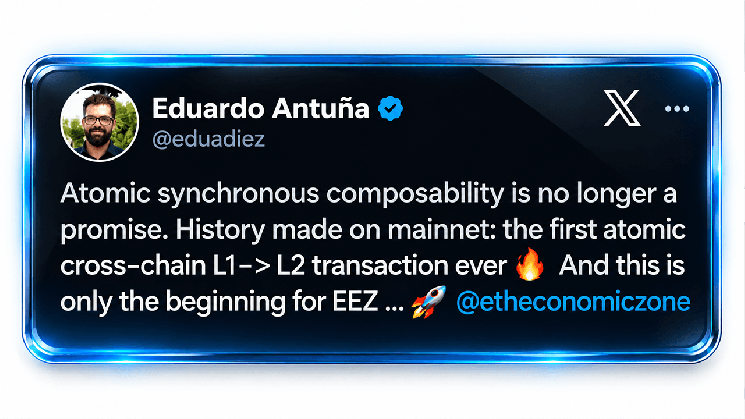
On Monday, Eduardo Antuña Díez, a core engineer from the EEZ initiative, highlighted a transaction on X showing how two layers can be locked to the same moment. “Atomic synchronous composability is no longer a promise,” the developer wrote. The developer added:

“History made on mainnet: the first atomic cross-chain L1->L2 transaction ever. And this is only the beginning for EEZ.”

Basically, EEZ moved 0.001 $ETH and updated a rollup in the same all-or-nothing operation, an action often dubbed “atomic.” It should be noted that EEZ’s transfer was a technical demo and not a finished product or an Ethereum protocol upgrade. Before the transfer took place, there was an audit, live blob encoding, and tests against Cow Swap and Uniswap v4.

app-logo

Know when your
coins move

Alerts, real-time prices, and market news — all in one app
4.8 based on 40K reviews in the App Store and Google Play

One Ethereum Ecosystem, Without Fragmented Capital

EEZ is a project designed to fully connect Ethereum’s separate offshoot networks, known as L2s, while combining their fragmented pools of capital into a single, shared ecosystem. Backed by the Ethereum Foundation and led by groups including Gnosis and Zisk, the initiative launched in early 2026. EEZ initiatives are designed to reduce fragmentation between Ethereum’s main chain and its growing collection of L2 networks.

A Major Technical Step, but the Hard Work Is Not Finished

Jakub Gregus, co-founder of the decentralized finance (DeFi) protocol Hydration, explained on X that this can help Ethereum a great deal. “I told you couple months ago I am becoming increasingly bullish on Ethereum as technology,” Gregus remarked, re-posting Antuña Díez’s X post. “This is insane. One of the most important milestone[s] in whole crypto [in my honest opinion]. Unlike other tech developments, this can also help $ETH directly a lot.”

Many other individuals asked the EEZ dev or Grok how the tech worked. Another individual said, “They just one-shotted Ethereum’s biggest problem.”

While the transfer is certainly exciting and new, saying it “one-shotted” Ethereum’s fragmentation issues is, to say the least, getting a little ahead of the technology. Full two-way calls, nested cross-chain calls, and real-time proving remain on the roadmap through 2027, while the publicly available core software is still characterized as early-stage.

news.bitcoin.com