
 ambcrypto.com

When institutions start reducing exposure, it’s rarely about short-term noise.
The latest move from the Harvard Endowment fits that narrative. According to Q1 2026 SEC 13F filings, Harvard reduced its IBIT exposure by 43% to 3,044,612 shares ($117 million), following a prior 21% trim in Q4. More notably, the endowment fully exited its $86.8 million position in BlackRock’s spot Ethereum [$ETH] ETF.
For context, Harvard had only initiated this Ethereum ETF position in Q4 2025, when filings first showed an $86.8 million allocation, making the recent exit a complete reversal within just one reporting cycle. Naturally, this raises the question: What does this exit really signal?

Looking beyond price action, Ethereum as an L1 network is about more than speculation.
According to DeFiLlama, Ethereum dominates key crypto market segments such as Total Value Locked (TVL), stablecoin liquidity, and tokenization activity. This dominance keeps Ethereum central to the broader Web3 transition, where chains with deeper on-chain liquidity attract institutional flows.
However, since the Q4 2025 cycle, Ethereum’s TVL dominance has largely reverted to earlier levels, while stablecoin supply has grown by only about 2.5%, pointing to slowing momentum across on-chain fundamentals. Against this backdrop, Harvard Endowment’s exit from BlackRock’s Ethereum ETF stands out as a meaningful shift in institutional positioning rather than just routine portfolio adjustment.
When you combine this with smart money positioning, the shift looks even more pronounced.
Ethereum sees smart money move from accumulation to speculation
In an uncertain market, smart money positioning is rarely a coincidence.
Ethereum’s technicals reflect this clearly. The asset has pulled back nearly 8% this week, forming a local top around the $2.5k zone. At the same time, $ETH has held above $1.7k for over three months, establishing a key base for bulls. If that level breaks, Ethereum risks printing a third lower low after its peak at $4.9k in August.
Typically, smart money accumulation helps stabilize price by buying into fear and reinforcing support levels. However, recent ETF outflows and whale selling suggest the opposite dynamic, with distribution pressure starting to build. In short, support formation is fading, and a breakdown below $2k is increasingly in focus.
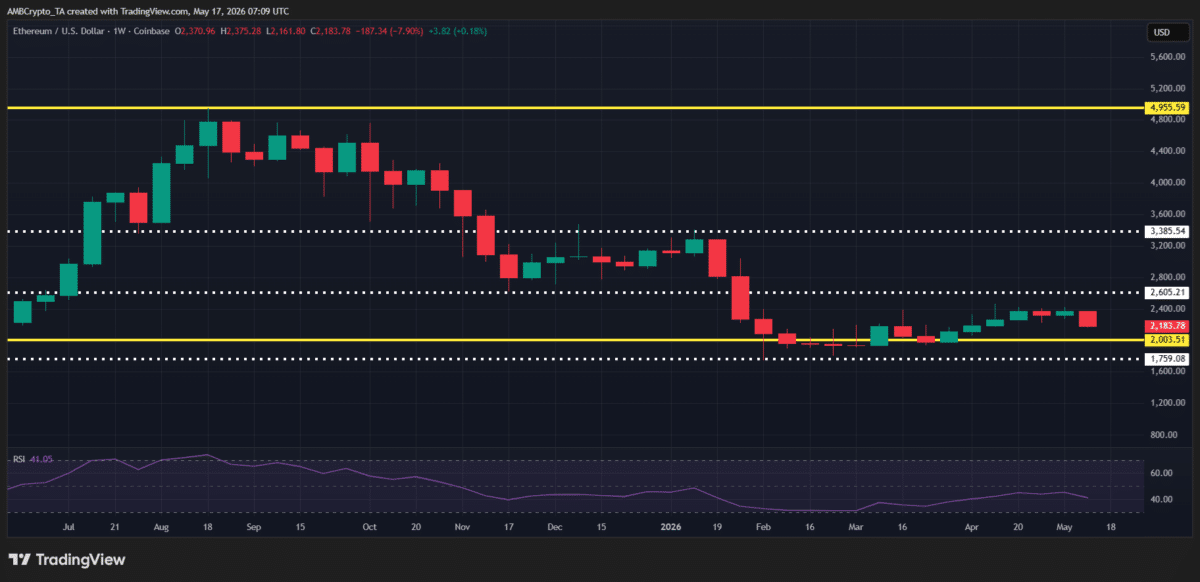
The key takeaway, however, is that Ethereum whales are now shifting into short positions.
As noted earlier, smart money behavior in a risk-off phase is rarely random. With Harvard’s exit, weakening on-chain fundamentals, and changing positioning across large players, the shift from “buying fear” to shorting $ETH signals growing downside conviction across the market. Naturally, this suggests that a third lower low below $1.7k is not overly pessimistic.
Final Summary
- Harvard’s ETF exit, weak on-chain growth, and whale shorts suggest institutions are reducing risk on Ethereum.
- If this continues, $ETH could lose $2k support and even dip below $1.7k.