In practice, this means $ETH can be allocated across multiple protocols, earning returns through lending, staking, or other yield mechanisms without locking users’ liquidity.
Staking Yield
In an X post on Aug. 18, ether.fi said $ETH Strategy “will be deploying a significant portion of their $ETH holdings into weETH,” a non-rebasing ERC-20 token representing staked Ethereum.
While the exact amount wasn’t disclosed, on-chain data shows $ETH Strategy has allocated 2,048 $ETH to weETH so far, along with smaller deposits to Lido, Liquid Collective, Renzo, and Aave.
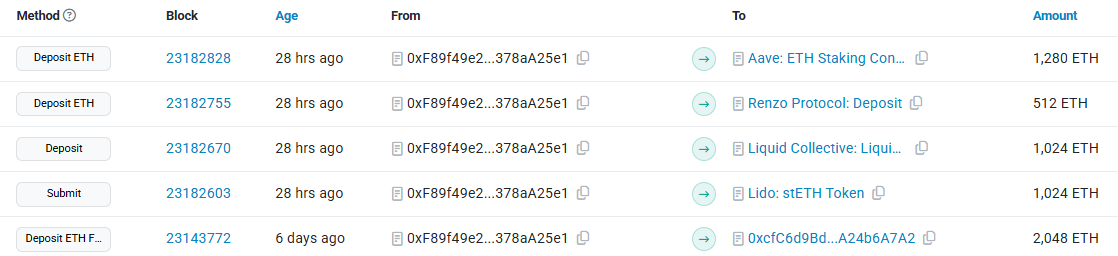
$ETH Deposits
$ETH Strategy isn’t a company with a traditional off-chain balance sheet. It’s a set of smart contracts running on Ethereum that manage treasury positions autonomously. In its official documentation, $ETH Strategy says it has “2 audits completed,” but adds that “these will be public later,” without naming the auditors or providing a timeline.
$ETH Strategy did not respond to The Defiant’s request for comment.
The protocol’s native token STRAT is designed to give leveraged exposure to $ETH without the typical liquidation risks of borrowing. Users bond $ETH or stablecoins to receive a convertible note, which consists of a fungible on-chain debt token (CDT) and an $NFT call option on STRAT.
Holders can sell the CDT for stablecoins while keeping the $NFT to later convert into STRAT.
The protocol earns from the option premiums, and STRAT only gets minted when someone exercises their $NFT option, which burns the matching CDT and keeps supply tied to activity.
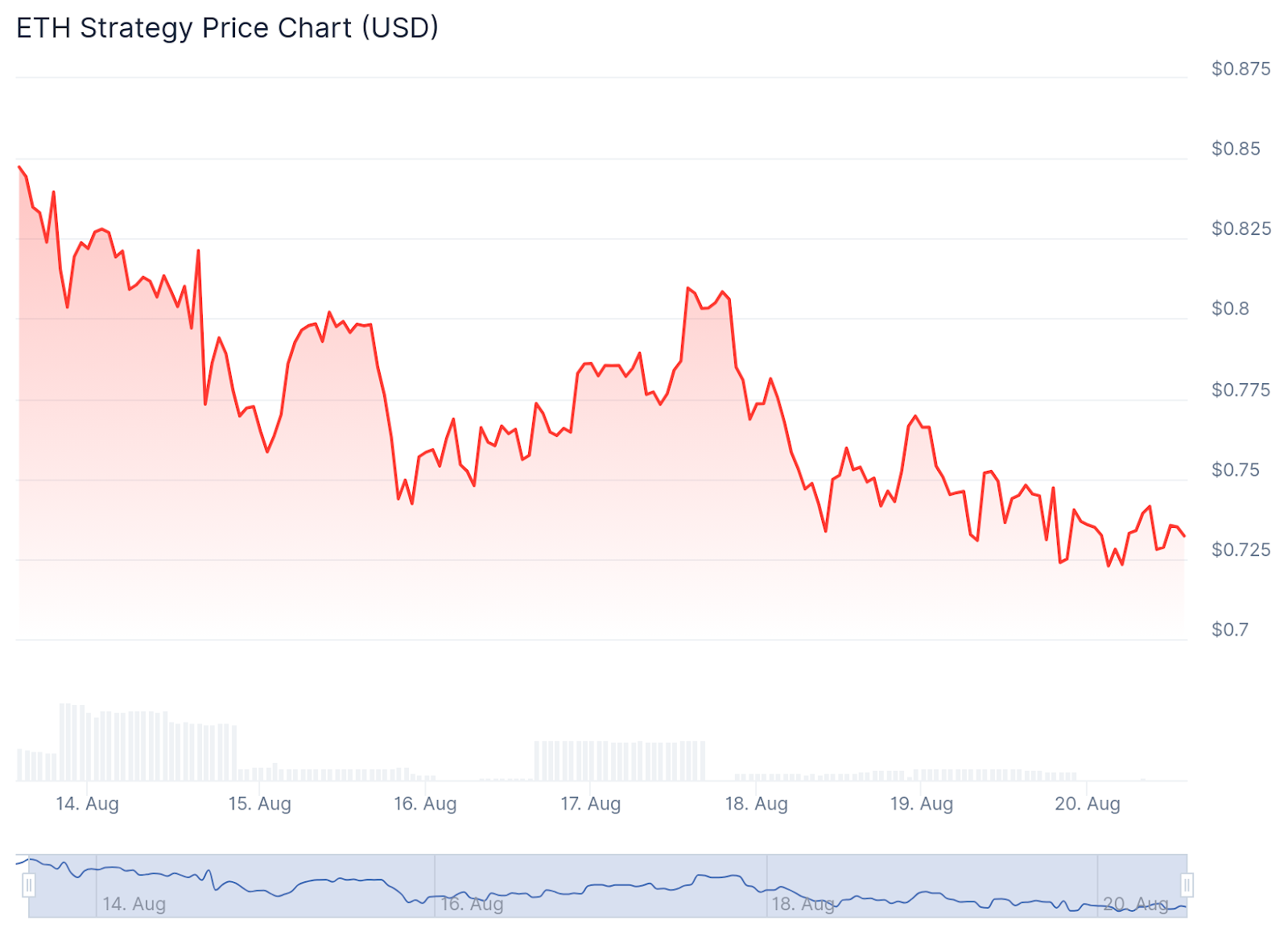
STRAT Chart
That structure doesn’t eliminate market risk, though. The project’s documentation specifically warns that a prolonged $ETH downturn “may result in insufficient treasury value to repay debt at expiry.”
As of press time, STRAT is down about 13.5% since its Aug. 13 launch, compared with roughly 9% for $ETH, per data from CoinGecko.

 thedefiant.io