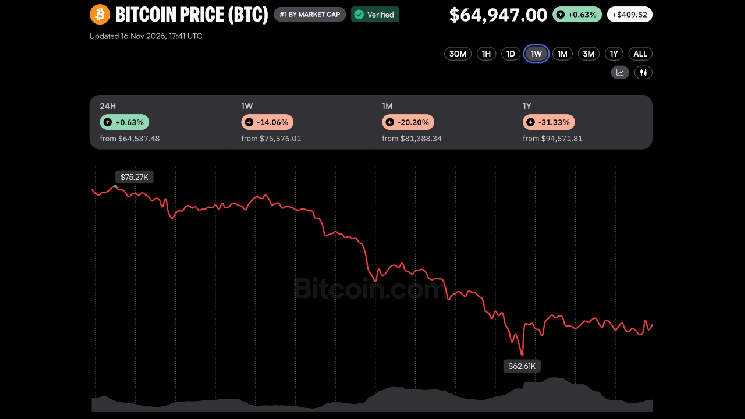
Several macro and political headwinds have weighed on the market since the start of the month, including a shift of power in the U.S. Congress and reports that Democrats plan to introduce legislation prioritizing consumer protection over crypto innovation. Meanwhile, a broader tech and AI-linked stock sell-off, compounded by the Nvidia scandal and the ouster of former CEO Jensen Huang, kept downward pressure on bitcoin heading into the weekend.
Glassnode Warns of Liquidity Constraints and Weak Institutional Demand
Onchain analytics firm Glassnode projects that these headwinds will keep the market in a constrained liquidity environment for the remainder of the year. In its latest report, the firm noted that capital is gradually leaving the ecosystem amid declining institutional demand, U.S. spot bitcoin ETF outflows, and slowing stablecoin momentum.
With bitcoin trading well below its short-term holder cost basis of roughly $75,600, Glassnode warns that a dense overhead supply zone stretching toward $83,600 will likely cap any major relief rallies. Still, the firm pointed out that recent corrections have flushed out systemic leverage and spurred renewed dip-buying among wallets holding between 100 and 10,000 bitcoin, providing structural support above earlier cycle lows.
Despite these broader pressures, a sharp sell-off that began Friday and spilled into Saturday initially sparked confusion among traders, as there were no obvious weekend catalysts to explain the drop. Himanshu Sahay, chief revenue officer at Arch Lending, attributed the sudden move to forced liquidations among overleveraged traders in a thinly traded market.
“I don’t think one event caused the weekend sell-off. Fewer people trade on weekends, so when the price started to slip, leveraged positions got closed automatically and that selling pushed it lower. The partial recovery since then suggests most of the selling was forced,” Sahay told Bitcoin.com News, adding that he is watching closely to see whether the rebound holds once the forced selling subsides.
Edwin Mata, CEO and co-founder of Brickken, echoed that assessment, pointing to rolling 24-hour crypto liquidations that briefly topped $2 billion on Sunday. Mata noted that when exchanges automatically close leveraged long positions, the resulting asset sales can trigger a cascade of downward price pressure, an effect amplified by lower weekend liquidity.
“With some leverage now gone, I will be looking to see if new selling can be absorbed by buying in the spot market. If bitcoin tests Sunday’s lows, then we will get a better understanding of how strong demand is. Clearing out leveraged longs can slow the selling. For a recovery to hold, spot buyers need to keep showing up after the forced selling has passed,” Mata said in a market report shared with Bitcoin.com News.

 news.bitcoin.com