
 coindesk.com
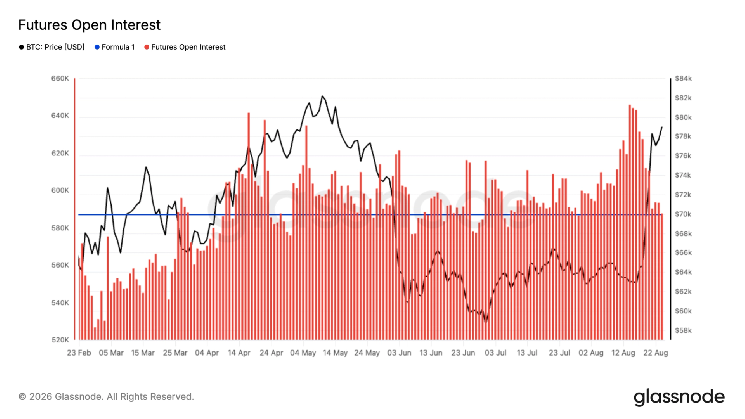
Over the past week, bitcoin $BTC$79,831.30 has surged from around $62,000 to around $80,000, delivering its second-largest weekly gain of the past five years. A rally of this magnitude would typically trigger a surge in risk-taking, with traders piling into leveraged products such as futures to amplify potential returns.
This time, however, appears different, and it points to a painful truth for bulls – short covering, or closure of bearish bets, appears to have helped drive prices higher rather than fresh outright long positions.
That’s evident from futures open interest (OI), a metric tracking the total number of active futures contracts at a given time. As of this writing, the OI stands at around 587,584 $BTC, the lowest in nearly five months and down from 645,760 $BTC on Aug. 14, according to data source Glassnode. Measuring open interest in bitcoin terms provides a clearer picture of positioning because it removes the mechanical increase that bitcoin’s rising dollar price would otherwise cause.
In other words, as the spot price surged, open interest actually fell. This happened because short sellers who had bet on a continued drop either closed their positions by buying back their shorts or were forcibly liquidated by exchanges due to margin shortfalls.
The data supports this. Billions of dollars in short positions were liquidated during the move, creating a short squeeze that helped propel Bitcoin above $80,000.
At the same time, annualized funding rates in perpetual futures, which provide a glimpse of trader positioning and market sentiment, have held steady below 10%, pointing to only moderate bullish positioning. Strong demand for long positions would have pushed those rates significantly higher.
Silver lining
Low participation in the derivatives market has a silver lining – it tends to make price moves steadier and gains more sustainable.
That positive impact is more pronounced when the slowdown in activity is characterized by a slide in open interest in futures collateralized by $BTC or another cryptocurrency. That’s precisely the case right now.
According to Glassnode, crypto-margined open interest has fallen to an all-time low of roughly 52,000 $BTC and now accounts for just 11% of the total market activity.
This makes the market structurally less volatile because the value of cash collateral does not fall alongside bitcoin during a sell-off. By contrast, crypto-backed collateral can create a feedback loop in which falling prices reduce collateral values, trigger liquidations and intensify the decline. The shift towards cash-margined futures helps explain both bitcoin’s dwindling volatility in recent years.
