
 ambcrypto.com
Bitcoin’s [BTC] recent price increase is shifting focus towards how long-term holders (LTH) are reacting to current market conditions. Instead of increasing the distribution rate, LTH activity still points to measured profit-taking during periods of strength.
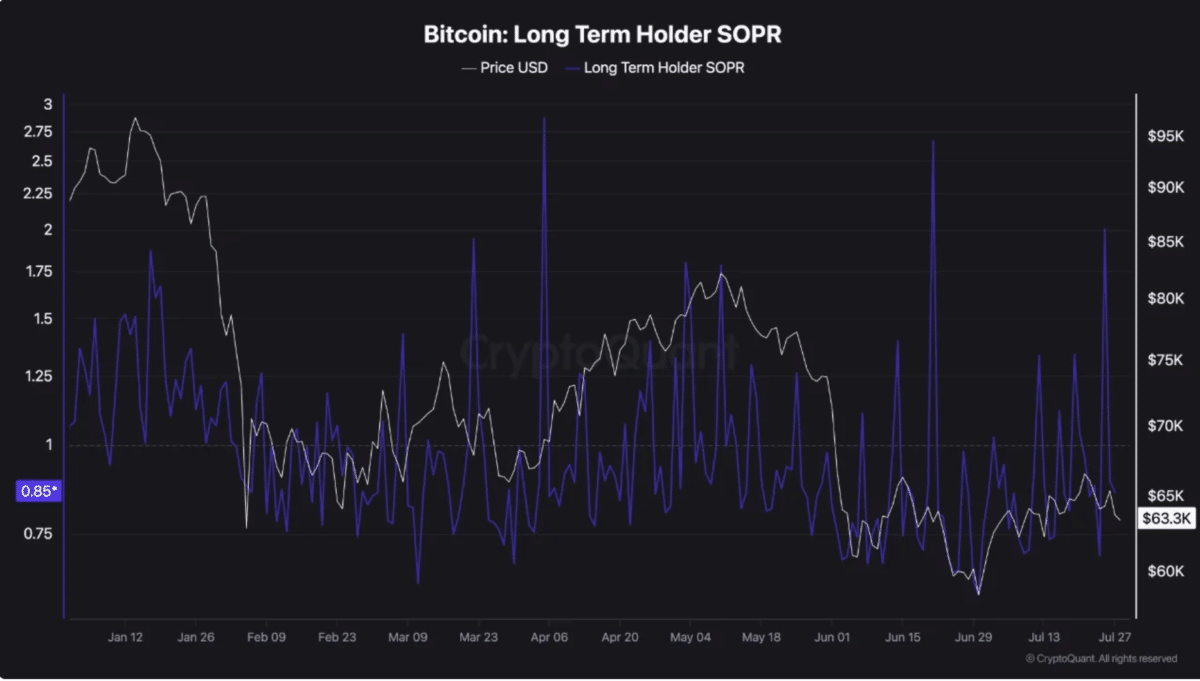
Recent Long-Term Holder SOPR data supports that view, printing another notable spike after similar peaks around the 5th of April and the 21st of June.
Since then, the metric has dropped down to about 0.85. However, the repeated spikes above the 1.00 baseline indicate that LTH are continuing to take profits.
Nevertheless, broader ownership trends remain constructive. The LTH/STH Realized Cap Ratio has climbed to 3.9, approaching the historical 4.0 cycle-bottom threshold. As realized capital increasingly shifts toward long-term holders, short-term participation weakens.
Still, fewer liquid coins remain available, reinforcing an accumulation-driven market structure despite periodic profit-taking.
Capital shifts to Bitcoin’s LTH
Despite the fact that long-term holders appear to be taking profits, overall ownership patterns point to additional bullishness. The LTH/STH Realized Capital Ratio has increased to 3.9 and is very close to the 4.0 level, which is historically a cycle-bottom threshold.
Meanwhile, Long-Term Holder Realized Cap continues to rise while Short-Term Holder Realized Cap remains muted near $215.9 billion. In simple words, this indicates that realized capital is increasingly concentrating among higher-conviction investors.
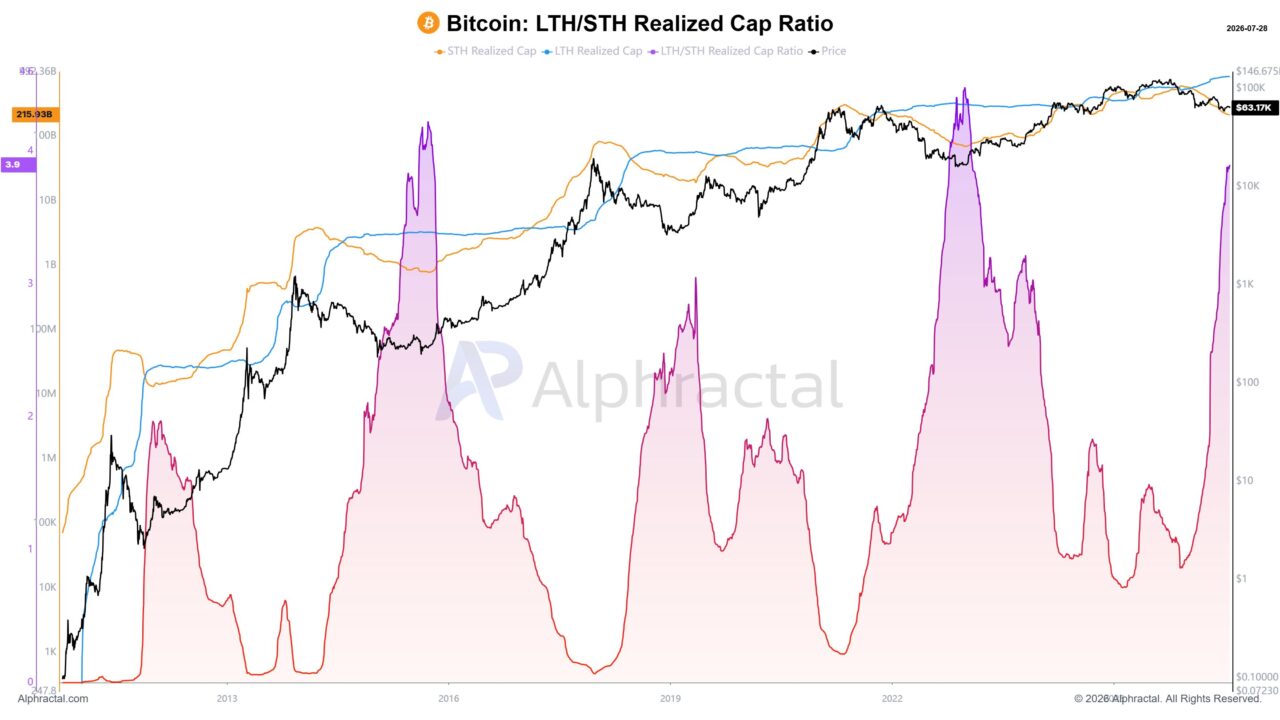
However, it’s worth noting that the ratio is still under 4.0. Therefore, the market has not yet established a historical pattern at a bottom. That said, the growing divergence between long- and short-term capital suggests accumulation continues outweighing speculation.
If the ratio breaks above 4.0 while this trend persists, it would strengthen the case for Bitcoin transitioning into a more mature accumulation phase.
Derivatives support the trend
That growing concentration of capital among long-term holders is now beginning to reflect in the derivatives market. This is through Binance’s 30-day Funding Rate sum, which has recovered to about 17.9 after remaining negative between March and late May.
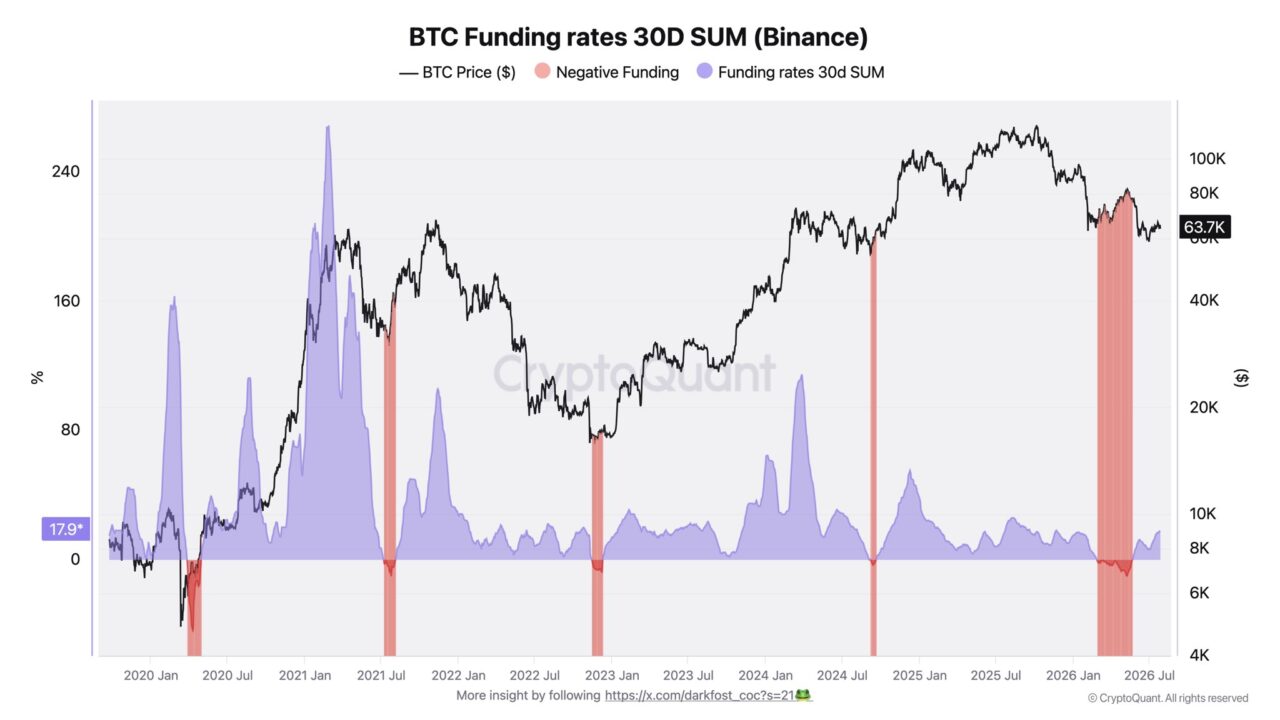
Putting it into perspective, negative funding typically signals that most traders expect prices to fall and are heavily shorting Bitcoin. A return to positive funding suggests bearish pressure is fading as buyers become more active.
Similar shifts emerged in December 2022 before Bitcoin recovered from $16,000, and again in September 2024 ahead of its rally from $54,000 to above $100,000.
Yet, history does not guarantee another rally. However, improving derivatives sentiment complements the broader accumulation trend evident in long-term holder activity
Final Summary
- Bitcoin continues favoring accumulation as long-term holders strengthen capital concentration despite measured profit-taking.
- Bitcoin is showing improving derivatives sentiment, though stronger demand is still needed to confirm a sustained recovery.