
 invezz.com

Bitcoin price has returned to the $63,000 region after surrendering Monday's geopolitical relief rally, leaving the cryptocurrency down about 3% over the past day.
According to CoinGecko data, Bitcoin ($BTC) was trading around $63,270 at the time of writing, down roughly 3% over the past 24 hours after briefly climbing above $65,500 during Monday's session.
The decline has left the world's largest cryptocurrency back near levels seen before the geopolitical relief rally.
Why did Bitcoin give back Monday's gains?
Monday's advance came after financial markets reacted positively to reports that military strikes between the United States and Iran had paused, reducing immediate concerns over a wider regional conflict.
Additional reports that Iranian and Omani officials were working on mechanisms to restore maritime traffic through the Strait of Hormuz also helped calm investors worried about disruptions to global oil supplies.
As crude oil prices fell and US equities opened higher, risk assets including cryptocurrencies moved higher.
The S&P 500 and Nasdaq Composite both traded modestly higher, while Bitcoin briefly reclaimed the $65,000 level.
The move failed to attract sustained institutional demand, however. Data from US spot Bitcoin ETFs showed $11.6 million in net outflows for July 27, indicating some institutional investors were reducing exposure even as prices moved higher.
By Tuesday, investor attention had returned to macroeconomic developments rather than geopolitics.
Ahead of the Federal Reserve's latest policy decision, market participants have remained cautious as Treasury yields stayed elevated and expectations for interest rates to remain higher for longer continued to weigh on risk assets.
Higher yields increase the relative appeal of government bonds compared with non-yielding assets such as Bitcoin, while a stronger US dollar can also pressure dollar-denominated assets by raising their cost for overseas investors.
Rather than extending Monday's rally, many traders treated the move above $65,000 as an opportunity to lock in short-term profits before the Fed announcement.
Selling accelerated once Bitcoin slipped below nearby technical support levels.
Data from derivatives markets showed more than $156.8 million worth of Bitcoin positions were liquidated over the past 24 hours, including approximately $133.5 million in long positions.
During the past 12 hours alone, long liquidations exceeded $106 million, indicating that leveraged bullish traders accounted for most of the forced selling.
As exchanges automatically closed those leveraged long positions, additional market sell orders entered the market, accelerating Bitcoin's decline toward the $63,000 region.
Bitcoin price analysis
The daily chart shows Bitcoin struggling below several key moving averages after failing to hold Monday's recovery.
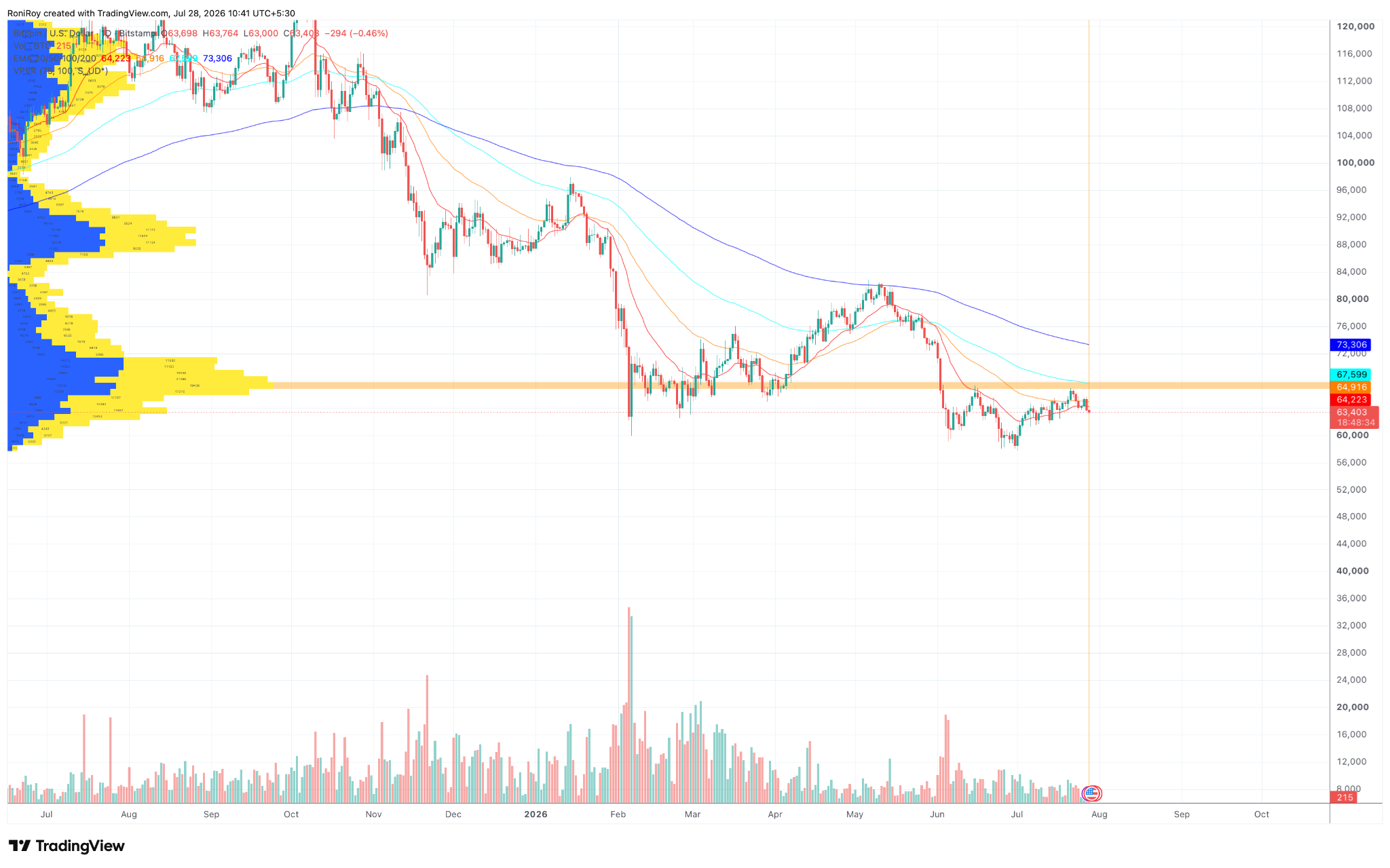
$BTC/USD 1-day price chart. Source: TradingView.
Price has slipped beneath the 20-day EMA near $64,223 and the 50-day EMA around $64,916, keeping short-term momentum tilted lower.
The 100-day EMA near $67,599 and the 200-day EMA around $73,306 remain well above the current price, indicating that the broader trend has yet to recover despite several rebounds during July.
Volume Profile Visible Range (VPVR) data identifies the $64,800-$65,000 region as one of the heaviest trading zones over recent months.
Repeated rejection from that area suggests sellers continue defending a major supply zone, limiting Bitcoin's ability to establish a sustained recovery.
The 4-hour chart also presents a similar picture as can be seen below.
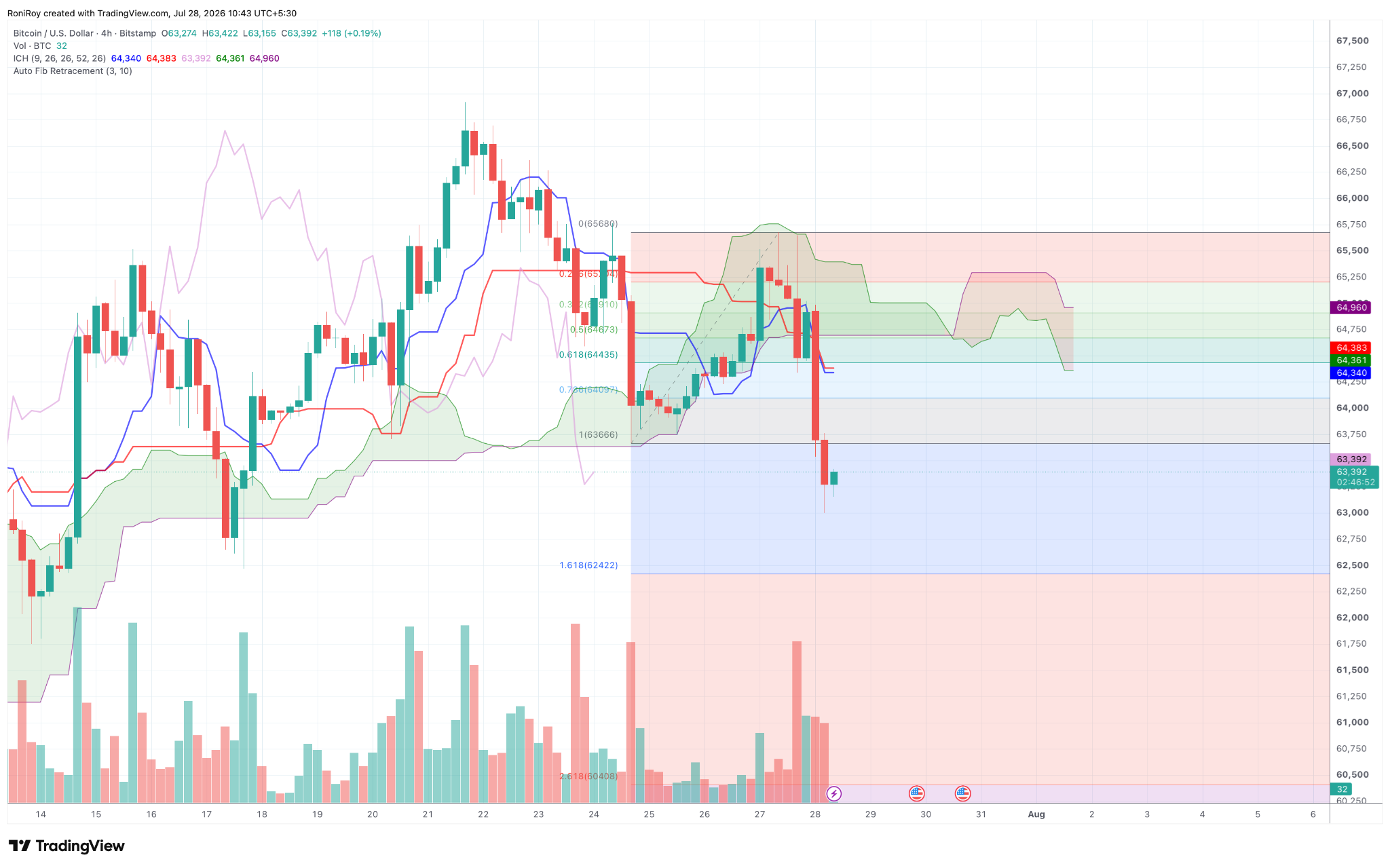
$BTC/USD 4-hour price chart. Source: TradingView.
After rallying into the $65,300-$65,600 resistance zone on Monday, Bitcoin reversed sharply and dropped through multiple Fibonacci retracement levels.
The sell-off also pushed price below the Ichimoku conversion line, base line and cloud, placing the cryptocurrency back in a bearish short-term structure.
The forward Ichimoku cloud continues to sit above current price action, indicating resistance could remain overhead if buyers attempt another recovery.
Immediate support now sits around the $63,000-$63,300 area, where Bitcoin has started to stabilise following Tuesday's sell-off.
Losing that zone could expose the recent swing low near $60,000-$61,000, which served as support earlier this month.
On the upside, Bitcoin would first need to reclaim the 20-day and 50-day EMAs before challenging the high-volume resistance around $65,000.
A decisive move above that region would improve the short-term outlook and reopen the possibility of retesting the $66,000-$67,000 area.