
 cryptopolitan.com
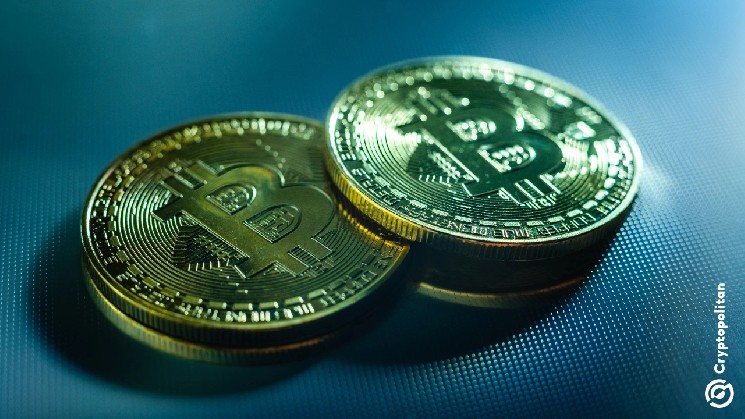
The Bitcoin Policy Institute (BPI) has been included by the US State Department as one of the founding partners in its new diplomatic initiative. This suggests that Washington is realizing the key role of Bitcoin in its strategic toolkit and is hence moving towards its increasing acceptance, at a time when institutional appetite for digital assets continues to be subdued.
This move is unlikely to bring about any substantial changes. However, it still stands as an important signal about the rising importance of Bitcoin in the US policy-making board, even if the market players are not yet ready to let their guard down and enjoy the various investment opportunities that cryptocurrencies can bring.
A signal for holders, not a catalyst for price
According to CoinMarketCap, Bitcoin ($BTC) had a value of approximately $64,000 at the time this article was published, which marks a decrease of around 2% from the previous 24 hours. The lack of substantial reaction was anticipated since Freedom Tech Excellence Program (FTEP) is more of a fellowship program instead of a policy change, government procurement of Bitcoin or stimulus measure.
Despite that the announcement is meaningful in the long term. The inclusion of Bitcoin supporters in the State Department’s digital freedom program means that Washington acknowledges the importance of Bitcoin-related knowledge and the fact that it should be considered in foreign policy debates. This transformation may prove more relevant to institutional investors than the one-day price fluctuations of Bitcoin.
What the program asks of its partners
The State Department introduced FTEP on July 24, together with BPI and other founding partners such as Palantir Technologies, Anduril Industries, and the Victims of Communism Memorial Foundation.
The program is designed to put private-sector professionals into temporary roles to assist in projects involving digital freedom and new technologies. While participating, the individuals maintain their jobs with their companies, as the program will not lead to permanent jobs in the government.
“Private sector participants gain firsthand insights into foreign policy and development, while contributing their specialized skills in new and emerging areas where the Department may lack sufficient in-house expertise,” the State Department said.
As stated by Bitcoin Magazine, this program is committed to defending free online speech, combating illegal digital surveillance and scams, putting into practice privacy solutions like VPNs and encryption, safeguarding responsible artificial intelligence as well as making the internet safer.
BPI stated on X that its activities within the framework of FTEP will touch upon “online freedom of expression, privacy-enhancing technologies, countering digital surveillance, and responsible AI governance.”
“FTEP brings private sector experts like BPI into the State Department to advance diplomatic efforts on key issues including online freedom of expression, privacy-enhancing technologies, countering digital surveillance, and responsible AI governance.” — Bitcoin Policy Institute
Why Washington wants Bitcoin advocates at the table
The appointment is part of Donald Trump’s larger effort to establish America as a leading country in the area of digital assets.
The strategy took shape in March 2025 when Trump enacted an executive order for the establishment of the Strategic Bitcoin Reserve and the US Digital Asset Stockpile. According to Bitcoin Magazine, the reserve was initially funded with around 200,000 Bitcoins acquired through civil and criminal confiscated property.
The Bitcoin Policy Institute, established in 2021, is a nonprofit organization that aims to promote Bitcoin research and public policy. It deals with issues like monetary policy, energy, national security policy, and financial freedom. Cryptopolitan also wrote about the contribution of the BPI in the suit that involved almost 3.7 million dormant ($BTC), linked to both Satoshi Nakamoto and the Mt. Gox hack.
BPI has consistently emphasized that “freedom tech” must be a crucial part of U.S. foreign policy because such technologies protect journalists and dissidents, as well as people living under oppressive regime.
Thus, having chosen to be a part of FTEP, it appears as though the State Department is recognizing the role Bitcoin knowledge plays in tackling issues like information privacy, censorship, financial freedom, and national security.
A market already under pressure
The announcement comes at a time when institutional investors are withdrawing capital from crypto-funds.
CoinShares’ Digital Asset Fund Flows report for the week ending June 1, 2026, recorded net outflows of $1.67 billion, indicating a third week of withdrawals in a row and the second biggest outflow of the year. Outflows due to Bitcoin products contributed $1.438 billion, while the total assets under management decreased from $148 billion to $141 billion.
“This represents the largest weekly Bitcoin outflow recorded in 2026 so far.” — James Butterfill, Head of Research, CoinShares
For several months now, pressure has been slowly mounting. In its May 28, 2026 market update, Fidelity Digital Assets stated that Bitcoin dropped by approximately 13% year-to-date because of the process of deleveraging, rise in inflation, and geopolitical uncertainties.
Governmental recognition by itself is probably not sufficient enough to change the situation. But it does reinforce the conditions in favor of the proposition that Bitcoin is gradually becoming an inherent part of debates about US policies—a process that can outlive the present market cycle.