
 newsbtc.com

Retail Fear Persists as Short-Term Holders Capitulate Within the Uptrend
A recent CryptoQuant analysis adds another layer to the current political and macro-driven volatility, revealing that retail investors remain fearful of short-term price swings even as Bitcoin maintains a broader upward structure. The Short-Term Holder SOPR (STH SOPR) highlights a recurring behavioral pattern that tends to appear during corrective phases within a larger bull trend.
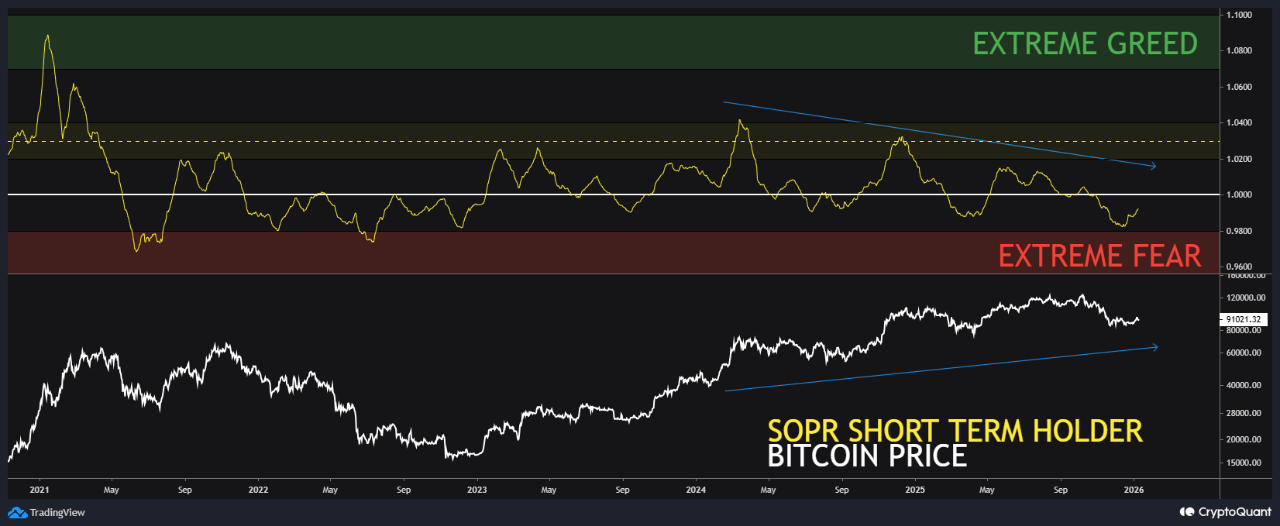
Despite Bitcoin printing higher highs and higher lows throughout 2024 and 2025, short-term investors have been consistently realizing losses. Toward the end of last year, retail sentiment deteriorated sharply, with the STH SOPR dropping to around 0.98. Levels last seen in November 2022, when Bitcoin was trading near $16,000. While the indicator has not fully entered extreme capitulation territory below 0.98, it has remained under the neutral 1.00 level for more than 70 days, signaling sustained selling at a loss.
This divergence is critical when STH SOPR remains below 1.00, coinciding with extended consolidations or corrective phases, driven by heightened pressure since Bitcoin broke above its previous all-time high. Historically, periods where STH SOPR stays below 1.00 coincide with extended consolidation or corrective phases, driven by elevated fear and realized losses.
However, during the current uptrend, these episodes have repeatedly marked favorable accumulation zones. The mismatch between rising prices and capitulating retail behavior often reflects opportunity rather than weakness. This highlights Bitcoin’s underlying structural strength despite short-term volatility.
Bitcoin Consolidates Below Key Resistance as Volatility Compresses
Bitcoin’s weekly chart shows the market in a consolidation phase following a sharp correction from the October highs near $120,000. After losing the $100,000 psychological level, BTC found demand in the low-$80,000s before rebounding toward the $90,000–$94,000 range, where price is currently stalling. This zone has clearly become a short-term equilibrium. With buyers defending higher lows but struggling to generate enough momentum for a decisive breakout.
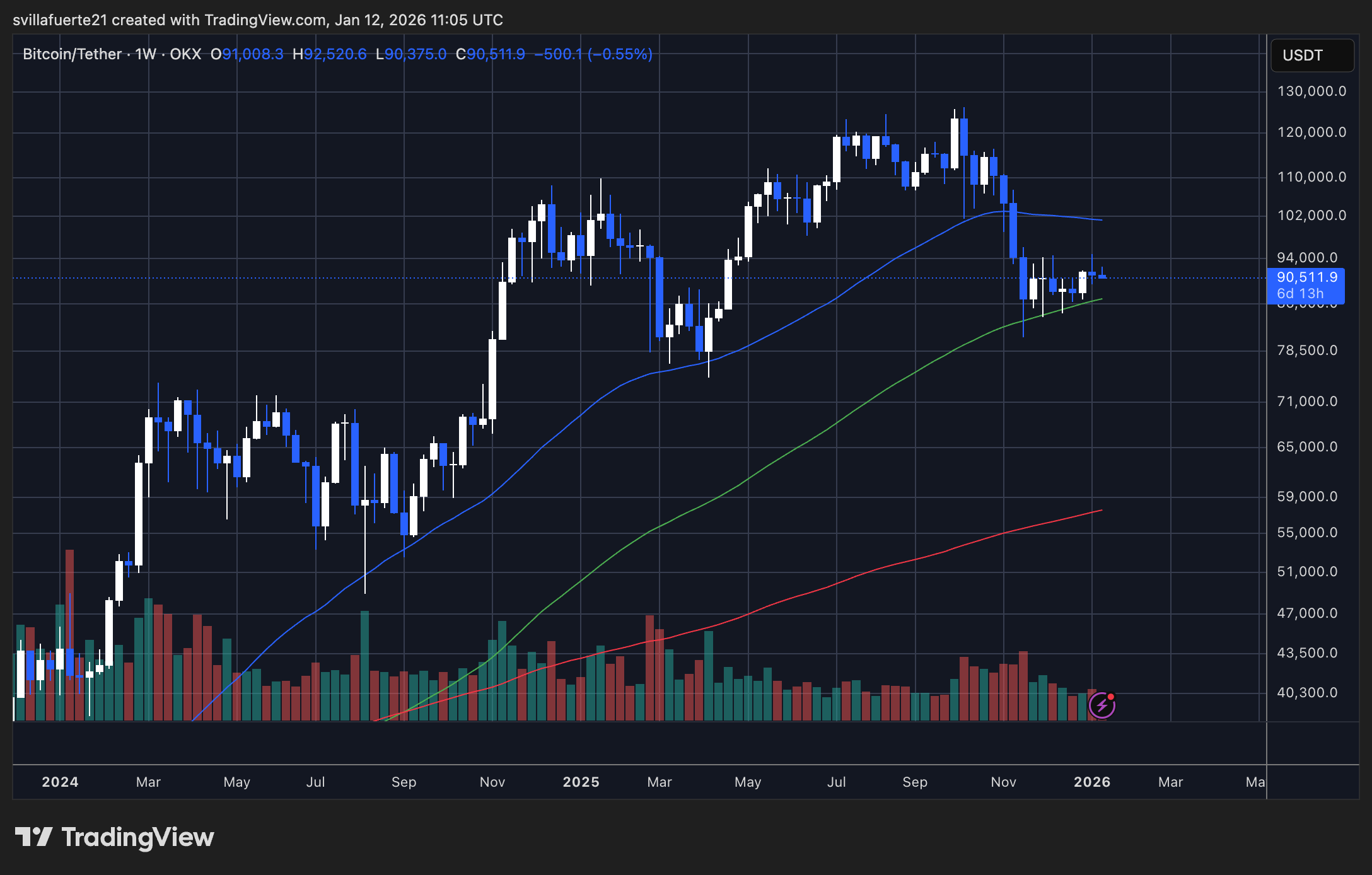
From a trend perspective, Bitcoin remains below the 50-week moving average, which is now acting as dynamic resistance around the mid-$90,000 area. In contrast, the 100-week moving average continues to slope upward well below the price. Reinforcing the idea that the broader macro trend remains intact despite recent weakness. The 200-week moving average, far lower, continues to define the long-term bull market structure.
Volume has compressed significantly during this consolidation, suggesting reduced participation and indecision. This typically precedes a volatility expansion rather than a continuation of slow, sideways trading.
As long as BTC holds above the rising 100-week moving average, downside appears structurally limited. Failure to reclaim the $94,000 resistance zone would keep the market vulnerable to another leg of consolidation before a sustainable trend resumes.
Featured image from ChatGPT, chart from TradingView.com