
 cryptoslate.com

The “infinite money glitch” of the corporate Bitcoin treasury has stalled.
For much of this market cycle, the trade was simple: stock in companies holding Bitcoin traded at a massive premium to the underlying Net Asset Value (NAV).
This allowed firms to issue expensive equity to buy cheaper coins, thereby accretively increasing Bitcoin per share. It was a flywheel of financial engineering that relied on one crucial input: a persistent equity premium.
Why Bitcoin treasury company premiums evaporated
However, that input is gone amid Bitcoin’s recent price struggles.
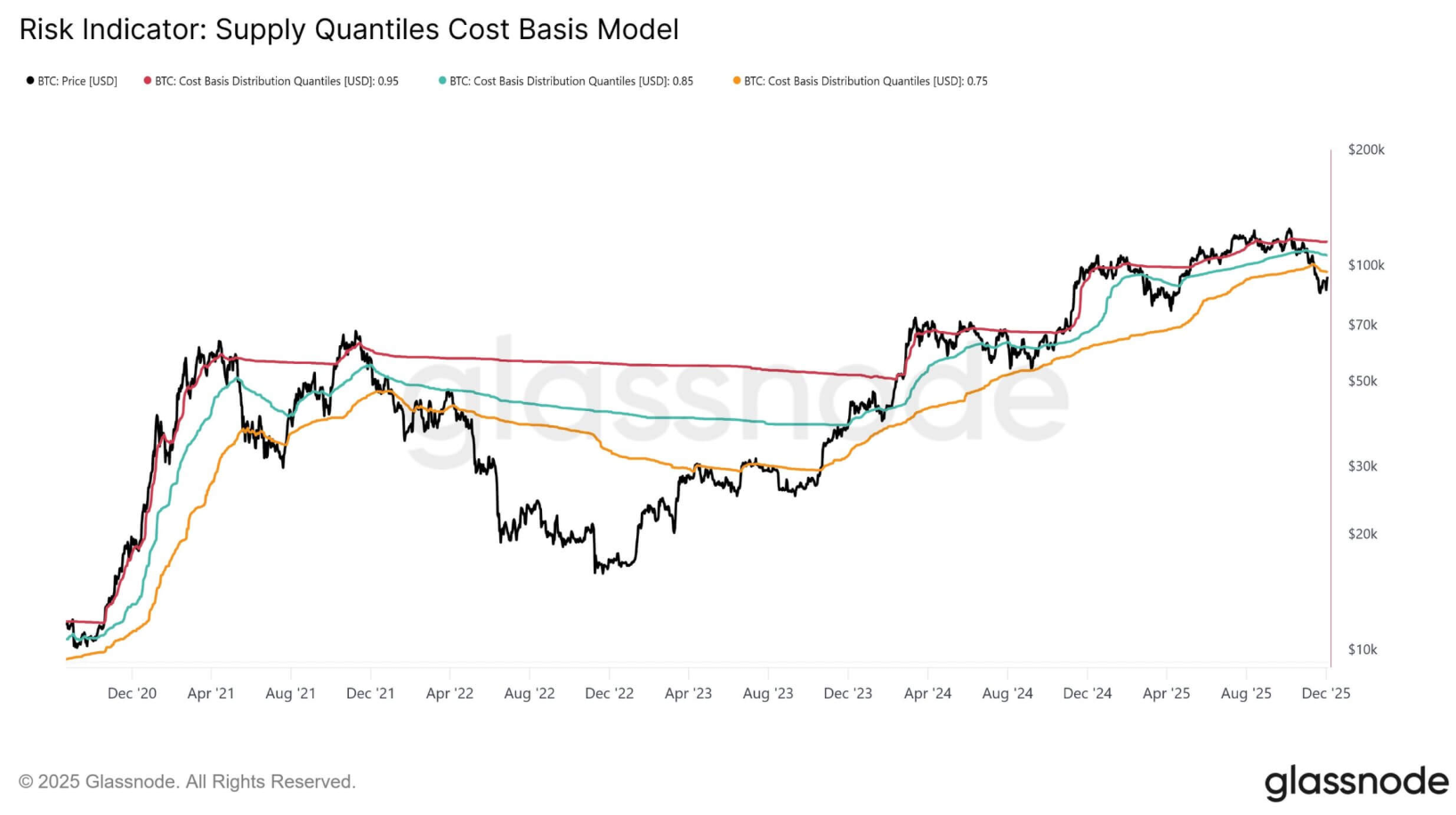
Data from Glassnode shows that BTC’s price has slipped below the 0.75 quantile since mid-November, leaving more than a quarter of its circulating supply sitting at an unrealized loss.
Considering this, companies in the Bitcoin Digital Asset Treasury (DAT) basket, a sector with a roughly $68.3 billion market capitalization, are down 27% over the last month and nearly 41% over three months, according to Artemis data.
In contrast, Bitcoin itself has drawn down roughly 13% and 16% over the same periods.
The “high beta” promise of these equities has held, but strictly to the downside. As a result, the mechanism has become broken.
The premium to NAV, which once justified the aggressive issuance strategies of firms like MicroStrategy (now known as Strategy) and Metaplanet, has largely evaporated.
At the same time, the majority of the sector now trades near or below 1.0x “mNAV” (market value adjusted for debt).
When the premium flips to a discount, issuing shares to buy Bitcoin becomes value-destructive rather than accretive.
So, for this sector to evolve from a basket of distressed proxies back into a premium asset class, the market requires more than a simple price bounce. A structural repair across price, liquidity, and governance is needed.
Clearing the underwater cost basis
The first hurdle is purely mathematical. A reflexive bounce in Bitcoin’s price is insufficient to restart the issuance engines, as the cost basis for the sector’s late entrants is perilously high.
The Artemis data reveals a bifurcation in the market. While early adopters sit on cushions of profit, the newer wave of treasury companies is underwater.
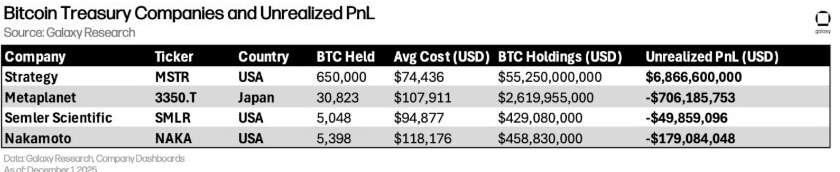
Galaxy Research noted that several BTC DATs, including Metaplanet and Nakamoto (NAKA), aggressively built their positions, with average Bitcoin cost bases exceeding $107,000.
With spot prices currently languishing in the low-$90,000s, these firms are managing significant mark-to-market losses.
This creates a severe narrative drag.
When a treasury trades well above its cost basis, the market treats it as a compounder of capital managed by visionary allocators. When it trades below, the market treats it as a distressed holding company.
The leverage inherent in the model, which Galaxy identifies as price leverage, issuance leverage, and financial leverage, magnifies this pain.
Nakamoto, for instance, has collapsed more than 38% in a month and over 83% in three months, behaving less like a structural proxy and more like a distressed small-cap.
For premiums to re-expand, Bitcoin must not only recover; it must sustain levels meaningfully above these $107,000 high-water marks. Only then can balance sheets be repaired enough to convince investors that “Bitcoin-per-share” is a growing asset rather than a liability requiring management.
The return of leverage demand
The second requirement is a shift in market psychology regarding leverage. The collapse in DAT valuations signals that equity investors are currently rejecting “unsecured leverage.”
In its analysis, Galaxy framed the DAT sector as a capital markets native solution for high-beta exposure. Essentially, this is a way for funds to express a convex view on Bitcoin without touching the derivatives market.
However, in the current risk-off environment, that convexity is working in reverse.
As long as spot ETF flows remain soft and perpetual futures open interest remains depressed, there is limited appetite for additional leverage via equities.
Indeed, data from CryptoQuant shows average weekly spot and futures volumes falling by another 204,000 BTC to roughly 320,000 BTC, a level consistent with cycle-low liquidity.
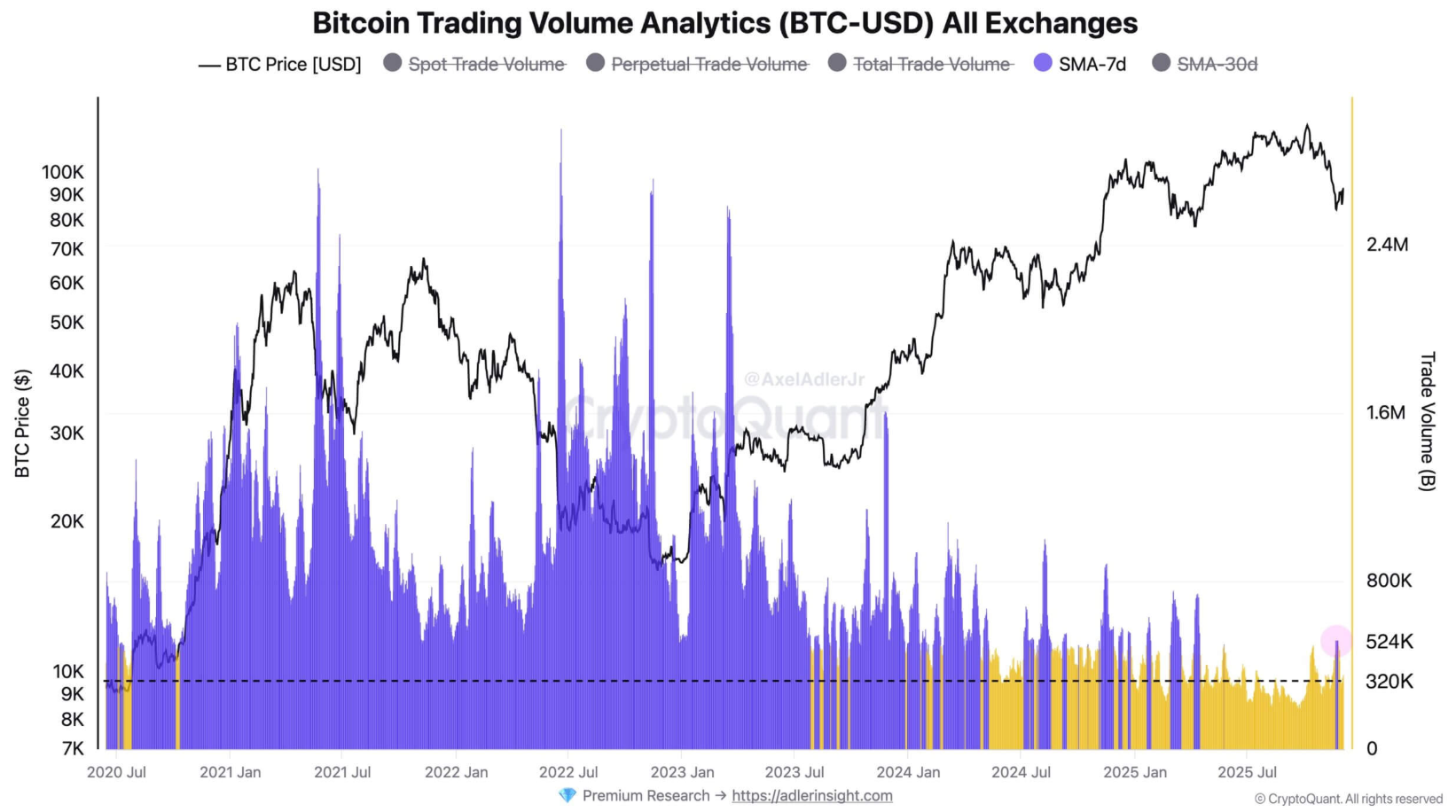
As a result, the market turnover has stalled, and positioning has become defensive.
Considering this, an institutional investor is mathematically better off holding a spot ETF like BlackRock’s IBIT if a DAT trades at 0.9x NAV. This is because the ETF offers 1.0x exposure with lower fees, tighter spreads, and zero execution risk or corporate overhead.
So, for the DAT premium to exist, the market must be in a “risk-on” mode, where investors are actively seeking volatility arbitrage offered by companies like MicroStrategy.
Data from Artemis confirms this “levered spot” punishment. With MicroStrategy down roughly 30% over the past month, versus Bitcoin’s 13% drop, the market is pricing in the fragility of the model rather than its optionality.
For the premium to return, derivatives metrics such as funding rates and open interest must signal a renewed appetite for risk that standard ETFs cannot satisfy.
From offense to defense
The era of “print stock, buy BTC” at any price is over. To regain investor trust, corporate boards must pivot from aggressive accumulation to a focus on balance sheet defense.
In early 2025, the market rewarded blind accumulation. Now, it demands survivability.
MicroStrategy’s recent move to raise approximately $1.44 billion in cash reserves is a leading indicator of this regime change. This capital is intended to cover coupon and dividend commitments, effectively building a fortress balance sheet capable of withstanding a prolonged bear market without forced selling.
This shift from “discount-avoidance” to “premium-justification” is critical.
Industry experts had warned that the DAT model is vulnerable to premium collapses. Now that the collapse is here, boards must demonstrate that future issuance will be disciplined and tied to clear value-creation thresholds.
If investors believe that new capital will be deployed prudently, like protecting downside rather than chasing the top, the mNAV multiple may expand again.
Concentration and indexation
Finally, the market must grapple with the overwhelming concentration risk within the DAT sector.
Available data shows that MicroStrategy alone controls more than 80% of the Bitcoin held by the DAT sector and accounts for roughly 72% of the category’s total market capitalization.
This means that the fate of the entire asset class is inextricably linked to MicroStrategy’s specific liquidity dynamics and index status.
Moreover, the pending MSCI consultation on whether to restrict “digital asset treasury companies” from major indices is the sword of Damocles hanging over the trade.
If MicroStrategy retains its index status, passive buying from benchmark-tracking funds can mechanically re-inflate its premium, dragging the rest of the basket upward.
However, if it is excluded, the mechanical bid disappears, and the sector risks becoming a collection of closed-end funds that trade permanently at a discount to their underlying holdings.