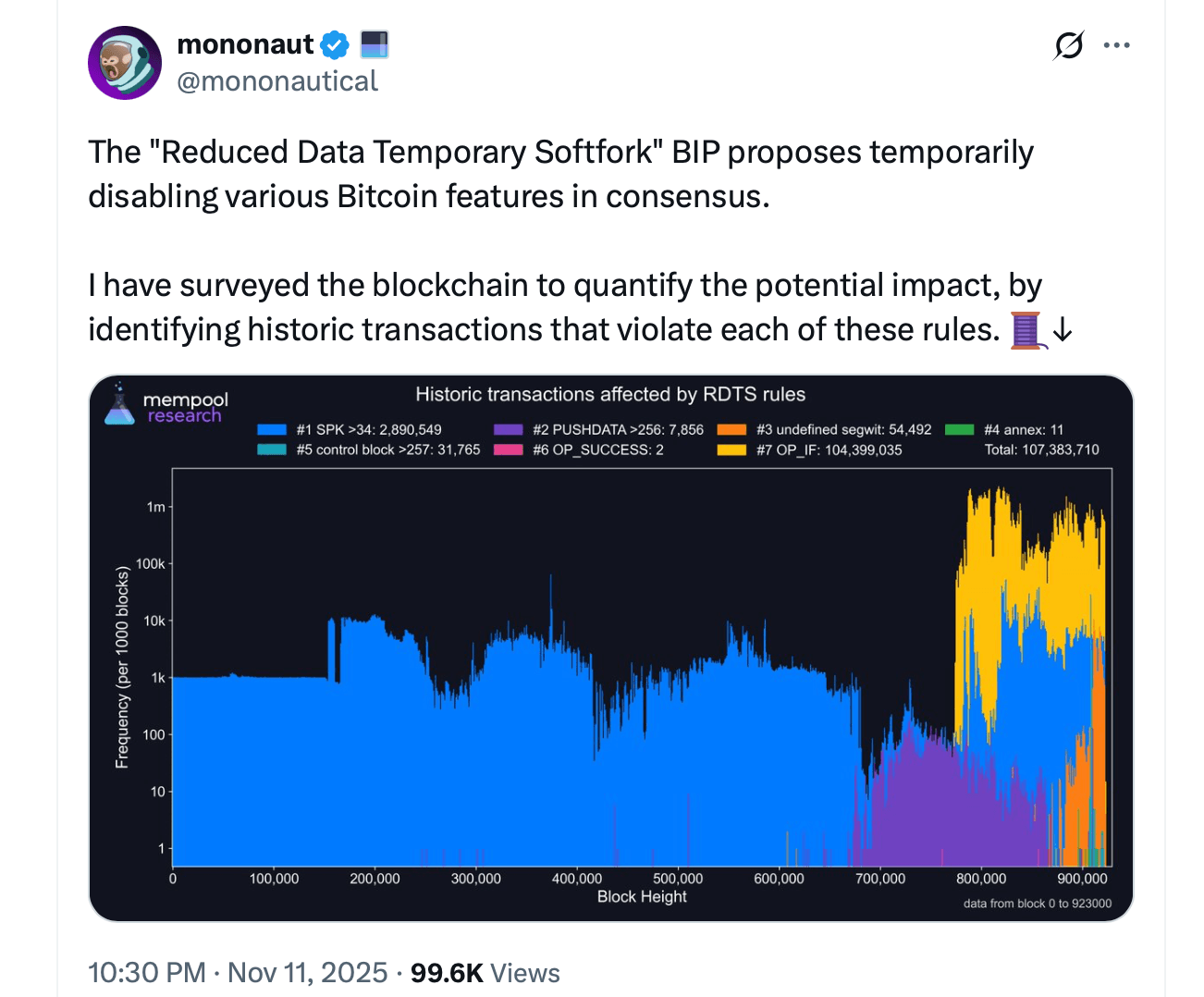
RDTS would apply for roughly one year if activated, limiting scriptPubKeys to 34 bytes, capping OP_RETURN outputs at 83 bytes, restricting Taproot control blocks, banning undefined witness versions, and disabling entire categories of Tapscript logic. Proponents of the BIP argue the measures act as an emergency brake against arbitrary data uploads that could expose node operators to legal liability if illegal material were embedded in the chain.
Mononaut’s assessment, however, quantifies the practical fallout of those restrictions by reviewing historical blockchain activity to see which real transactions would have violated the proposed rules. His findings suggest significant disruption. Under the scriptPubKey size limit alone, all pay-to-public-key (P2PK) and multisig (P2MS) outputs would be invalid. That restriction also affects a small number of non-standard outputs in past transactions.
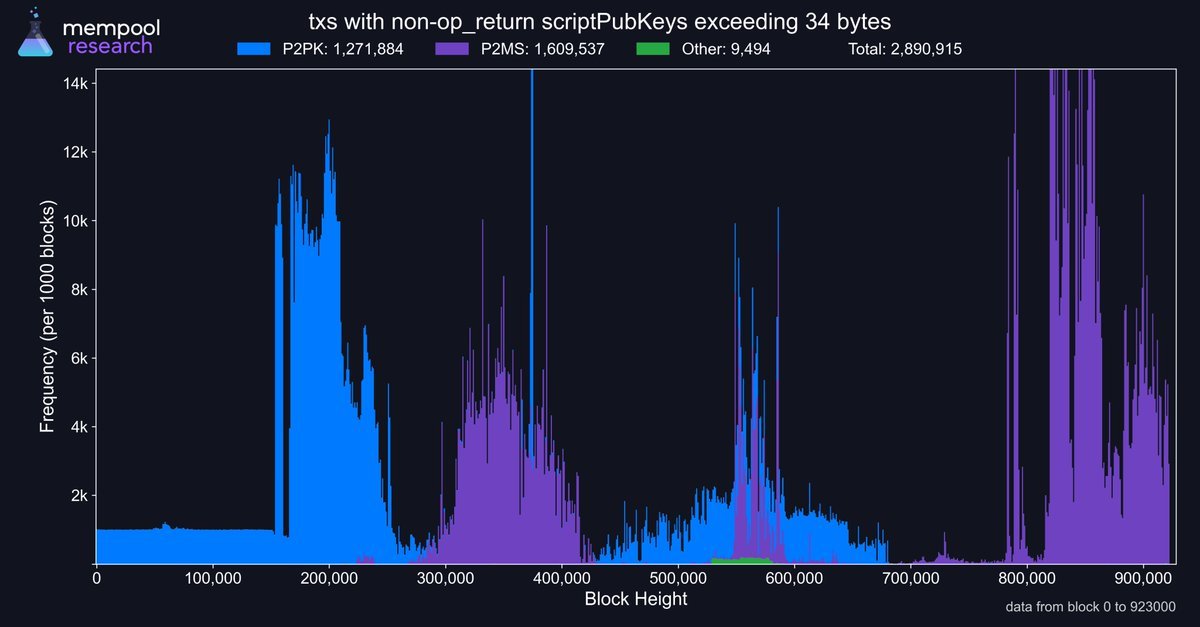
The rule set change “affects all P2PK and P2MS outputs, as well as a small number of non-standard SPKs,” Mononaut said.
One of the more sweeping rules—invalidating OP_PUSHDATA operations with payloads above 256 bytes—would not affect inscription envelopes, assuming only executed pushes qualify. But Mononaut stressed that undefined witness versions would impact more than 54,000 historic transactions, many of which used unconventional outputs to bypass OP_RETURN data caps. Because witness version lengths are tightly defined in BIPs 141 and 341, the proposal as written would even block some valid modern formats such as P2A anchors.
Also read: Bitcoin Core Developers Merge Controversial Policy Changes: Is a Fork Ahead?
Mononaut detailed that RDTS also invalidates witness stacks containing a Taproot annex. While rare, the mempool.space developer notes that at least 11 transactions have used an annex for>
Supporters of the temporary soft fork maintain that RDTS is a short-term protective measure designed to preserve Bitcoin’s monetary utility, prevent legal hazards, and reduce node burdens by limiting data storage. Critics counter that broad restrictions on Tapscript behavior risk introducing de facto censorship, disabling valid transaction types, and breaking existing applications.
The debate mirrors earlier disputes over inscription-driven data growth, reflecting deeper disagreements over whether Bitcoin should remain strictly monetary or continue accommodating experimental uses. As the proposal remains in draft form, discussion is ongoing among developers, researchers, and ecosystem participants.
FAQ ❓
-
What is RDTS?A temporary soft fork proposal that restricts several Bitcoin script and data features.
-
Why is RDTS being debated?Supporters want to curb data abuse, while critics say it disables valid transactions.
-
What did Mononaut find?His analysis shows many historical transactions would fail under RDTS rules.
-
How long would RDTS last?The proposal outlines a one-year activation window if adopted.

 news.bitcoin.com