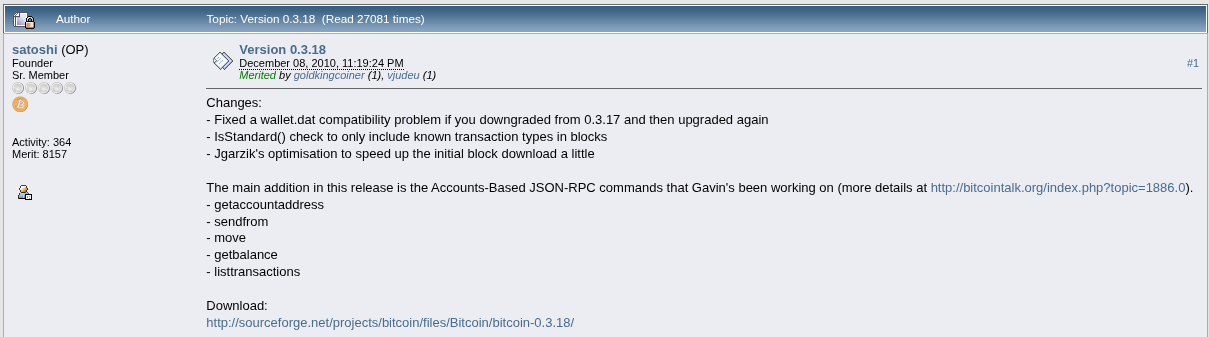
Satoshi’s post on Bitcoin Forum. Source: Bitcoin Forum
The choice to limit the storage of arbitrary data onchain is immediately controversial. “Why on Earth would any miner adopt this change, when it means that they will be getting fewer transaction fees due to the lost non-standard transactions?” one user asked.
Related: Jimmy Song slams Bitcoin Core devs for ‘fiat’ mentality on OP_Return
Governing with incentives
Bitcoin is a decentralized network with no central authority able to enforce its rules, which complicates enforcement.
If miners have a financial incentive to allow something, such as the inclusion of non-financial data onchain, they are likely to adjust the parameters of their software in a way that enables it. This was the case back then, too, with multiple miners announcing that they would allow non-standard transactions with arbitrary data.
One user suggested allowing non-standard transactions up to 128 bytes, but Bitcoin Core developer Jeff Garzik said that attempting to enforce such limits would make little sense:
“It seems pointless for the official Bitcoin client to attempt to ‘legislate’ any restrictions of this type when all miners have an interest in including any and all fee-carrying transactions.“
Related: Bitcoin Core default minimum relay fees decrease 90% as update rolls out
Accepting the inevitable
Users also quickly released a patch for Bitcoin Core’s latest version that did not include checks to ensure transactions follow established standards. Early Bitcoiner Christian Decker recognized that this was an important moment for Bitcoin’s community:
“I guess we have the first official release that is disputed by the majority of computation power, Bitcoin’s coming off age.”
As suggested by some commenters back in 2010, it is hard to ensure that miners enforce a rule that goes against their own incentive to include fee-paying transactions. A January 2024 review showed miners like F2Pool were already including non-standard transactions that exceeded OP_RETURN limits.
The OP_RETURN debate is also occurring in a different environment than the original arbitrary data debate, one in which corporate interests are pressuring developers to allow for more onchain data storage. The reason is that storing such data enables the development of Bitcoin-based systems, such as layer-2 networks and others.
Magazine: Bitcoin’s long-term security budget problem: Impending crisis or FUD?

 cointelegraph.com